


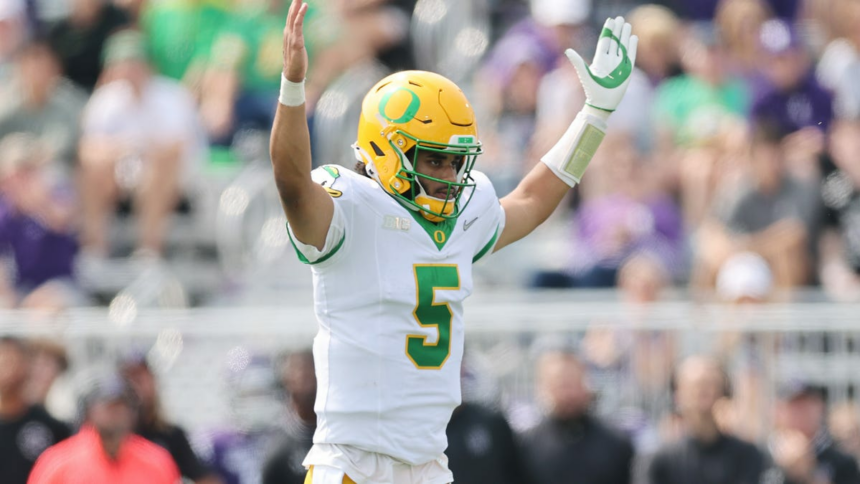
Before Dante Moore’s offseason of on-field development began, Oregon’s starting quarterback used his platform as one of college football’s most well-known players to advocate for a statewide improvement off the field.
Moore sent a letter to Oregon Gov. Tina Kotek on March 3 in which he discussed his own struggles with depression and the pressures that come with playing college football at a high level. He asked for the governor’s support for mental health services in the state.
“In my life, what made the difference was support,” Moore wrote. “Support from my friends, love from my family, and access to the resources I needed to get better. As a young Black man and athlete, reaching out for help can often feel like climbing an uphill battle. It required vulnerability and trust, and I was fortunate to get the care I needed.”
The Oregonian/OregonLive received a copy of Moore’s letter and wrote about it in a story published March 16.
This past week, following an Oregon spring practice, Moore talked to the media for the first time since his letter became public.
“There are a lot of times in football, we have anxiety of performing on the field, taking care of our families, trying to keep up with our schoolwork, football, just all your things going on, and it can be stressful,” said Moore, who spoke openly about his mental health battles as a freshman at UCLA in 2023.
Not long after joining the Bruins, his mother was diagnosed with breast cancer in the spring of 2023 – she was declared cancer-free in the summer of 2024 – and during that ensuing fall season he struggled to have success on the field after arriving in Los Angeles with soaring expectations as a highly touted five-star recruit out of Detroit.
He transferred to Oregon in December 2023, and after a redshirt season sitting behind Dillon Gabriel, Moore started in 2025 and led the Ducks to the College Football Playoff semifinals.
“I’ve been through it all,” Moore said. “I feel like just using my voice, and just all the athletes just using our voices, our platforms (to tell) the world, and telling the … men or women in this world that mental health is important. Because when you’re performing at your greatest, your mental health is great. And then when you perform at your worst, your mental health is terrible. We’re human at the end of the day.”
Wide receiver Jeremiah McClellan said the way Oregon treats mental health is “amazing,” and credits his quarterback with making it easier for players to have conversations about the subject.
“Dante made it so it’s not a weird question to talk about in the locker room,” the redshirt sophomore said Thursday. “We all talk about it and are all comfortable enough to get vulnerable with each other if we need to.”
Coach Dan Lanning said he wants his team to have an atmosphere of open communication where players can not only speak freely and comfortably about how they feel, but also be willing to provide support for each other.
“Football is tough. Life’s hard,” Lanning said. “Our guys recognize all those pieces, but if you don’t recognize it in your program, then you’re probably missing something. And I like to think that we hit that.”
He’ll get no disagreement from offensive lineman Michael Bennett III, who has been in Eugene for just a short time after transferring from Yale this offseason.
The 6-foot-5, 310-pound redshirt senior and two-time first-team all-Ivy League player spoke Thursday about his own struggles with mental health, especially following the death of his father during Bennett’s first fall camp at Yale in 2022.
“I didn’t feel like I belonged there yet … but I was around a bunch of guys who picked me up,” Bennett said. “Picked me up by the shoulder pads and said you’re going to be alright. I think that’s what we need more of, honestly, across the country, that’s why I think stuff like the letter from Dante is so strong. It’s critical that people know they’re not alone.
“Mental health is one of those things that the more willing you are to get help and ask for help, the easier it is to handle it. It’s never really truly easy, but the more willing you are to reach out, the more help you’re gonna have. That’s what I was fortunate enough to have myself in some really hard times over my career.”
Chris Hansen covers University of Oregon football, men’s basketball, track and field, cross country and softball for The Register-Guard. You can reach him at chansen@registerguard.com.
Oregon's Dante Moore a model for mental health advocacy, teammates say – The Register-Guard


Leave a Comment