


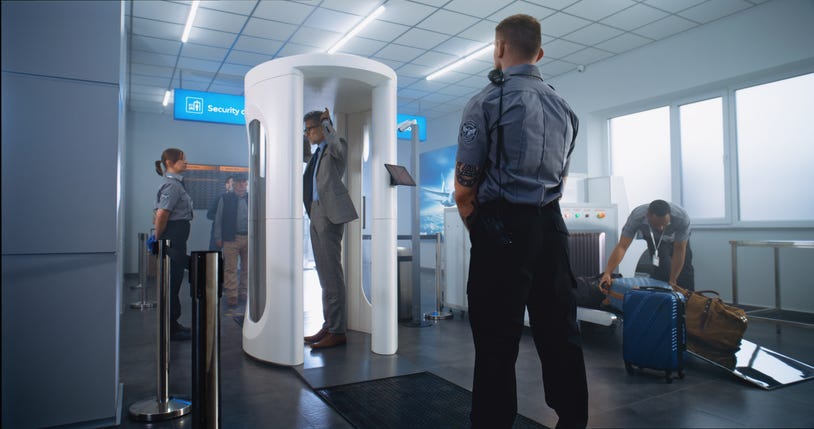
Myah Ward and Oriana Pawlyk write in Politico, “The partial government shutdown and President Donald Trump’s budget proposal are adding new momentum to a conservative push to privatize airport security screening.” They quote Chris Edwards on expanding the Screening Partnership Program (SPP), a private screening pilot created alongside TSA:
The SPP could become the foundation for eventually privatizing airport security screening altogether, said Chris Edwards, who examines federal agency spending at the libertarian Cato Institute. He cited the example of some European countries and Canada, where airport security is already run by private security screening companies.
“From a safety perspective, there’s no reason why not,” Edwards said. “We can do this incrementally by expanding the SPP program” with more airports, he said, but then eventually allowing them greater flexibility to decide how — and by whom — screening is carried out.
Edwards said airports vary widely in their traffic patterns, with peaks and lulls depending on location and demand. He said that’s often hard to staff adequately with TSA screeners, leading to mismatches between staffing and demand that can result in long lines or idle capacity.
“We have these 20 airports with experience now,” Edwards said. “Let’s get them in and testify to Congress about how it’s working.”
Tony Romm reports in the New York Times on the political dynamics surrounding Trump’s FY2027 budget proposal. Romm quotes Dominik Lett on why spending cuts face an uphill battle:
“Across-the-board cuts are hard sells, particularly during the midterms,” said Dominik Lett, a budget policy analyst at the Cato Institute, a libertarian-leaning think tank. “Politicians want to signal they’re increasing spending and delivering for their constituents, even if in reality, the cuts in the future will be much more significant and draconian if we don’t take responsible action today.”
Lindsey Wilkinson reports in FedScoop that the White House’s FY2027 budget would trim the DHS inspector general’s workforce by 85 full-time employees and cut nearly $22 million in funding. Wilkinson quotes David Bier on the cuts:
“At no point in DHS’s history has oversight been more needed than now because the base budget has expanded so rapidly,” David Bier, director of immigration studies at the Cato Institute, said in an email to FedScoop.
“The IG budget should expand proportionally to the overall budget, but not only has it not expanded, the administration proposes to reduce it,” Bier said. “The result will be more violations of congressional requirements on appropriations and more waste, fraud, and abuse.”
The House Budget Committee compiled statements from leading voices on a 3 percent deficit-to-GDP target following last week’s hearing on fiscal sustainability. Romina Boccia weighed in on what the target needs to succeed:
“A 3 percent of GDP deficit limit offers a clear, credible benchmark to guide policymakers and help reassure markets that Congress is serious about stabilizing the nation’s finances. It brings much-needed focus to the worsening debt crisis.
“To reach the target goal, lawmakers should pair it with an effective mechanism to enact needed reforms, such as a fiscal commission. Pursued seriously, a 3 percent of GDP deficit target can help put the federal budget on a more sustainable path.”
This article first appeared at The Daily Economy, an imprint of the American Institute for Economic Research, on April 6, 2026. Read it here.
The Debt Dispatch is a reader-supported publication. To receive new posts and support my work, consider becoming a free or paid subscriber.
No posts