


9 Apr 2026
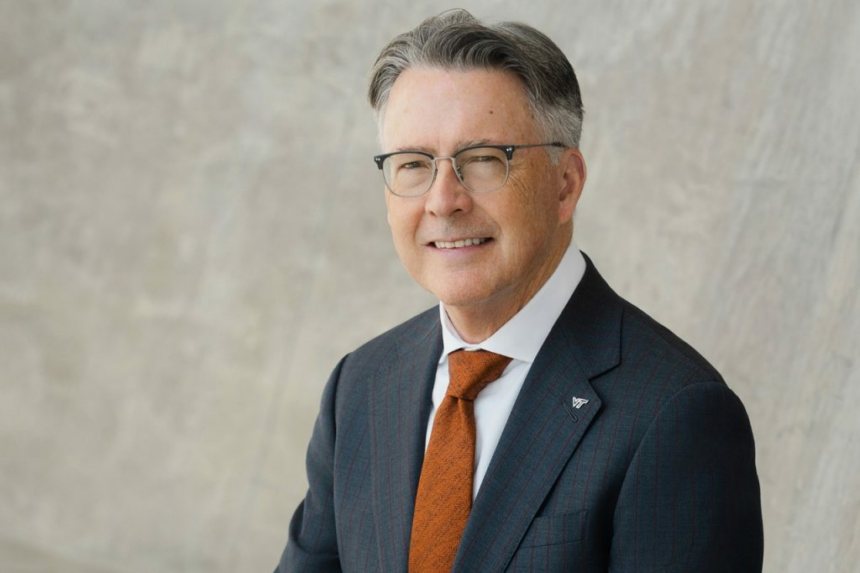
After 12 years of service to the university community and the Commonwealth of Virginia, and a career dedicated to the advancement of science and the impact of public higher education, Virginia Tech President Tim Sands intends to step down in the coming months. Sands made the announcement Thursday in a letter addressed “to Hokies everywhere.”
“There is no better role in higher education than to serve as the president of the Virginia Polytechnic Institute and State University,” Sands said. “Stewarding Virginia Tech as president has been the most fulfilling experience of my career.”
Sands said it was the right time to begin the process of stepping aside and provide the next president the opportunity to “take the baton at full stride” and continue Virginia Tech’s significant growth and momentum, telling the community that “together we have transformed Virginia Tech for the better.”
During his tenure, the university experienced a 30 percent increase in undergraduate enrollment, 200 percent increase in applications, 70 percent increase in extramural research expenditures, and 185 percent increase in the university’s endowment.
In sharing his plans with the rector of the Virginia Tech Board of Visitors, John Rocovich, Sands said he was committed to serving until his successor was in place to ensure a smooth transition.
“I am deeply grateful to President Sands for his leadership and tireless dedication to our university and his vision for what we can accomplish in service to our students and the commonwealth,” Rocovich said. “His drive to expand Virginia Tech’s impact through collaborative engagement with our communities and partners, and his steadfast commitment to public higher education have positioned us well for the future ahead. President Sands’ leadership in establishing the Virginia Tech Carilion Academic Health Center and the Innovation Campus will yield huge dividends to Virginia Tech for 100 years.”
Sands became president of Virginia Tech on June 1, 2014, after serving as provost and acting president of Purdue University. In his installation address on Oct. 17, 2014, he called on the university community to advance its impact on the commonwealth by developing the “binary star” created by the university’s main campus in Blacksburg and academic programs, opportunities, and partnerships in the greater Washington, D.C., area. Four years later, Virginia Tech announced plans to build an “innovation campus” in Alexandria as a signature part of the higher education package that brought Amazon’s HQ2 to Northern Virginia and continues to develop technology talent for the region.
The Alexandria building, now known as Academic Building One and home to the new Institute for Advanced Computing, is part of Virginia Tech’s significant growth across the commonwealth under Sands’ leadership. Fifteen major new construction projects have been launched since 2014 totaling 1.9 million square feet.
The North Academic District of the Blacksburg campus is the site of the largest transformation impacting students at nearly 500,000 square feet. It includes the Data and Decision Sciences Building, Hitt Hall and the Perry Place dining facility, the Undergraduate Science Laboratory, the New Classroom Building, and the New Business Building.
The Upper Quad also experienced significant expansion and improvement with the construction of Pearson Hall East and West, Upper Quad Hall North, and the Corps Leadership and Military Science Building.
Virginia Tech’s ongoing partnership with Carilion Clinic has been transformative in the Roanoke region with the development of the Health Sciences and Technology campus. The transition of the Virginia Tech Carilion School of Medicine from an independent institution to the university’s newest college is advancing a robust and growing academic health care presence. The expansion of the Fralin Biomedical Research Institute at VTC, with more than 40 faculty-led research teams in 260,000 square feet of laboratory and teaching space, doubled the university’s economic impact in Roanoke from $214 million in 2017 to $475 million in 2025.
Other new buildings that are complete or currently under construction include Mitchell Hall, the Creativity and Innovation District residence hall, the Beamer-Lawson Indoor Practice Facility, and the Dairy Science Complex at Kentland Farm.
Additional highlights of Sands’ leadership include:
Of all the university’s accomplishments over the past 12 years, Sands is most proud of the more than 100,000 Hokies who earned their degrees, saying the legacy of Virginia Tech’s motto, Ut Prosim (That I May Serve), lives on in them and the impact they will have on generations to come.
Sands and his wife, Laura P. Sands, plan to remain in the area. “Laura and I will always be Hokies,” he said. “We plan to stay rooted in Blacksburg as this is most definitely home.”
Mark Owczarski
540-231-5396
Virginia Tech demonstrates impact as a global land grant – progressing sustainability in our community, through the Commonwealth of Virginia, and around the world.
Get Directions
See All Locations
Contact Virginia Tech
For the media
© 2026 Virginia Polytechnic Institute and State University. All rights reserved.