


Now
41°
Fri
75°
Sat
71°
by ChiefMeteorologistVeronica Johnson
WASHINGTON(7News) — On April 10, 2026, we will have the opportunity to witness a milestone in space exploration as NASA’s Artemis II mission will return from it's journey around the moon.
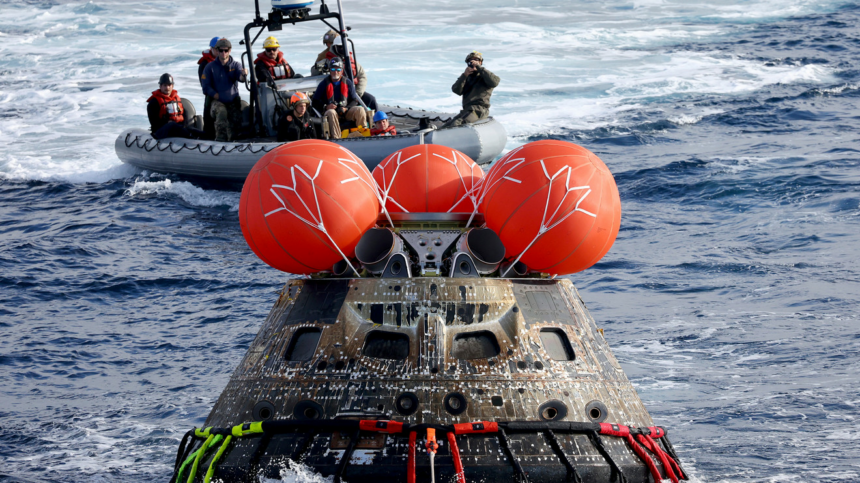
The Orion spacecraft, carrying four astronauts, will re-enter Earth’s atmosphere and splash down in the Pacific Ocean under nearly perfect conditions.

Artemis II wasn’t about landing on the Moon — it was a critical test of deep-space operations with humans aboard. The crew traveled farther from Earth than anyone has in decades, testing the Orion spacecraft’s systems, life support, and communication technology. This mission has set the stage for future lunar landings and helps NASA plan for longer-term human exploration of space.
After looping around the Moon, the Orion spacecraft began its return to Earth using a trajectory shaped by lunar gravity. The capsule will endure extreme heat and friction as it passes through the atmosphere, before slowing with a series of parachutes, and landing in the ocean.
NASA has strict limits to ensure safe recovery, and Artemis II’s landing conditions are within thresholds:
Sky: Partly sunny, providing clear visibility for recovery teams.
Air temperature: A comfortable 60–68F, ideal for operations.
Water temperature: Around 60F, standard for safe recovery.
Waves: 2–4 ft, below NASA’s 6 ft limit.
Wind: 12 mph, far under the 29 mph safety limit.
These favorable conditions should make it easier for recovery crews to secure the spacecraft quickly and safely.
Artemis II’s successful flight demonstrates that humans can travel safely beyond low Earth orbit, bringing NASA one step closer to landing astronauts on the Moon again with Artemis III.
2026 Sinclair, Inc.