Since its founding in 1922, Foreign Affairs has been the leading forum for serious discussion of American foreign policy and global affairs. The magazine has featured contributions from many leading international affairs experts.
HUSSEIN BANAI is Associate Professor of International Studies in the Hamilton Lugar School of Global and International Studies at Indiana University, Bloomington, and a co-author of Republics of Myth: National Narratives and the US-Iran Conflict.
A Shared Enemy, but Diverging Views of Its Motives and Character
Hussein Banai
President Donald Trump’s announcement of a two-week cease-fire on Tuesday night has ended, at least temporarily, the fighting between the United States, Israel, and Iran. But it has done little to resolve the strategic incoherence at the heart of the U.S.-Israeli campaign that neither government has been willing to acknowledge publicly: the two partners have been fighting the same war for fundamentally different reasons. For Israel, the prospect of direct confrontation with the Islamic Republic has loomed large for decades. It has studied the regime with a granularity that Washington has rarely matched. Because Israel understands that regime survival is the Islamic Republic’s organizing principle, Israeli Prime Minister Benjamin Netanyahu has focused on leadership elimination and regime change as the campaign’s primary objectives.
The Trump administration, by contrast, entered the conflict under the assumption that a sufficiently credible demonstration of military force could coerce the regime’s leadership into making a deal. The same logic animated the first Trump administration’s maximum pressure campaign on Tehran, as well as the second Trump administration’s decision to oust Venezuelan President Nicolás Maduro. U.S. strategic planning regarding Iran, in other words, has consistently prioritized tractable questions of missile counts and uranium enrichment levels with the goal of getting to a nuclear deal while treating as secondary Tehran’s genuine ideological commitment to regime preservation.
These two theories of the case are not complementary. They pull in opposite directions, and the tension between them has produced a campaign that is operationally coordinated but strategically adrift. Israel’s reading of the Islamic Republic—that regime survival is the master key to Iranian behavior—is the more accurate one, even if the conclusions Netanyahu draws from it have been strategically dubious. Israel’s systematic elimination of any credible Iranian interlocutor threatens to foreclose the diplomatic space that Trump’s dealmaking calculus requires, while Trump’s periodic signals of openness to a deal have undermined the pressure on which Israel’s theory of regime dissolution depends. Whether or not the cease-fire holds, a growing rift between the goals of Israel and the United States has been exposed and the Islamic Republic can claim confirmation of what its founders always argued: that survival, on whatever terms, remains tantamount to victory.
Shortly after the 1979 revolution, Ayatollah Ruhollah Khomeini broke with a long tradition of Shiite political quietism that held that no legitimate political authority could exist until the reemergence of the Twelfth Imam and that, until then, the clergy’s proper role was moral guidance, not governance. Khomeini inverted this position, arguing that the very absence of the Hidden Imam obligated the leading Islamic jurist to assume political authority and prepare conditions for the imam’s eventual return.
In January 1988, eight years into the Iran-Iraq War, Khomeini went further. Pressed by the contradictions between revolutionary idealism and the demands of wartime governance, he declared that the interests of the Islamic state—what he termed maslahat-e nezam—outranked even the key tenets of Islamic law, including prayer, fasting, and pilgrimage. The theological and the strategic fully collapsed into one another. The preservation of the Islamic Republic itself thus became the highest religious duty.
When Khomeini died in 1989, Iran’s constitution was amended, and one man’s charismatic authority was institutionalized into an architecture of overlapping power centers. Theological rank was separated from political authority—a concession to the reality that none of Khomeini’s disciples possessed the Islamic jurisprudential standing his original doctrine required—and the Islamic Revolutionary Guard Corps (IRGC), the Basij paramilitary force, the judiciary, the Assembly of Experts, the Guardian Council, and the Expediency Discernment Council were reshuffled and redesigned with deliberate redundancy. The goal was to ensure that the destruction of any single node could not bring the whole system down.
Israel’s assassination of Supreme Leader Ali Khamenei in February was the most serious test of this design in the history of the Islamic Republic. The ensuing succession, carried out under sustained U.S.-Israeli aerial bombardment, provided proof of concept. Within ten days of Khamenei’s death, Iran’s Assembly of Experts convened and selected Mojtaba Khamenei as supreme leader, a process driven by direct IRGC pressure on assembly members, according to multiple accounts in major Western news outlets. The selection of Mojtaba, a hard-liner even before the killing of his father, wife, and child, was a security decision made in the interest of regime continuity. In his first public statement, Mojtaba vowed to continue the war, to keep the Strait of Hormuz closed, and to maintain what he called the inseparable values of the Islamic Revolution.
With his appointment, the Islamic Republic reconstituted itself around an even more security-centric interpretation of its founding doctrine, one in which institutional survival and strategic command take explicit precedence over theological propriety. If Khomeini’s original vision described the supreme leader as a “philosopher king,” it has given way to the role of security manager.
Israel has tracked this evolution closely. Whereas Iran competes for bandwidth in Washington with a global portfolio of threats—and where each administration arrives with its own set of policies—successive Israeli governments have regarded the Islamic Republic as an existential threat since its inception. Washington tends to read Iran through the aggregated outputs of signals intelligence and satellite imagery, but Israel read it through decades of penetration of the IRGC, the nuclear program, and the supreme leader’s inner circle. Such deep intelligence allowed Israel to develop an intimate understanding of how the regime’s leadership actually thinks, what it fears, and where its greatest vulnerabilities lie.
Israel has applied its hard-won knowledge ruthlessly, killing Khamenei and seven senior defense and intelligence officials on the first day of the war. Weeks later, it assassinated Ali Larijani, the secretary of Iran’s Supreme National Security Council and the figure most widely believed to be running the country after Khamenei’s death. Netanyahu has been unambiguous about the campaign’s purpose. He has framed the strikes as creating the “optimal conditions” to collapse the government “to give the Iranian people the opportunity to remove it.”
The campaign has reflected the Israeli security establishment’s insight that the Islamic Republic’s survival imperative is so deeply embedded in its institutional architecture that any strategy short of regime dissolution would leave the fundamental threat intact. A constrained Islamic Republic, the theory goes, will always reconstitute its capacity and resume its campaign against Israel.
Trump’s theory of the case has been different. His administration entered the conflict with the expectation that Iran’s leadership, faced with the destruction of its nuclear program and the elimination of its supreme leader, would eventually produce a leader more willing to negotiate than his predecessors. Trump’s limitless belief in his own dealmaking acumen has been central to his Iran policy dating back to his first term. Since he withdrew the United States from the Joint Comprehensive Plan of Action in 2018, he has maintained that he alone could extract the comprehensive agreement that President Barack Obama’s negotiators failed to secure. Trump publicly insisted that he wanted to be involved in selecting Iran’s next leader and compared Operation Epic Fury, the U.S. campaign against Iran that began in late February, to the U.S. operation to capture Venezuelan President Nicolás Maduro and install Delcy Rodriguez as interim leader. He appears confident that an Iranian interlocutor amenable to U.S. interests could yet emerge.
This confidence rests on a misreading of the Islamic Republic’s animating principle that Israel, whatever its other miscalculations, does not share. Unlike Venezuela, where Maduro’s exit was the product of a transaction among secular power brokers with reconcilable material interests, the Islamic Republic is animated by a theology of regime survival that, even if understood as in the service of national independence, makes an equivalent arrangement impossible. The Revolutionary Guards’ devotion to the Islamic Republic is religious in character, making the prospect of an Iranian analog to Rodriguez rising from the ranks exceedingly unlikely.
This is not the first time the United States and Israel have pulled in different directions over Iran. Trump forced through a cease-fire over Israeli objections to end the 12-day war in June 2025. Now, even with another cease-fire deal reached, the tension between the Israeli and U.S. theories makes a coherent path to permanent termination difficult for either partner. Trump has declared regime change achieved while denying he ever sought it, threatened to reduce Iran to rubble while signaling openness to a deal, and identified the current Majlis speaker, Mohammad Baqer Qalibaf, as a promising interlocutor, even as Qalibaf, a former IRGC commander, has denounced the possibility of negotiation. Israel’s assassination campaign, meanwhile, continues, despite Netanyahu’s admission that he “cannot say for certain that the Iranian people will bring down the regime.” “You can lead someone to water; you cannot make him drink,” he patronized in March.
The result is a war in which the United States and Israel have each fought toward an outcome that the other’s strategy makes less achievable. Israel’s relentless targeting of Iran’s leadership has made the possibility of Trump’s negotiated off-ramp more difficult. Trump’s signals of openness to negotiation, meanwhile, undermine Israel’s strategy by giving Tehran reason to wait out the pressure rather than conclude that no diplomatic escape exists, which is precisely the conclusion Israel needs Iran to reach. The gap between Trump’s and Netanyahu’s objectives has given Tehran the reasonable expectation that its enemies’ partnership will not hold, with or without a cease-fire.
Israel has a more granular understanding of regime dynamics in Tehran than the United States. But neither Israel nor Washington has properly accounted for the degree to which external enmity has been constitutive of the Islamic Republic’s legitimacy since the revolution. Khomeini’s designation of the United States as the “Great Satan” and of Israel as an affront to Muslim dignity has been reproduced across every organ of state culture for decades, creating a permanent adversary against which the necessity of clerical guardianship could be justified.
Tehran defended its funding of the axis of resistance—the network of regional forces comprising Hamas, Hezbollah, Houthis, and Shia militias in Iraq—along similar lines. Through its proxies, it has kept the conflict with Israel and the United States at a geographic remove while sustaining the narrative for the regime’s domestic base that Iran is a revolutionary state under permanent siege. Although that narrative has little purchase with the majority of Iranians, it commands the fervent loyalty of a substantial plurality.
Israel’s dismantling of the axis of resistance between 2023 and 2025 removed the intermediary layer that had allowed Iran to absorb external pressure without facing it directly. The 12-day war in June thus tested the regime anew, but Tehran’s core institutional structures remained intact. Then, as Iran’s economy went into free fall, protests in January led the regime to carry out its most savage crackdown since the revolution. Tehran, however, drew from that period the same lessons it has drawn from every previous crisis—that the alternative to endurance is extinction and that acknowledging weakness to an adversary actively seeking to exploit it would only hasten the regime’s demise.
The current conflict has reinforced this belief for Tehran. The regime believes that if it can survive external pressure and impose enough costs on its adversaries to exhaust their political will, it will have won. That the Islamic Republic has survived Operation Epic Fury is, from Tehran’s perspective, a form of strategic vindication, validating the regime’s claim to permanence. If anything, the war has confirmed Tehran’s assertion that the adversary’s ultimate aim is the destruction of the Islamic Revolution.
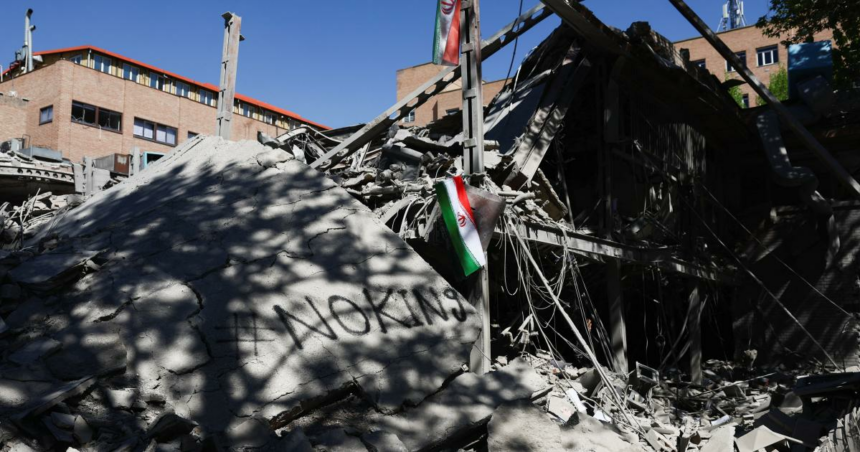
For the regime’s core constituency, and for many Iranians who oppose the government but cannot endorse a foreign-imposed dissolution of the state, that confirmation is galvanizing in ways that neither Washington nor Israel appears to have adequately anticipated. The military force required to break the Islamic Republic’s will has proved considerably greater than either partner expected. The war has made regime critics inside Iran less, not more, likely to agitate for the system’s collapse, invalidating the premise of Israel’s strategy. As strikes on civilian infrastructure, universities, and residential neighborhoods collapsed the distinction between targeting the regime and destroying the state, Iranians of all political stripes have grown disenchanted with the aimlessness of the Trump administration’s coercive tactics.
The apparent vindication of the regime’s founding narrative allowed Tehran to prosecute the war more aggressively than it might have otherwise. By closing the Strait of Hormuz, Iran imposed one of the largest oil supply disruptions on record, nearly generating a global energy crisis. By striking all six Gulf Cooperation Council states for the first time since the so-called tanker war of the late 1980s, Iran demonstrated that the United States’ regional partners bear real and ongoing costs for their alignment. The new supreme leader’s first statement warned that Iranian officials were studying “the opening of other fronts in which the enemy has little experience and is highly vulnerable.” The Supreme National Security Council has framed the cease-fire not as an end to hostilities but as a temporary pause, stating explicitly that it “does not signify the termination of the war,” that its “hands remain upon the trigger, and should the slightest error be committed by the enemy, it shall be met with full force.”
The losses Iran has absorbed to sustain this posture are severe. More than 3.2 million Iranians have been displaced by the bombing, military and nuclear infrastructure has been further degraded, and the economy, already devastated by sanctions and the currency collapse that followed the 12-day war, continues to teeter on the edge of collapse. The January protests were a testament to the regime’s genuinely weakened popular legitimacy before the war began. But with its economic empire, its political influence, and the theological warrant for its existence dependent on the continuation of the Islamic Republic, the IRGC will have every reason to climb the escalation ladder should the cease-fire not hold.
The strategic dissonance of the U.S.-Israeli campaign carries consequences—especially for Washington. During the 12-day war, Israel was prepared to press the campaign toward regime change before Trump summarily instructed Netanyahu to accept a cease-fire. That tension, then suppressed by the explicitly limited nature of the U.S. operation to degrade Iran’s nuclear capabilities, has returned, this time a in far more intractable form. Trump appears to have once more engineered at least a momentary truce. But if he wants to keep more lasting negotiations in the frame, he will have to confront an Israeli government whose war aims remain more radical than his own. A tension that has thus far been carefully managed could still quickly devolve into a real and acrimonious split. Tehran would be quick to exploit it.
Washington, in other words, has few good options for permanently ending the war on its own terms. Declaring victory on the basis of degraded Iranian military capabilities, while leaving the Islamic Republic institutionally intact and ideologically galvanized, would produce the very outcome that four decades of U.S. policy toward Iran was designed to prevent: a regime that has survived its ultimate test and has every incentive to reconstitute and fortify its capabilities with a new clarity of purpose.
The Islamic Republic has for decades consistently sacrificed the welfare of its population and the possibility of internal reform at the altar of its own survival. For the hardened remnants of a regime that understands the continuation of the Islamic Republic as a theological obligation and a revolutionary duty in ordinary times, the act of surrender now is indistinguishable from self-annihilation. The United States has misread that logic for 47 years. The cost of doing so today is a war still without a permanent exit, a partner pulling in a different direction, and a global order whose instability will outlast whatever settlement Washington eventually accepts as its own.
Subscribe to Foreign Affairs to get unlimited access.
Already a subscriber? Sign In
The Risk Is Not Just an Energy Shock—but Also a Debt Crisis
Henry Tugendhat
Wars in Gaza, Iran, and Elsewhere Have Sunk Washington’s Reputation—Maybe for Good
Amaney A. Jamal and Michael Robbins
And the Dangerous Allure of Energy Autarky
Jason Bordoff and Meghan L. O’Sullivan
A Deal Tehran Could Take
M. Javad Zarif
How America and Israel Can Shape a New Middle East
Amos Yadlin and Avner Golov
The Iran War Will Accelerate the Region’s Economic Transformation
Karen E. Young
Wars in Gaza, Iran, and Elsewhere Have Sunk Washington’s Reputation—Maybe for Good
Amaney A. Jamal and Michael Robbins
And the Dangerous Allure of Energy Autarky
Jason Bordoff and Meghan L. O’Sullivan
A Deal Tehran Could Take
M. Javad Zarif
Trump Can’t End a War With a Real Estate Transaction
Samuel Charap and Jennifer Kavanagh
Cooperation Is Necessary—and Possible
Christina Knight and Scott Singer
The Risk Is Not Just an Energy Shock—but Also a Debt Crisis
Henry Tugendhat
How America’s Allies in the Region Can Get Out of the Cross Hairs
Neil Quilliam and Sanam Vakil
Our editors’ top picks, delivered free to your inbox every Friday.
* Note that when you provide your email address, the Foreign Affairs Privacy Policy and Terms of Use will apply to your newsletter subscription.
Published by The Council on Foreign Relations, Inc.
© 2026. All Rights Reserved.
From the publishers of Foreign Affairs
We and third parties may collect data using cookies and similar technologies for site functionality and advertising. Choose “Accept All” to consent to optional cookies. Manage your preferences in our cookie consent form. Privacy Policy.
Our editors’ top picks from the week, delivered on Friday.
* Note that when you provide your email address, the Foreign Affairs Privacy Policy and Terms of Use will apply, and you will receive occasional marketing emails.