


Come explore with us!
The astronauts set a record for flying farther than any other humans
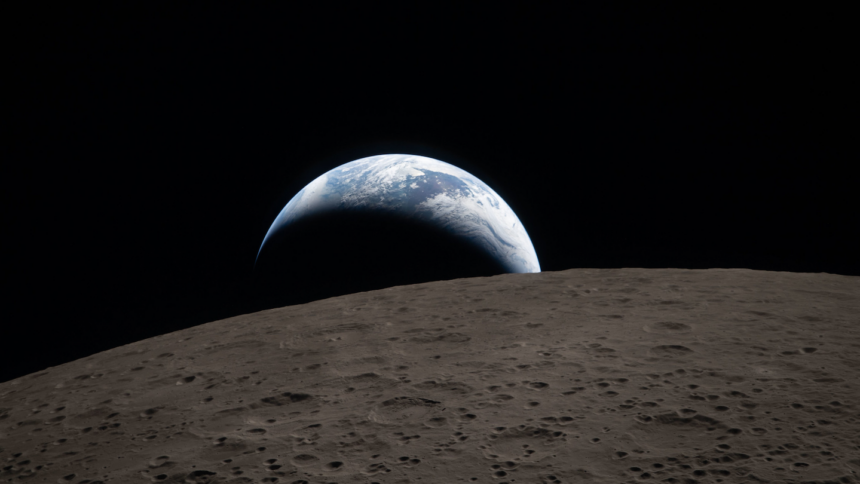
The Artemis II crew captured this photo through the window of the Orion spacecraft during their flyby of the moon.
NASA
By
HOUSTON — After five days in space and five decades of waiting, astronauts just got a view of the moon unlike any other.
The Artemis II mission’s Orion spacecraft looped around the farside of the moon on April 6. This lunar flyby lasted roughly seven hours. The sun lit up only about a fifth of the moon’s farside during that time. Yet the Artemis II crew got front-row seats to parts of the moon that have barely been glimpsed before by human eyes.
The crew includes four astronauts. Three work for NASA: Christina Koch, Victor Glover and Reid Wiseman. The fourth, Jeremy Hansen, works for the Canadian Space Agency. On April 1, the team lifted off for a 10-day round trip to the moon. Their close encounter with the lunar farside lasted only a few hours. They spent that entire time furiously collecting scientific data.
The nearside of the moon is an old friend. It always faces Earth. All Apollo missions landed there. The lunar farside is more mysterious. It has more craters and the chemistry of its rocks is different. Only a few spacecraft have ever landed there.
As the Orion capsule passed behind the moon, its crew took photos. They also recorded themselves making observations aloud.
The moon has been thoroughly photographed by robots. But people can pick up details in color and texture that cameras can’t. (If you’ve ever tried to snap a photo of the moon on your phone, you know it looks better in person.) The Artemis II astronauts could see browns and greens where cameras picked up only grays. Some of their descriptions were downright poetic.
Koch remarked on “all the really bright new craters” on the moon. “Most of them are pretty small,” she said. “What it looks like is a lampshade with pinprick holes and light shining through. They are so bright compared to the rest of the moon.”
Glover was struck by the terminator. That’s the line between the moon’s dark and light sides. “There are little islands of terrain out there that are completely surrounded by darkness,” he said. “To the north, there’s a really nice double crater. It looks like a snowman. On the southern edge it looks like there’s a gigantic hole.”
About four hours into the flyby, the Orion capsule passed fully behind the moon (relative to Earth). As a result, for about 40 minutes no signals could be sent to or received from the spacecraft.
During that time, the capsule made its closest approach to the moon. It flew just 6,545 kilometers (4,067 miles) above the lunar surface. Minutes later, the astronauts reached their farthest point from Earth, setting a new record.
Until now, the Apollo 13 crew has held the record for humans’ farthest venture from Earth. In 1970, that mission took them some 400,171 kilometers (248,655 miles) into space. The Artemis II crew ventured about 6,600 kilometers (4,100 miles) farther.
The moon wasn’t the only thing the Artemis II astronauts had in their sights. They also got a unique view of the sun. As their capsule headed back toward Earth, they pointed it so that the moon blocked the sun. This created a total solar eclipse.
The crew became the first humans to ever see an eclipse from the moon. And it brought the sun’s wispy outer corona into view. “It’s bright and it creates a halo almost around the entire moon,” Glover said.
The side of the moon facing Earth was also lit up by earthshine — sunlight reflected off our planet’s surface. “Earth is so bright out there and the moon is just hanging in front of us, this black orb,” Glover said. “It creates quite an impressive visual illusion. Wow.”
Bathed in earthshine, much of the moon’s surface was actually visible during the eclipse, Glover said. “We just went sci-fi,” he added. “It just looks unreal.”
During this period, the astronauts watched the shadowed part of the moon for impact flashes. These short-lived spikes of light can be seen as space rocks hit dark parts of the moon.
Scientists weren’t sure if the astronauts would see any flashes from lunar meteorites, but the team reported they saw at least four!
After the solar eclipse, the lunar flyby came to an end. But analyzing the astronauts’ trove of data has just begun. The crew bore witness to moments that will have a lasting impact on science — and on the astronauts.
“At one point … I just had an overwhelming sense of being moved by looking at the moon,” Koch said during the flyby. “It lasted just a second or two, and I actually couldn’t even make it happen again. But something just drew me in suddenly to the lunar landscape, and it became real.”
“The moon really is its own unique body in the universe,” Koch continued. “It’s not just a poster in the sky that goes by. It is a real place. And when we have that perspective and we compare it to our home of the Earth, it just reminds us how much we have in common. Everything we need, the Earth provides. And that truly is somewhat of a miracle.”
Apollo missions: NASA’s third human spaceflight program eventually took humans to the lunar surface. Along the way, this program sought to develop the technologies needed for long-distance space travel. It got a big kick-start after President John F. Kennedy proposed in 1961 creating the national goal of “landing a man on the Moon and returning him safely to the Earth.”
astronaut: Someone trained to travel into space for research and exploration.
basin: (in geology) A low-lying area, often below sea level. It collects water, which then deposits fine silt and other sediment on its bottom. Because it collects these materials, it’s sometimes referred to as a catchment or a drainage basin.
chemistry: The field of science that deals with the composition, structure and properties of substances and how they interact. Scientists use this knowledge to study unfamiliar substances, to reproduce large quantities of useful substances or to design and create new and useful substances. (about compounds) Chemistry also is used as a term to refer to the recipe of a compound, the way it’s produced or some of its properties. People who work in this field are known as chemists.
corona: An adjective that refers to crown, as in crown-shaped viruses known as coronaviruses. (in astronomy) The outermost layer of the atmosphere surrounding the sun (and other stars). The sun’s corona is normally visible only during a total solar eclipse, when it is seen as an irregularly shaped, pearly glow surrounding the darkened disk of the moon.
crater: A large, bowl-shaped cavity in the ground or on the surface of a planet or the moon. They are typically caused by an explosion or the impact of a meteorite or other celestial body. Such an impact is sometimes referred to as a cratering event.
eclipse: This occurs when two celestial bodies line up in space so that one totally or partially obscures the other. In a solar eclipse, the sun, moon and Earth line up in that order. The moon casts its shadow on the Earth. From Earth, it looks like the moon is blocking out the sun. In a lunar eclipse, the three bodies line up in a different order — sun, Earth, moon — and the Earth casts its shadow on the moon, turning the moon a deep red.
Grand Canyon: A natural canyon in northwest Arizona that formed as the Colorado River cut through the rock here over the past 5 million to 6 million years. This is one of many canyons on the river, which drains water from seven states. The Grand Canyon is 446 kilometers (277 miles) long. Its depth varies. At its deepest point, the river is 1,829 vertical meters (6,000 feet) below the upper rim. From rim to rim, the canyon’s width also varies — from about 16 kilometers (10 miles) to 29 kilometers. Of this impressive national land formation, more than a million acres (4,931 square kilometers, to be exact) was turned into a U.S. national park in 1919.
illusion: A thing that is or is likely to be wrongly perceived or interpreted by the senses.
lunar: Of or relating to Earth’s moon.
meteorite: A lump of rock or metal from space that passes through Earth’s atmosphere and collides with the ground.
NASA: Short for the National Aeronautics and Space Administration. Created in 1958, this U.S. agency has become a leader in space research and in stimulating public interest in space exploration. It was through NASA that the United States sent people into orbit and ultimately to the moon. It also has sent research craft to study planets and other celestial objects in our solar system.
robot: A machine that can sense its environment, process information and respond with specific actions. Some robots can act without any human input, while others are guided by a human.
solar eclipse: An event in which the moon passes between the Earth and sun and obscures the sun, at least partially. In a total solar eclipse, the moon appears to cover the entire sun, revealing on the outer layer, the corona. If you were to view an eclipse from space, you would see the moon’s shadow traveling in a line across the surface of the Earth.
terrain: The land in a particular area and whatever covers it. The term might refer to anything from a smooth, flat and dry landscape to a mountainous region covered with boulders, bogs and forest cover.
unique: Something that is unlike anything else; the only one of its kind.
Lisa Grossman is the astronomy writer at Science News. She has a degree in astronomy from Cornell University and a graduate certificate in science writing from University of California, Santa Cruz. She lives near Boston.
Readability Score: 6
Founded in 2003, Science News Explores is a free, award-winning online publication dedicated to providing age-appropriate science news to learners, parents and educators. The publication, as well as Science News magazine, are published by the Society for Science, a nonprofit 501(c)(3) membership organization dedicated to public engagement in scientific research and education.
© Society for Science & the Public 2000–2026. All rights reserved.
Artemis II just made a historic loop around the moon – Science News Explores



Leave a Comment