


Come explore with us!
Teen identifies possible building blocks for these cosmic brutes
Scientists think “intermediate mass” black holes were the building blocks of today’s supermassive black holes. But where did such mid-sized black holes come from? A teen’s research points to one possible answer.
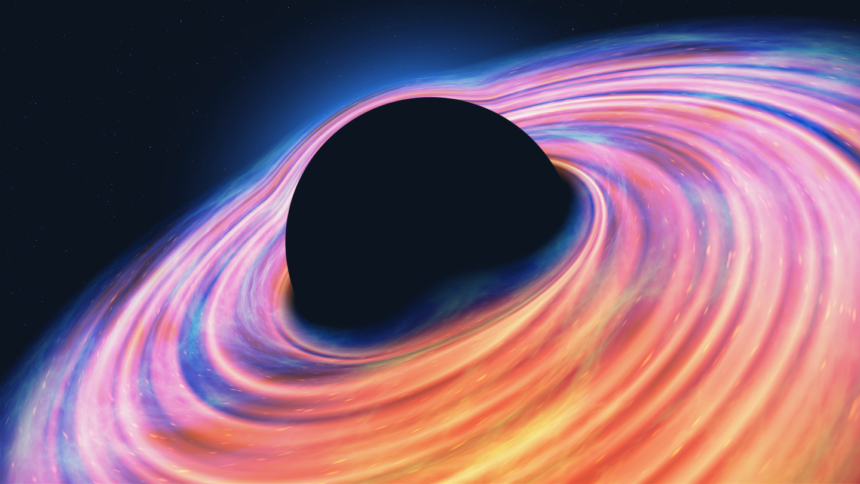
keybal/Vetta/Getty Images Plus
By
Khushi Karthikeyan, 18, has been fascinated by black holes since childhood. “Part of that fascination lies in the mystery,” Khushi says. “We don’t know so much about them.” One of the biggest open questions: How did those supermassive ones at the centers of galaxies get so enormous? Khushi’s research might bring scientists one clue closer to solving that mystery.
Supermassive black holes at the hearts of galaxies are truly monstrous. They can be millions to billions of times more massive than the sun. They shape how their home galaxies behave and evolve. Scientists think these beasts formed through collisions between smaller, “intermediate mass” black holes. But if so, how did such intermediate mass black holes form — those 100 to 100,000 times the mass of the sun?
To find out, Khushi ran computer models of huge stars in the early universe. Such stars had 200 times the mass of the sun and were low in elements heavier than hydrogen and helium. These models showed that those stars could indeed collapse, at the ends of their lives, into intermediate mass black holes. This hints that perhaps the origins of today’s supermassive black holes could trace back to such huge ancient stars.
Khushi is currently a high school senior at Ardsley High School in Ardsley, N.Y. Their research earned them a finalist spot at the 2026 Regeneron Science Talent Search. (That competition is run by Society for Science, which also publishes Science News Explores.) In this interview, Khushi shares their research experiences and advice.
“One of my favorite parts was that I was actually able to make my own contributions toward the field that has so long fascinated me,” says Khushi. They have loved learning from black hole research. “Now, I can kind of give back to it.”
Khushi struggled at first to get their data because the complex star models had taken so long to run. “I got back one simulation after it had been running for a few days. It was complete garbage. There were squiggles all over the place on the graphs,” Khushi says. They would have to run much more detailed models to get good results. And that would take weeks.
“There were these two weeks of excruciatingly waiting for my data,” Khushi says. “Luckily, there were people in my life who helped encourage me [and] helped me not lose hope.”
“My mentors,” Khushi says. “I would not have been able to do it without them.” Khushi found their research mentors by emailing dozens of scientists. “My [main] mentor was one of the few people who actually responded,” Khushi says. “The person who gets back to you will be the right person for you.” If at first you struggle to find a mentor, they say, “don’t lose hope.”
“Start small,” Khushi says. “You’re not trying to cure cancer on your first project. The goal is to make your own contribution to the field [you care about]. You don’t need to try something way too enormous, because if you do that, you’re likely going to be faced with disappointment. … If it’s achievable and you’re passionate about it, you will go far.”
black hole: A region of space having a gravitational field so intense that no matter or radiation (including light) can escape.
cancer: Any of more than 100 different diseases, each characterized by the rapid, uncontrolled growth of abnormal cells. The development and growth of cancers, also known as malignancies, can lead to tumors, pain and death.
computer model: A program that runs on a computer that creates a model, or simulation, of a real-world feature, phenomenon or event.
element: A building block of some larger structure. (in chemistry) Each of more than one hundred substances for which the smallest unit of each is a single atom. Examples include hydrogen, oxygen, carbon, lithium and uranium.
evolve: (adj. evolving) To change gradually over generations, or a long period of time.
field: An area of study, as in: Her field of research is biology. Also a term to describe a real-world environment in which some research is conducted, such as at sea, in a forest, on a mountaintop or on a city street. It is the opposite of an artificial setting, such as a research laboratory.
helium: An inert gas that is the lightest member of the noble gas series. Helium can become a solid at -272 degrees Celsius (-458 degrees Fahrenheit).
high school: A designation for grades nine through 12 in the U.S. system of compulsory public education. High-school graduates may apply to colleges for further, advanced education.
hydrogen: The lightest element in the universe. As a gas, it is colorless, odorless and highly flammable. It’s an integral part of many fuels, fats and chemicals that make up living tissues. It’s made of a single proton (which serves as its nucleus) orbited by a single electron.
mass: A number that shows how much an object resists speeding up or slowing down — basically a measure of how much matter that object is made from.
mentor: An individual who lends his or her experience to advise someone starting out in a field. In science, teachers or researchers often mentor students or younger scientists by helping them to refine their research questions. Mentors also can offer feedback on how young investigators prepare to conduct research or interpret their data.
model: A simulation of a real-world event (usually using a computer) that has been developed to predict one or more likely outcomes. Or an individual that is meant to display how something would work in or look on others.
Science Talent Search: An annual competition created and run by Society for Science. Begun in 1942, this event brings 40 research-oriented high school seniors to Washington, D.C. each year to showcase their research to the public and to compete for awards. Since spring 2016, this competition has been sponsored by Regeneron Pharmaceuticals.
simulation: (v. simulate) An analysis, often made using a computer, of some conditions, functions or appearance of a physical system. A computer program would do this by using mathematical operations that can describe the system and how it might change over time or in response to different anticipated situations.
Society for Science: A nonprofit organization created in 1921 and based in Washington, D.C. Since its founding, the Society has been promoting not only public engagement in scientific research but also the public understanding of science. It created and continues to run two renowned high-school science competitions: the Regeneron Science Talent Search (begun in 1942) and the Regeneron International Science and Engineering Fair (created in 1950). A third, middle-school competition, launched in 2010, has since 2023 been known as the Thermo Fisher Scientific Junior Innovators Challenge. The Society also publishes award-winning journalism: in Science News (launched in 1922) and Science News Explores (created in 2003).
star: The basic building block from which galaxies are made. Stars develop when gravity compacts clouds of gas. When they become hot enough, stars will emit light and other forms of electromagnetic radiation. The sun is our closest star.
sun: The star at the center of Earth’s solar system. It is about 27,000 light-years from the center of the Milky Way galaxy. Also a term for any sunlike star.
universe: The entire cosmos: All things that exist throughout space and time. It has been expanding since its formation during an event known as the Big Bang, some 13.8 billion years ago (give or take a few hundred million years).
Maria Temming is the Assistant Managing Editor at Science News Explores. She has bachelor’s degrees in physics and English, and a master’s in science writing.
Readability Score: 6.4
Founded in 2003, Science News Explores is a free, award-winning online publication dedicated to providing age-appropriate science news to learners, parents and educators. The publication, as well as Science News magazine, are published by the Society for Science, a nonprofit 501(c)(3) membership organization dedicated to public engagement in scientific research and education.
© Society for Science & the Public 2000–2026. All rights reserved.
Supermassive black holes might trace back to huge, ancient stars – Science News Explores



Leave a Comment