




As a high school student, Mariam Elsawy would often sketch characters to better understand concepts in biology, chemistry and physics.
Now as a master’s student in the Temerty Faculty of Medicine’s Institute of Medical Science (IMS), Elsawy finds herself wanting to visualize science once again. As she completes her research project on the alternatives to drug criminalization in Canada, she says she wants to draw as a way to explain certain papers to herself.
“I wondered if there were other people who would be interested in thinking of science in the form of cartoons, comics or characters,” says Elsawy.
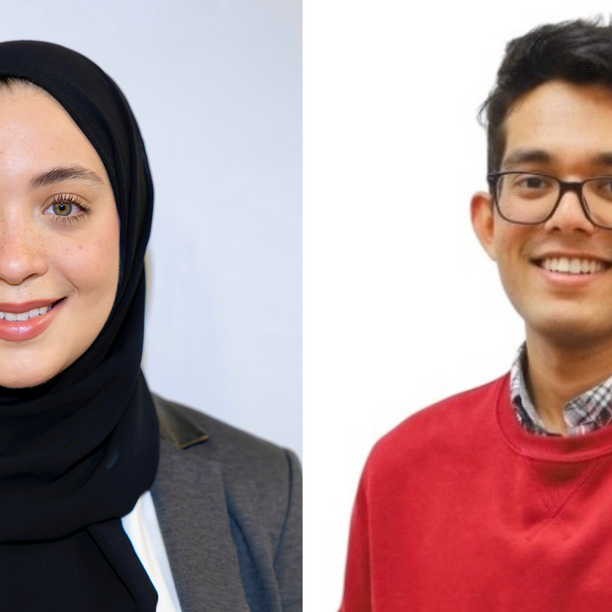
With her sights set on helping others draw on the power of illustration to communicate science, she became an organizer for MedComic Con, an in-person conference that explores the emerging field of graphic medicine. The April 1 event will showcase research-based comics created by graduate students within the Institute of Medical Science.
Visualized by master’s students in the Biomedical Communications program, a two-year professional master’s degree within the Institute of Medical Science, comics will feature current IMS research projects from students across various specialties.
The agenda includes talks by experts in graphic medicine, a discipline that combines illustration and medical science, as well as networking opportunities, a panel Q&A and comic making workshops. Organizers will also present awards for the top three comic posters and IMS Magazine will publish the winners’ names in the fall issue.
Elsawy and her co-organizer, fellow master’s student Shannen Kyte, began planning MedComic Con last year. The pair received the 2025 Jay Keystone Memorial Award for Innovation in Scientific Communication, which provides a $4,000 grant to create a new initiative that demonstrates innovation and excellence in sharing medical science to diverse audiences.
Shelley Wall, who developed and teaches U of T’s first graphic medicine course, says comics can communicate information that text alone cannot.
“It’s so much easier to access information when it’s clothed in a story. It’s easier to remember, maybe easier to follow,” says Wall, an associate professor of biomedical communication and the project’s supporting faculty member.
In recent years, graphic medicine has seen an upswing in popularity as an effective way to share health and science information with patients.
Wall was appointed Temerty Medicine’s inaugural illustrator-in-residence in 2012 and helped form the Graphic Medicine International Collective in 2019.
She says the field is constantly growing, with medical journals recognizing the comic medium as a tool for communication. The Annals of Internal Medicine features a regular comic series called Annals Graphic Medicine to address medically relevant topics. The New England Journal of Medicine has also released comics to merge medicine and storytelling.
Wall says MedComic Con can offer attendees a fresh perspective on how to approach their work in science.
“As vehicles for information, comics harness all of that fantastic power that narrative holds for humans,” says Wall.
Wall also connected Elsawy and Kyte with biomedical communications students, including second-year master’s student Ella Eberhardt.
Eberhardt has a particular interest in patient education and says she is driven to create engaging health materials.
“For me, it’s very important that people, especially patients, are able to engage meaningfully with the information they’re receiving,” says Eberhardt, who is completing her thesis on education materials for those experiencing facial paralysis.
To create a comic, Eberhardt worked with IMS student Lyanne Zhang, whose neuroscience research explores the complexity of neural systems. The comic shows how the brain, like many other complex systems in our universe, operates near a “critical point,” making it able to process information efficiently and adapt.
“Graphic medicine is a way that most people can consume medical information,” says Eberhardt. “It is very accessible.”
Elsawy says she hopes MedComic Con can inspire others to combine art and science rather than viewing them as strictly separate.
“There can be a tendency to think of people as either scientific or artistic,” says Elsawy. “I connect with both of those qualities, and want to help empower others to do the same.”
MedComic Con will take place Wednesday, April 1 in the Medical Sciences Building from 5:00 to 8:00 p.m. Click here for more information.
Science Meets Art: MedComic Con communicates research through stories – University of Toronto



Leave a Comment

