


Bridge Michigan
Michigan’s nonpartisan, nonprofit news source
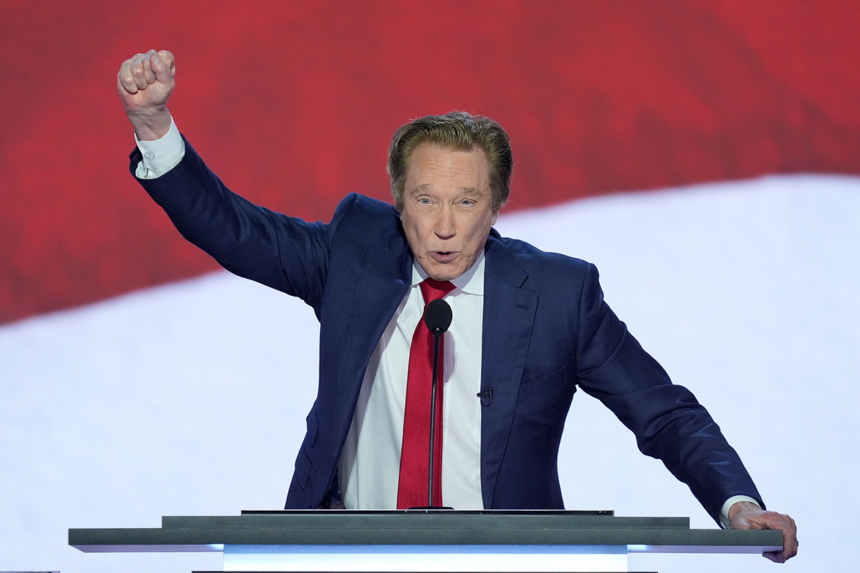
LANSING — Michigan gubernatorial hopeful Perry Johnson is filling television airwaves and social media feeds with a promise to save taxpayers $4,747 a year by eliminating the state income tax.
“Keep your money, live your dreams,” Johnson’s campaign says as part of a reported $10 million ad blitz from the wealthy Republican businessman, who is pumping his own money into the race after spending more than $20 million on prior failed campaigns for governor and president.
Fellow GOP candidates Mike Cox, Aric Nesbitt and Ralph Rebandt have also called for axing the income tax, while others have called for cuts. Some candidates are also proposing property tax cuts or elimination.
Johnson’s proposal, in particular, has sparked several reader inquiries as part of Bridge Listens, our non-scientific survey of election year issues. Among them:
The purported $4,747 in savings touted by Johnson is, in part, a nod to President Donald Trump, who is the nation’s 47th commander-in-chief. Johnson calls it a “magical number.”
Related:
But an analysis by Bridge Michigan shows most families would not save as much as he claims. And major questions remain about how he — and other candidates with similar proposals — would operate state government after cutting one of its primary funding sources.
Here are the facts.
Asked about the math behind Johnson’s claim of income tax elimination savings, his campaign pointed to a social media video in which he explains: “The median income for a family of four is $111,690. A savings of 4.25% in income tax would be $4,747 every year in your pocket.”
On its face, that math essentially checks out. Michigan currently has a 4.25% income tax, and the median family of four actually earns a bit more than Johnson claims.
But taxes aren’t so simple.
After exemptions, subtractions and credits, single and joint filers who earn between $110,000 and $120,000 paid an effective Michigan income tax rate of 3.01% in 2021, the most recent year for which state data is available.
Filers with gross incomes of $111,691 paid an average state tax of $3,406 that year – about 30% less than Johnson claimed.
“Treasury data is a better way to look at it,” said Bob Schneider, a state budget expert with the non-partisan Citizens Research Council of Michigan.
According to the most recent US Census Bureau data, Michigan’s median income for a four-person household is currently about $123,010. Filers who earned that much in 2021 paid an effective tax rate of 3.11%, or about $3,826.
So those families would save significant money if the income tax were eliminated – just not as much as Johnson has suggested.
Also worth noting: Because Michigan has a flat tax — 4.25% regardless of income — higher earners would save more on a dollar-by-dollar basis if the tax is eliminated:
Michigan’s 4.25% income tax generated about $13.5 billion in revenue for the state last fiscal year, and experts say eliminating that funding would mean a sea change for the way Michigan funds its government.
The income tax provides about a third of all state funding used to craft annual budgets, which must be balanced each year under the Michigan Constitution. But it makes up a far larger share of discretionary revenue — about 60% — that state officials can spend without strings attached.
Michigan’s state government took in about $14.5 billion in unrestricted revenue in the last fiscal year, according to the House Fiscal Agency. Personal income taxes made up $8.4 billion of that. Another big chunk of income tax revenue — close to $4 billion —flows into the School Aid Fund for education.
Many of the Republican candidates now pitching major tax cuts point out that state budgets have grown significantly under Gov. Gretchen Whitmer. This year’s $81 billion state spending plan is up from the $57 billion budget signed into law the year before she took office.
That’s true. But eliminating the state income tax would still require the next governor to cut significant spending, not simply vow to attack “waste, fraud and abuse.”
“You’re talking about a massive amount of the state’s general fund, and you would need to eliminate a lot of stuff,” Schneider said. “We can evaluate whether individually, any of those are good things, but they’re not gonna get you $13 billion.”
Johnson has offered a handful of ideas to help pay for his proposed income tax elimination, but several of his plans are vague and he has not identified projected savings.
Among other things, he’s vowed to:
The problem with relying on savings from unemployment insurance reform? Employers fund the program, not individual taxpayers.
“It doesn’t mean it’s not something we should look at, but it’s not going to… address this issue of, how are we going to find savings that help us defray $13 billion of income tax?” Schneider said.
Responding to specific questions from Bridge, Johnson’s campaign insisted his administration would uncover “billions of dollars of fraud,” use zero-based budgeting to “dramatically cut spending” and grow the tax base by encouraging people to “flock to Michigan.”
Johnson isn’t the only candidate to promise major tax cuts without providing a detailed plan to pay for the lost revenue.
Cox, for instance, has said he’d do it the same way he “navigated the attorney general’s office,” where he had proposed spending cuts. “It’s a process,” he said during a February appearance on WKAR-TV’s Off the Record.
Aric Nesbitt, the state Senate Minority Leader now running for governor, has no qualms saying he wants to contract state government in order to pay for income tax elimination.
“We’ve got to shake up the status quo, shrink the size of government, make sure more money is back in the pockets of hard working families,” Nesbitt told Bridge.
Nesbitt argues there’s savings to be found by cutting unspecified “waste, fraud and abuse” out of the state budget and promises “we can find savings.”
Candidates could have a strategic reason for being intentionally vague about potential cuts but may have “a secret plan,” said James Hohman, the director of fiscal policy for the Mackinac Center for Public Policy, a free-market think tank.
“There is a lobbying interest group behind every single dollar of spending from the state budget, and by being very specific about what you’re going to do to them, you’re painting a target on your back,” he said.
Hohman added that campaigns often don’t have the policy staff needed to nail down details, and he suggested eliminating the income tax should be spaced out over a long period, using economic growth to gauge the size of cuts.
Both Nesbitt and Johnson have also called for property tax cuts, backing a proposal from GOP House Speaker Matt Hall to begin by eliminating the State Education Tax, which charges homeowners $6 for every $1,000 of taxable value on their homes per year to fund schools.
In the fiscal year ending October 2024, the education tax raised more than $2.5 billion for schools.
Nesbitt cited “social welfare” — meaning programs like Medicaid or food assistance — as potential targets for savings. But he has not specified how he’d reform those programs, which are primarily funded by the federal government and relied upon by millions of Michiganders.
“We need to fund our schools, our law enforcement and our roads first, but the growth and scope of social welfare over the last seven years under this governor has been huge,” he said.
Of the $27.8 billion allocated for Medicaid spending in the last fiscal year, Michigan directly paid about $8 billion. The state Department of Health and Human Services, which administers the program, has noted the cost of private insurance has far outpaced Medicaid over the past two decades.
Pastor Ralph Rebandt is going a step further than some GOP gubernatorial candidates by backing an AxeMITax initiative that aims to cut all property taxes — state and local — in Michigan.
“By doing a total overhaul on the budget, on the economy, in the government, we will cut (property tax) out,” Rebandt said in a recent candidate forum.
The effects across Michigan would be seismic, cutting off billions of dollars in funding for state and local governments that rely on property tax revenue to fund essential services.
Neither Rebandt nor AxeMITax proponents have said how governments would rebound from the drop in revenue.
Schneider estimated property taxes make up as much as 90% of the funding for many municipal and county governments, which collected about $6.8 billion in property taxes in 2024. Public schools, too, are dependent on property taxes to fund capital projects, raising about $8.8 billion.
“Any local government in Michigan is going to be highly dependent on the property tax, so you’re basically taking out the fundamental fundable component of local revenue across the entire state,” he said. “No local government would not be heavily impacted by the elimination of the property tax without replacement revenue.”
Hohman, with the Mackinac Center, said voters shouldn’t expect details about potential cuts because campaigns have little incentive to provide them.
“Until people demand that type of detail in order to feel confident in their pledges about tax cuts, you’re unlikely to get it from the campaigns,” he said.
Journalism like this doesn’t happen without community support. Your contribution powers reporting that listens to Michigan residents and holds leaders accountable.
Join 8,000+ members building accountability journalism that serves communities, not special interests.

Republish our articles for free, online or in print, under our Republication Guidelines. Questions? Email republishing@bridgemi.com
This work is licensed under a Creative Commons Attribution-NoDerivatives 4.0 International License.
by Simon D. Schuster, Bridge Michigan
March 30, 2026
Only donate if we’ve informed you about important Michigan issues
See what new members are saying about why they donated to Bridge Michigan:
If you want to ensure the future of nonpartisan, nonprofit Michigan journalism, please become a member today. You, too, will be asked why you donated and maybe we’ll feature your quote next time!
Click “No, thanks” if you do not want to be counted in our site traffic.
You must be logged in to post a comment.