


Notifications can be managed in browser preferences.
Please refresh the page or navigate to another page on the site to be automatically logged inPlease refresh your browser to be logged in
Swipe for next article
Thousands of US marines arrive in Middle East amid reports American president considering sending 10,000 troops
Removed from bookmarks
I would like to be emailed about offers, events and updates from The Independent. Read our Privacy notice
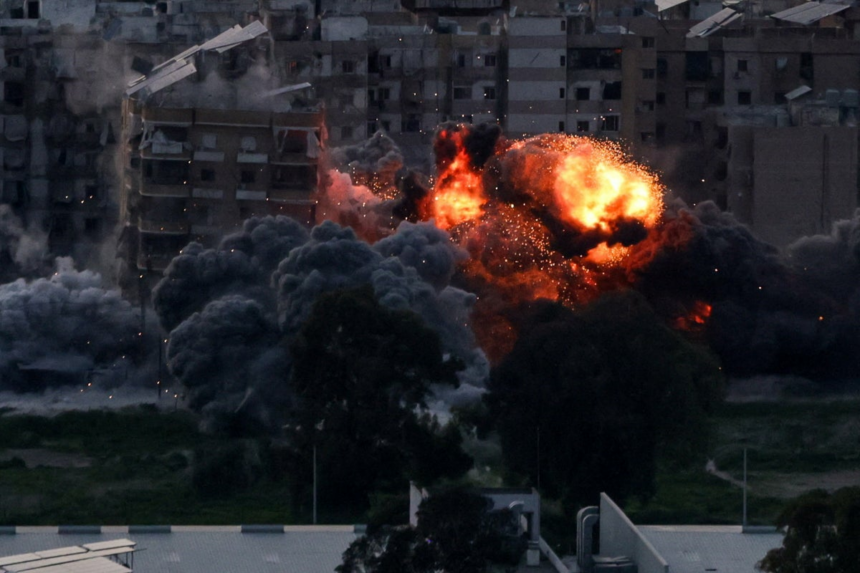
Prime minister Benjamin Netanyahu has ordered the expansion of a controversial security “buffer zone” in southern Lebanon as Iran warned that President Donald Trump is leading US troops into the “swamp of death”.
“I have just instructed to further expand the existing security buffer zone. We are determined to fundamentally change the situation in the north,” Netanyahu said in a video statement from the Northern Command.
The Islamic Revolutionary Guard Corps released a new video on Sunday amid reports of a US ground invasion with military spokesperson Ebrahim Zolfaqari saying: “Unfortunately, the leaders of the United States have delegated the authority to command the armed forces to someone who, due to imbalance, dangerous and wrong positions and decisions, has led the US army into the swamp of death.”
It follows speculation that Pentagon officials are preparing for potential ground operations in Iran, which could last for weeks, The Washington Post reported on Saturday. Thousands of US marines arrived in the region aboard the USS Tripoli on Saturday, according to US Central Command.
However, secretary of state Marco Rubio said on Friday that the US could achieve its goals without a ground invasion.
Iran has agreed to allow 20 more Pakistan-flagged ships to pass through the beleaguered Strait of Hormuz, Pakistan’s deputy prime minister and deputy foreign minister confirmed this weekend.
“I am pleased to share a great news that the Government of Iran has agreed to allow 20 more ships under the Pakistani flag to pass through the Strait of Hormuz; two ships will cross the Strait daily,” he wrote in a post on X on Sunday.
“This is a welcome and constructive gesture by Iran and deserves appreciation. It is a harbinger of peace and will help usher stability in the region.
“This positive announcement marks a meaningful step toward peace and will strengthen our collective efforts in that direction. Dialogue, diplomacy, and such confidence-building measures are the only way forward.”
Pakistan has been leading diplomatic efforts to come to a resolution on the blockade of the Strait of Hormuz.
The Islamic Revolutionary Guard Corps has accused President Donald Trump of starting the war in Iran in order to deflect from the ongoing Epstein controversy in the US that has seen several high-profile figures named.
Trump has repeatedly denied any wrongdoing in regards to the ongoing scandal and said he has “done nothing wrong”. A mention in the files is not an implication of guilt.
Military spokesperson Ebrahim Zolfaqari said in a video broadcast on state media on Sunday that there was “no doubt” that the US president had been “under pressure” by Israel to commence the war “due to his record in the Epstein case”.
“The President of the United States, who has become known as the most lying president of the world, and has no stability of thought or discourse, is not trustworthy in any way, and unfortunately, the leaders of the United States have delegated the authority to command the armed forces to someone who, due to imbalance, dangerous and wrong positions and decisions, has led the US army into the swamp of death.”
Iran says it is ready and waiting for US troops to launch a ground invasion and threatened to “set fire” to President Trump’s forces if they enter the Islamic Republic’s territory.
Speaker of Iran’s parliament, Mohammad Bagher Ghalibaf said Tehran is “waiting for the arrival of American troops on the ground to set them on fire”, in a published message broadcast on Iranian state media including the official IRNA news agency on Sunday.
It follows overnight reports that the Pentagon is awaiting President Trump’s approval for weeks of ground operations in Iran, according to the Washington Post.
On Saturday, thousands of US sailors and marines moved to the Middle East aboard the USS Tripoli warship, US Central Command confirmed.
Ghalibaf, who has been eyed by the US as a potential figurehead to lead negotiations in Iran amid the absence of newly-appointed supreme leader Mojtaba Khamenei, said: “The enemy signals negotiation in public, while in secret it plots a ground attack”.
Israeli Prime Minister Benjamin Netanyahu said on Sunday he had instructed the military to further expand the existing security buffer zone in southern Lebanon, vowing to fundamentally change the security situation there.
“I have just instructed to further expand the existing security buffer zone. We are determined to fundamentally change the situation in the north,” Netanyahu said in a video statement from the Northern Command.
He said the decision aimed to strengthen Israel’s security posture along the northern frontier, amid ongoing tensions along Israel’s northern border, where cross-border hostilities have raised fears of a broader regional escalation.
Kuwait’s army has said that 10 of its personnel were injured in an attack on a military camp on Sunday.
The camp sustained material damage, the army said in a post on X, adding that Kuwait had dealt with 14 ballistic missiles and 12 drones over the past 24 hours.
It did not specify the location of the attacks.
Israel’s ADAMA plant, a maker of active ingredients and crop protection materials, said its Makhteshim plant in southern Israel had been hit by either an Iranian missile or debris from a missile on Sunday.
ADAMA, part of Chinese owned Syngenta Group, said the damage to the plant was not immediately known. No injuries were reported.
Iran’s Supreme Leader Ayatollah Mojtaba Khamenei has thanked the Iraqi people and religious leadership for their support of Iran “in the face of aggression”, Iran’s state media reported on Sunday, without saying how this message was conveyed.
Khamenei has not been seen in public since the outbreak of war. His father, the slain supreme leader Ayatollah Ali Khamenei, was killed in US-Israeli strikes on his compound on 28 February.
Iranian state media have shared written messages by Mojtaba Khamenei to the public via its channels.
Since the United States and Israel launched their war against Iran in late February, Iran has retaliated by targeting commercial ships in the Strait of Hormuz, effectively shutting down the narrow channel of water.
It’s caused a global fuel crisis, even though some ships are managing to get through the strait. US President Donald Trump has given Iran an ultimatum to fully reopen the waterway to oil and gas shipments, and called on NATO allies to help in the effort.
We asked naval expert Jennifer Parker, who served for 20 years with the Royal Australian Navy, to explain what kind of military force would be required to reopen the strait to commercial shipping and why the US hasn’t yet taken this step.
Join thought-provoking conversations, follow other Independent readers and see their replies
Please refresh the page or navigate to another page on the site to be automatically logged inPlease refresh your browser to be logged in
Iran war latest: Israel to expand into Lebanon as Tehran warns of ‘swamp of death’ – The Independent



Leave a Comment