




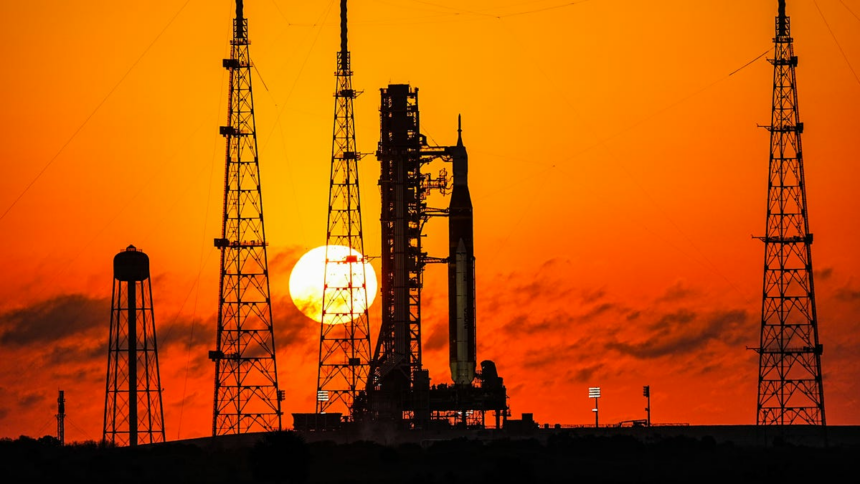
Towering over Florida’s eastern coastline, NASA’s imposing Space Launch System rocket has stood still as a sentinel since it was rolled back to the launch pad.
But in a matter of days, the rocket could burst with life, sending plumes of exhaust and steam billowing around it as it blasts off at the Kennedy Space Center. Propelling a crew of astronauts on NASA’s first human moon mission in more than 50 years, the SLS rocket will be among the largest vehicles to ever launch from Florida’s Space Coast near the Atlantic Ocean.
At 322 feet tall, the Space Launch System rocket is almost as tall as an American football field is long from endzone to endzone. Put another way, the giant rocket, which is set to launch the Artemis 2 moon-circling mission as early as April 1, even towers over the 305-foot-tall Statue of Liberty near New York City.
In addition to its colossal size, the SLS rocket is also the most powerful NASA has ever launched. The space agency’s iconic Saturn V, active during the Apollo era, may still have the edge on the SLS in terms of height, but it pales in comparison when it comes to thrust.
Ahead of the Artemis 2 launch from Cape Canaveral, here’ what to know about NASA’s SLS rocket, including how it compares in height to other behemoths and how Floridians can see in vertical on the launch pad.
The Space Launch System (SLS) is the gigantic rocket NASA developed specifically for its Artemis lunar program, which the agency’s ambitious campaign to put astronauts back on the moon for the first time since 1972.
Built by Boeing and Northrop Grumman, what the SLS rocket lacks in a catchy name it more than makes up for in sheer power.
Topped with an Orion crew capsule where astronauts will ride, the SLS will launch atop a staggering 8.8 million pounds of thrust – a measure of the amount of force used to push the vehicle off the ground. For space nerds, that’s about 15% more power than the SLS rocket’s Saturn V predecessor, pivotal in the U.S. space agency’s historic Apollo lunar missions of the 1960s and 1970s, according to NASA.
Classified as a super-heavy lift launch vehicle, the SLS carried 27 metric tons (59,000 pounds) to the moon during its debut launch. The rocket is also the only one capable of sending NASA’s Orion capsule occupied by up to four astronauts, along with “large cargo” directly to the moon, according to NASA.
The Space Launch System stands at 322 feet tall, making it one of NASA’s largest rockets ever much taller than the 184-feet-tall space shuttles.
The SLS rocket is composed of a 212-foot core stage propelled by four engines powered by a mix of liquid hydrogen and liquid oxygen, as well as two 177-feet-tall solid rocket boosters mounted to the sides providing the bulk of the initial burst of thrust at liftoff.
In NASA’s rocket arsenal, the SLS is only outdone in terms of height by the retired 363-foot-tall Saturn V, which was a three-stage heavy-lift launch vehicle.
But as for the world’s largest rocket? That honor still belongs to Starship, the approximately 400-foot megarocket that billionaire Elon Musk’s SpaceX has been developing with a series of test flights in South Texas.
Still, the SLS towers over most other rockets that are active today in the United States.
That includes SpaceX’s 230-foot Falcon 9, the world’s most active rocket responsible for deploying the company’s Starlink internet satellites and launching astronauts to orbit on missions to the International Space Station.
The SLS rocket is also just slightly taller than the 320-foot-tall New Glenn, a two-stage heavy-lift launch vehicle manufactured by billionaire Jeff Bezos’ spaceflight company Blue Origin for commercial, civil and military launches.
NASA’s Space Launch System rocket has only launched once from Florida, making its maiden flight Nov. 16, 2022 during the Artemis 1 mission to send the Orion capsule around the moon without a crew.
The mission made history, with the SLS rocket becoming the most powerful rocket NASA has ever launched.
At the Kennedy Space Center, perhaps no launch site is more iconic than Launch Complex 39A. After all, the historic launch pad is where the majority of NASA’s Apollo moon missions got off the ground – including the groundbreaking Apollo 11 moon landing.
But because SpaceX has construction underway at 39A ahead of a highly-anticipated Florida debut of Starship, the launch pad has been closed for weeks. That means the Artemis 2 mission will instead lift off a little further north from the less prolific Launch Complex 39B, which, in fairness, was the site of one Saturn V launch on the Apollo 10 mission in 1969.
The Space Launch System should be easily visible from the pad along the Kennedy Space Center’s skyline, including from the nearby Playalinda Beach.
NASA is working toward an April 1 launch of the Artemis 2 mission from the Kennedy Space Center.
Ahead of the launch, the crew of Artemis 2 – NASA astronauts Reid Wiseman, Victor Glover and Christina Koch, and the Canadian Space Agency’s Jeremy Hansen – entered quarantine at the Johnson Space Center in Houston and will soon fly to Florida.
Hitching a ride atop the SLS rocket, the Artemis 2 astronauts are due to pilot an Orion capsule on a 10-day trip around the moon without landing in a major test of the vehicle while traveling farther from Earth than any humans before them.
A moon landing is now due to take place as early as 2028 during a mission known as Artemis 4. Prior to that mission, Artemis 3 astronauts aboard the Orion capsule are due to meet and dock in 2027 in Earth orbit with at least one of the commercial lunar landers being developed by Elon Musk’s SpaceX and Jeff Bezos’ Blue Origin.
Eric Lagatta is the Space Connect reporter for the USA TODAY Network. Reach him at elagatta@usatodayco.com. Subscribe to the free Florida TODAY newsletter.
NASA’s giant moon rocket ready for Florida Artemis 2 launch. What to know – Florida Today



Leave a Comment

