


Thank you for visiting nature.com. You are using a browser version with limited support for CSS. To obtain the best experience, we recommend you use a more up to date browser (or turn off compatibility mode in Internet Explorer). In the meantime, to ensure continued support, we are displaying the site without styles and JavaScript.
Advertisement
Communications Sustainability volume 1, Article number: 51 (2026)
Global warming and electric heat pump adoption will, together, likely have a complex effect on energy burdens in the United States. Here, for 10,000 representative buildings in 28 U.S. cities, we estimate the distribution of monthly and annual energy burdens for every combination of current and future (electrified) heating and cooling systems, and the historical and future climates. In cold climates, the combined effect of electrification and warming could help reduce energy burdens, while heat pump adoption alone would raise them. In very cold cities, the energy bills in January could exceed income, a phenomenon that warming will only partially blunt. In Detroit in January, heat pump adoption would produce a 2 percentage point increase in energy burden compared to natural gas heating, but would reduce energy burdens by 8 percentage points for homes that use resistance electric heating. Decision-makers should carefully target information and incentives for heat pump adoption.
About a fifth of U.S. households reduce or forgo food or medicine to pay their energy bills—a phenomenon often referred to as the “heat or eat” dilemma1. These burdens are not equally distributed. The energy burden—defined as the percentage of a household’s income spent on utility bills—is higher for Black and Hispanic households than it is for others. High energy burdens force households to heat or cool their homes inadequately, harming physical and mental health2,3,4. These burdens stem from the fact that low-income households often live in inefficient homes, which may have poor insulation, be leaky, and have inefficient heating and cooling systems5,6.
It is possible that two trends will change energy burdens and their distributions. The first of these trends is the need to electrify heating, using air source heat pumps. Analysts believe that this switch is essential for decarbonization; Federal (e.g., the Inflation Reduction Act, now revoked), local, and state policy7 has sought to subsidize this transition; and heat pumps have outsold natural gas furnaces in the U.S. since 2021. Past work has shown that in cold climates, switching from natural gas furnaces to air source heat pumps often increases household energy bills and energy burdens in a way that may disproportionately hurt low-income households8,9. Conversely, in the southern U.S. and the Pacific Northwest, heat pump adoption cuts bills. The second trend is a changing climate. A warmer climate may reduce energy burdens in cold climates in the winter, but raise them in warm climates in the summer. This phenomenon will likely have a complex effect on energy burdens. Furthermore, these trends could interact. Heat pumps will become more efficient and therefore more economically attractive as sources of heat in warming winters. Modern heat pumps may also provide more efficient air conditioning than currently installed air conditioners do.
Outside the U.S., analyses of climate change and residential electrification largely focus on energy consumption rather than household energy burdens. Climate-focused studies show how warming and shifting seasonal conditions alter heating and cooling demand in buildings, including work on Australian office buildings10, Italian residential sectors11, and Chinese residential buildings across multiple climate zones12. Studies of residential electrification similarly examine how heat pump adoption affects energy use or costs without assessing household energy burden, such as recent analysis of regional inequalities in the United Kingdom under future energy prices13. One study considers both climate change and heat pump deployment, but it evaluates changes in energy demand rather than affordability, as illustrated by work on German residential heating and cooling under projected climate conditions14.
The energy justice aspects of the energy transition are recognized as critical. Nonetheless, as we show in Table 1, few studies have systematically examined how electrification and a changing climate might affect the distribution of energy burdens across cities. Energy burdens are typically felt from month to month and in many places are driven by seasonal weather. Therefore, annual energy burdens–which are almost always what is reported–may mask untenably high burdens in specific months. We could find few studies15 that accounted for this seasonality in energy burdens. Moreover, while most existing work16,17,18,19,20,21 relies on annual average energy prices and overlooks the spatial and temporal complexity of real-world utility rate structures, our approach incorporates actual time-varying electricity rates. This enables a more granular assessment of household energy burdens.
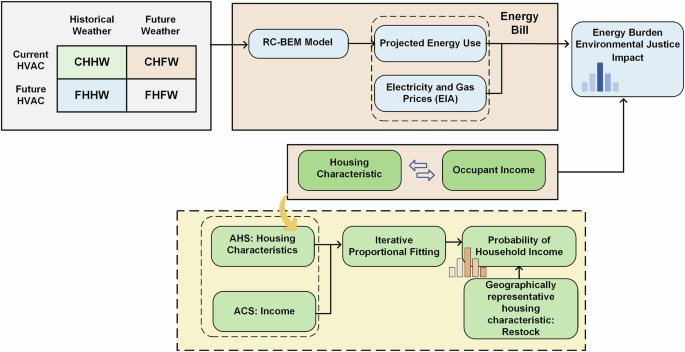
This study extends the literature in four ways, using a method described in Fig. 1. First, we quantify the change in energy burdens due to a changing climate, electrification, and a combination of the two. Second, for each of 28 cities across the nation’s climate zones, we produce a realistic distribution of energy burdens that accounts for the distribution of characteristics of the single-family housing stock in that city. This allows us to understand not only the change in average energy burdens, but also to highlight the changes experienced by the households that are most heavily burdened. Third, we report distributions of monthly energy burdens, which correspond to the ways in which many low-income households–who have a limited ability to absorb even small shocks in expenditure–experience those burdens. Fourth, we use realistic utility rate structures, which account for the fact that, in many cases, energy burdens are determined not only by the quantity of energy consumed, but also by the temporal pattern of consumption. This approach provides a clearer understanding of the intersection between energy costs, energy efficiency upgrades, and household demographics, all while considering the impact of climate change. This insight enables stakeholders to design better strategies for creating more equitable and healthy communities. Table 1 presents a survey of the literature on energy burdens. in which we classify existing studies based on data source, building energy models, geographical coverage, temporal resolution, and whether climate change is considered.
A reduced complexity building energy model (see34 and Methods) integrates climate data and heating and cooling system characteristics to project energy use for each of a sample of representative homes in selected cities. Coupled with electricity and fuel prices from utility rate books for electricity and the Energy Information Administration (EIA), this energy use data is used to calculate annual and monthly energy bills. Housing and income data, sourced from the American Housing Survey (AHS) and the American Community Survey (ACS), are synthesized using Iterative Proportional Fitting (IPF) to generate the joint probability distribution of household income and characteristics, which in turn estimates a probability distribution of household income for each house.
We selected 28 cities to represent a range of climate conditions across the United States. Following the city selection approach in9, climate regions were defined using data from the U.S. Office of Energy Efficiency and Renewable Energy’s Building America project22. Eight primary cities were highlighted in the main text as representative examples of distinct U.S. climate zones, including very cold, cold, mixed humid, hot humid, hot dry, and marine regions. The remaining cities were included to ensure regional diversity and adequate coverage for cross-city comparisons. We also prioritized locations with readily available time-of-use rate structures and accessible data from the American Housing Survey and the American Community Survey.
Across 28 representative U.S. cities, our results reveal that the combined impacts of heat pump adoption and climate change on household energy burdens are climate-dependent. In cold regions such as Buffalo and Boston, heat pump adoption increases winter burdens due to the replacement of low-cost natural gas with higher-cost electricity, but this effect is partially counterbalanced by future warming, which reduces heating demand and lowers seasonal burdens. In mixed-humid regions such as Baltimore and St. Louis, electrification and warming act in the same direction, amplifying burden reductions as heat pumps operate efficiently with warmer ambient temperatures. In hot and hot-humid regions such as Houston and Phoenix, heat pump adoption lowers burdens by improving cooling efficiency, yet future warming amplifies cooling demand, producing only modest net reductions. Marine climates such as Seattle and San Francisco show minimal overall change due to mild temperature variability and balanced seasonal demand. Our analysis highlights strong spatial heterogeneity: heat pump adoption and climate warming interact in ways that can either amplify or counterbalance each other, underscoring the importance of regional policy design tailored to local fuel prices, climate conditions, and baseline heating technologies.
While we analyze 28 cities (The code and data can be found in the public repository: https://github.com/yiminghit/Energ_Burden_Electrification (https://doi.org/10.5281/zenodo.17555298))., we begin by comparing the results for Detroit and Phoenix, as these are large cities that represent starkly different (cold and hot) climates. We analyze six scenario combinations of HVAC systems and climate conditions, summarized in Table 2, to isolate and compare the effects of electrification, climate change, and their interactions. We present the distribution of annual energy burdens, defined as the proportion of income spent on electricity and gas utility bills, for both cities for all six scenarios in Fig. 2. To understand how the most vulnerable households are affected, for each city, we separately present the results for the 10% of households that have the highest energy burdens in the current heating, historical climate (CHHW) scenario.
Comparison of annual energy burdens, defined as the proportion of income spent on utility bills, for a all sampled homes in Detroit, b top 10% of households with the highest burdens in Detroit, c all sampled homes in Phoenix, and d top 10% of households with the highest burdens in Phoenix for six scenario combinations of HVAC system and climate assumptions. The central horizontal line indicates the median, and whiskers denote the 5th and 95th percentiles. Scenario definitions: CHHW: Current HVAC with Historical Weather; CHFW_cool: Current HVAC with cooler RCP4.5 realization; CHFW_hot: Current HVAC with hotter RCP4.5 realization; FHHW: Future HVAC with Historical Weather; FHFW_cool: Future HVAC with cooler RCP4.5 realization; FHFW_hot: Future HVAC with hotter RCP4.5 realization.
The energy burden in Detroit is much higher than that of Phoenix as homes in Detroit require a large amount of energy for both heating and cooling, while Phoenix’s energy needs are dominated by cooling. The hourly average ambient temperature in Detroit in the winter is -2°C23; so, to maintain an indoor temperature of 24 ∘C, for example, a heating system must work against a temperature differential of 26 ∘C. The average hourly ambient summer temperature in Phoenix is 34 ∘C; so a cooling system would need to overcome a temperature differential of only 10 ∘C on average.
The median energy burden in Detroit with current and future heating systems is 4.8%. In Phoenix, the energy burden is 3.5% with current systems and 3.1% (or 16% lower) with future systems, since heat pumps–acting as air conditioners in the summer–provide more efficient cooling than currently-installed air conditioning systems. Furthermore, the use of these future systems produces a narrower spread in energy burden in Phoenix but not in Detroit. The 90th percentile range of energy burdens in Detroit is 58% with current and future heating systems. In Phoenix, the 90th percentile range of energy burdens is 37% with current heating systems and 35% for future systems.
Figure 2 shows that, in Detroit, the 10% of households with the highest energy burden have a median annual energy burden of 58%, which is 12 times the already-high annual energy burden of nearly 5% for all homes. These burdens remain persistently high in all scenarios. In Phoenix, the annual median energy burden for all modeled homes is 3.5% (5th to 95th percentile range: 0.36–37%); for the 10% of homes with the highest burdens it is 37%.
Our finding that a switch to electric heat pumps only slightly increases energy burdens in Detroit appears at first glance to be inconsistent with past findings that a switch from natural gas heating to electric heating raises energy costs in cold climates in the U.S9. However, other studies have shown that a shift from resistance electric heating, propane, or fuel oil cuts bills and burdens even in cold climates24. Our study (Fig. 3) shows that the savings from the latter are so large that, when aggregated with the losses from the former, they could produce an overall reduction in energy burdens even for cities such as Detroit, which are cold and for which natural gas heating dominates. Decision-makers should however, be careful about aggregating such observations across households as well as across the months of the year. In the coldest months, the aggregate effect of total heating electrification is to raise the energy burden. In January, the median energy burden of households with natural gas is 7.7% (0.83–65%), which increases to 9.5% (0.10–69%) with electrified heating systems. A two percentage-point change in energy burdens is large: the median energy burden in the U.S. is 3%21; so a 2 percentage point increase represents a near-doubling of what an average household spends on energy. Put differently, the Federal poverty line for the continental United States is $25,820. A 2 percentage point increase in energy burdens translates to $500 in additional energy costs every year for a poor household. For households with heating systems using propane and oil, the median energy burden is 3.7% (0.38–46%) and would decrease to 3.3% (0.31–48%) with future electrified systems. In contrast, current heating systems using electricity with resistive heating have a median energy burden of 19% (0.23–93%), which reduces to 11% (1.2–75%) with future electrified systems.
The winter energy burdens for homes that use resistive electric heating (CHHW_Electricity) are high; these burdens are sharply reduced by a shift to electric heat pumps (FHHW_Electricity). The central horizontal line indicates the median, and whiskers denote the 5th and 95th percentiles. Scenario definitions: CHHW: Current HVAC with Historical Weather; FHHW: Future HVAC with Historical Weather.
This reinforces the need to target both subsidies and advice: a switch to heat pumps produces big benefits for those who use resistive heating and smaller benefits for those who use propane or fuel oil. While our analysis focuses on energy burdens, switching to heat pumps may bring co-benefits such as improved indoor air quality from the elimination of natural gas, which are not examined in this study. Subsidies that reduce upfront cost are most likely to induce these households to switch to heat pumps. For households using natural gas, one-off subsidies are unlikely to compensate for the lifetime of higher bills. Therefore, such subsidies may only be taken up by those who are sufficiently well off to accept higher bills. Overall for IRA subsidies, the evidence so far suggests that this is already happening25.
Figure 4 shows that in Detroit, the energy burden is highest in January. A warmer climate could alleviate the energy burden during the colder months by reducing heating demand. In Phoenix, the energy burden rises in the summer with a warmer climate. Warmer future climates induce a substantial increase in energy burden.
Distributions of monthly energy burdens in January (winter), April (shoulder season), July (summer), and October (shoulder season) for (a) all modeled households in Detroit, (b) for the 10% of Detroit households with the highest energy burdens, (c) all modeled households in Phoenix, and (d) for the 10% of households with the highest energy burdens in Phoenix. The central horizontal line indicates the median, and whiskers denote the 5th and 95th percentiles. Scenario definitions: CHHW: Current HVAC with Historical Weather; CHFW_cool: Current HVAC with cooler RCP4.5 realization; CHFW_hot: Current HVAC with hotter RCP4.5 realization; FHHW: Future HVAC with Historical Weather; FHFW_cool: Future HVAC with cooler RCP4.5 realization; FHFW_hot: Future HVAC with hotter RCP4.5 realization.
In Detroit, electrification raises the energy burden in January because the ratio of electricity to gas prices exceeds the coefficient of performance of cold climate heat pumps in the winter. In Phoenix, a switch to heat pumps–which we assume will be more efficient than existing air conditioners–consistently lowers energy burdens throughout the year, with the largest impact occurring during summer. In January, the coldest month of the year, switching to electric heat pumps increases energy burdens in Detroit. Under the current climate, the median energy burden of the current heating system is 7.5% (0.74%–67%). This increases to 8.7% (0.83%–69%) with the adoption of electric heat pumps. A warmer climate eliminates this effect, reducing the median burden for all households to levels similar to those before the switch to electric heating. Under the cool realization of RCP 4.5 scenario, with electrified heating, the median energy burden is 7.5% (0.76%–64%), while under the hot realization scenario, it is 7.3% (0.34%–64%). For the 10% of households with the highest energy burdens, switching to electric heating the median energy burden rises slightly from 67% (41%–98%) to 69% (41%–97%).
However, with current heating systems, a warmer climate reduces heating burdens during the coldest months. The median energy burden under the cool realization scenario decreases from 7.5% (0.74–67%) to 7.0% (0.69–64%), while under the hot realization scenario, it decreases further to 6.9% (0.71–64%). Importantly, for some of the households with the highest energy burdens, energy costs in January currently exceed income. A warming climate, along with heat pump adoption, eliminates this effect. Only 0.14% of all households exhibit January energy burdens exceeding 100% of income with the current climate. These households earn less than $15,000 annually and typically spend $1,250–$2,500 on energy during January. Nearly all (97.4%) rely on electric heating, with the rest using natural gas. Following heat pump adoption with the current climate, the share of households with energy burdens above 100% declines to 0.0036%. With heat pump adoption and a cooler climate, no households experience monthly energy costs that exceed income.
Similarly, while a warmer climate slightly increases energy burdens in Detroit during the summer, this effect is partially offset by the more efficient cooling assumed for heat pumps. The median energy burden rises from 4.1% (0.43–57%) under the current climate with current HVAC to 4.9% (0.51–58%) under a hot climate with current HVAC. However, when future HVAC systems are adopted under the same hot climate, the burden decreases to 4.5% (0.49–58%).
In Phoenix, with the historical climate and the efficiency of current air conditioners, the median energy burden in July is 6.3% (0.64–50%), rising to to 7.3% (0.73–55%) under the hot realization. Under the historical climate, the median energy burden with more efficient air conditioning is 5.43% (0.56–45%). With the hot realization of the RCP 4.5 scenario and more efficient air conditioning, the median energy burden is reduced 6.1% (0.62–48%), similar to the energy burden with the current climate and current air conditioner efficiency.
For the 10% of Phoenix homes with the highest energy burdens, with current air conditioners, the median extreme energy burden increases from 50% (27–95%) to 54% (30–96%) under the cooler realization and to 55% (31–96%) under the hotter realization. With more efficient heat pumps providing air conditioning, the energy burden for this subset of homes is 48% (26–95%) under the hot realization, lower than the burden observed with the historical climate and current air conditioner efficiency.
The monthly energy burden across diverse cities reveals a complex interplay between heating electrification, climate change, and regional variations in electricity, gas, propane, and oil prices. Here, we explore these complex interactions for six cities, examining how heating electrification, climate change, and local energy prices shape monthly energy burdens (Fig. 5).
Distribution of monthly energy burdens for select cities in different IECC Climate Zones as defined in42 for (a) all modeled homes and (b) 10% of homes with the highest energy burdens in select U.S. cities in January and July. In each column, we present the distribution of energy burdens for (left) January and (right) July. The central horizontal line indicates the median, and whiskers denote the 5th and 95th percentiles. Scenario definitions: CHHW: Current HVAC with Historical Weather; CHFW_cool: Current HVAC with Future Cooler Weather; CHFW_hot: Current HVAC with Future Hotter Weather; FHHW: Future HVAC with Historical Weather; FHFW_cool: Future HVAC with Future Cooler Weather; FHFW_hot: Future HVAC with Future Hotter Weather.
Our results show extraordinarily high energy burdens in cities such as Buffalo, which has a combination of extremely cold winters and low income. This finding is consistent with other observations: a study by the State University of New York Buffalo finds an annual energy burden of 9% in Erie County, New York, with one census track showing annual energy burdens as high as 18%26. By comparison, we find an annual energy burden of 12.6% (5.9–29.9%) in Buffalo. We show that, in January, the median energy burden across all households in Buffalo is 23.9% (10.9–55.0%). Compared with other cities, Buffalo experiences exceptionally high winter energy burdens, roughly four to five times higher than those in Seattle and about three times higher than those in Baltimore or Dallas. Warming alone would reduce this burden to 21.4% (9.7–49.1%); a switch to electric heat pumps alone would increase the burdens to 25.0% (11.8–54.2%). A combination of warming and a switch to electric heat pumps would keep the burdens at 20.8% (9.8–45.2%).
Heating electrification with efficient heat pumps reduces energy burdens in all cities with milder winters, particularly for households experiencing high energy burdens.
Baltimore and Dallas both experience warm summers and moderately cold winters. In Baltimore, during January with the historical climate, the median energy burden decreases from 7.6% (0.69–73%) with the current heating system to 5.5% (0.53–59%) when using electric heat pumps, a fall of over 2 percentage points. The burden falls slightly further to 5.1% (0.49–57%) for the hot realization of RCP4.5. In comparison, with the current heating system, the energy burden falls 1.3 percentage points to 6.3% (0.6–65%) for the hotter realization of RCP4.5. In Dallas, in January with the historical climate, the median energy burden decreases from 7% (0.75–63%) with the current heating system to 4.9% (0.54–55%) with electric heat pumps. For the current heating system, the energy burden decreases to 6.4% (0.7–61%) for the hot RCP4.5 realization. However, with electrified heating systems, the energy burden is only slightly affected, remaining at 4.9% (0.54–55%) for the hotter RCP4.5 realization. A switch to heat pumps reduces energy burdens in Baltimore and Dallas primarily because moderate winter temperatures mean that the effective coefficient of performance (COP) during the winter, and the greater cooling efficiency during the winter, are together sufficient to overcome the fact that, per unit energy, electricity is more expensive than gas. This electricity-to-gas price ratio is also lower in these cities than colder, northern cities.
Although Seattle, Detroit, and Boston are at similar latitudes, Seattle has a milder, wetter climate. The average winter temperature in Seattle is around 6 ∘C, which is higher than in Detroit or Boston, enabling households in Seattle to meet heating demands with lower energy consumption. Electrification, therefore, yields notable energy savings in Seattle due to high COPs and low electricity prices. In January, the median energy burden decreases from 4.6% (0.41–64%) with the current HVAC system to 3.4% (0.32–54%) after electrification.
Orlando experiences a large cooling demand even during the winter months. In January, the median energy burden with the current HVAC system increases from 5.9% (0.60–54%) to 6.5% (0.63–58%) under the hot RCP4.5 realization. If more efficient heat pumps are used to provide cooling, the median energy burden increases from 3.6% (0.37–44%) with the historical climate to 4.2% (0.44–46%) with the hot realization. Orlando’s energy use is dominated by cooling needs. The energy burden increases when moving from the current historical (CHHW) to the future (CHFW) climate due to the latter’s higher cooling demand. Although switching to more efficient heat pumps (FHFW) reduces the burden relative to CHFW, the total burden remains higher than in CHHW.
Figure 6 shows how the distribution of energy burdens varies by climate zone (each of the cities in these figures belongs to a different climate zone), season, current or future HVAC system, and historical and projected climate. The energy burden statistics for the median, fifth percentile, and ninety-fifth percentile are presented in Tables A3 through A6 in the Supplementary Information. The changes in energy bills under different climate conditions and current/future HVAC systems are provided in Tables A7 and A8. We plot the distribution of energy burdens for 19 additional cities in Figs. 7, 8, and 9. The apparent similarity of the violin plots arises partly from a visualization trade-off between emphasizing differences in mean values and capturing the full range of outcomes. Our figures are designed to show the complete energy burden distribution, including its spread and skewness, to highlight inequality and variability across households. This broader representation can visually mask small mean differences between modeling approaches; zooming in on the central region would make these mean shifts more apparent but would obscure the overall distributional changes that are key to understanding energy burden disparities. Beyond visualization, the similarity also reflects structural consistency in the underlying systems. RC-BEM framework is physics-based and rely on comparable thermodynamic principles, leading to convergence in heating and cooling demand predictions. Additionally, income distributions, housing characteristics, and fuel price ratios across U.S. cities share similar patterns, producing distributions with comparable shapes even when their mean energy burdens differ.
The leftmost dot represents the median percentage point change in energy burden associated with a shift from current to future, electrified heating, given the historical climate. The middle dot represents the change in burden associated with a shift from the current to the future, RCP4.5_hot, climate assuming that the heating system stays unchanged. The rightmost dot represents a change from the historical climate and current heating system, to the RCP4.5_hot climate and future heating system. Produced by authors using the maps open source package in R.
Distribution of monthly energy burdens for IECC Climate Zones 2A and 3A, as defined in42 for (a) all modeled homes and (b) 10% of homes with the highest energy burdens in select U.S. cities in January and July. In each column, we present the distribution of energy burdens for (left) January and (right) July. The central horizontal line indicates the median, and whiskers denote the 5th and 95th percentiles. Scenario definitions: CHHW: Current HVAC with Historical Weather; CHFW_cool: Current HVAC with Future Cooler Weather; CHFW_hot: Current HVAC with Future Hotter Weather; FHHW: Future HVAC with Historical Weather; FHFW_cool: Future HVAC with Future Cooler Weather; FHFW_hot: Future HVAC with Future Hotter Weather.
Distribution of monthly energy burdens for IECC Climate Zones 1A, 3B, 3C, and 4C as defined in42 for (a) all modeled homes and (b) 10% of homes with the highest energy burdens in select U.S. cities in January and July. In each column, we present the distribution of energy burdens for (left) January and (right) July. The central horizontal line indicates the median, and whiskers denote the 5th and 95th percentiles. Scenario definitions: CHHW: Current HVAC with Historical Weather; CHFW_cool: Current HVAC with Future Cooler Weather; CHFW_hot: Current HVAC with Future Hotter Weather; FHHW: Future HVAC with Historical Weather; FHFW_cool: Future HVAC with Future Cooler Weather; FHFW_hot: Future HVAC with Future Hotter Weather.
Distribution of monthly energy burdens for IECC Climate Zones 4A, 5A, and as defined in42 for (a) all modeled homes and (b) 10% of homes with the highest energy burdens in select U.S. cities in January and July. In each column, we present the distribution of energy burdens for (left) January and (right) July. The central horizontal line indicates the median, and whiskers denote the 5th and 95th percentiles. Scenario definitions: CHHW: Current HVAC with Historical Weather; CHFW_cool: Current HVAC with Future Cooler Weather; CHFW_hot: Current HVAC with Future Hotter Weather; FHHW: Future HVAC with Historical Weather; FHFW_cool: Future HVAC with Future Cooler Weather; FHFW_hot: Future HVAC with Future Hotter Weather.
In Fig. 6 the impact of heat pump adoption (leftmost dot), climate change (middle dot), and their combined effects (rightmost dot) on energy burden across five U.S. climate zones: hot-humid, hot-dry/mixed-dry, mixed-humid, marine, and cold/very cold. The results highlight regional disparities in electrification benefits, influenced by seasonal energy demands, fuel costs, and climate shifts. During the winter, electrification alone is likely to increase the energy burden in cities in the Northeast, but a combination electrification and climate change is projected to increase the median energy burden in only in Buffalo and San Francisco. A warming climate will likely increase burdens everywhere, although this effect will be ameliorated by the higher efficiency of heat pumps operating as air conditioners in cities that are already hot.
In hot-humid regions (e.g., Houston, Miami, Atlanta), heat pump adoption reduces energy burden in both summer and winter by improving cooling efficiency and replacing higher-cost electric resistance heating. Projected future climates increase cooling demand, leading to slightly higher summer and winter energy costs. The combined effect during winter remains a net burden reduction.
In hot-dry and mixed-dry regions (e.g., Phoenix, Las Vegas), results are mixed. Most areas maintain stable burdens, but Phoenix may experience higher cooling costs due to extreme summer temperatures. A switch to efficient heat pumps for air conditioning lower burdens; however, future warming increases burdens. Phoenix’s summer energy burden is lower than Las Vegas’s because Phoenix households have higher incomes, which reduces the burden denominator, and because Phoenix’s TOU peak electricity rate is substantially lower than Las Vegas’, while off-peak rates are similar. The combination of higher income and lower peak pricing lowers Phoenix’s July energy burden relative to Las Vegas, despite broadly similar cooling loads.
In mixed-humid regions (e.g., St. Louis, Kansas City), heat pump adoption reduces energy burden as these systems improve cooling efficiency and moderate heating costs. Future climate conditions slightly increase summer burdens and decrease winter burdens. A combination of electrification and warming would reduce burdens.
In marine climates (e.g., San Francisco, Seattle, Portland), energy burdens remain relatively stable across future climate and HVAC scenarios. Heat pump adoption generally lowers burdens in winter, with Seattle and Portland seeing slight reductions. San Francisco, however, experiences a modest winter increase, likely due to higher electricity use for heating. Climate change has minimal impact on summer energy burdens in San Francisco and Seattle, consistent with their already mild summer conditions. Portland, however, exhibits a modest increase in summer burden, showing a potential sensitivity to warmer weather and increased cooling demand. The net effect of electrification and climate change in the Pacific Northwest remains limited, with energy burdens stable or marginally affected. Portland exhibits higher energy burdens than Seattle, largely due to income and electricity cost differences. Portland has lower average household incomes and a larger proportion of low-income residents, causing energy expenses to represent a greater share of income. In contrast, Seattle benefits from lower electricity rates, which help keep energy burdens lower despite similar climate conditions.
In cold and very cold regions (e.g., Boston, Chicago, Minneapolis), electrification often increases winter energy burdens due to the replacement of lower-cost fossil fuels with higher-cost electricity for space heating. However, winter warming under future climate scenarios reduces heating demand, which can partially or fully offset these increases. For instance, in Chicago, electrification alone leads to a noticeable rise in winter burden, but this effect is counterbalanced by projected climate warming, and the combined effect of electrification and climate change results in a net burden decrease. By contrast, cities such as Buffalo continue to experience an increase in winter burden even under warming projections. These findings underscore the spatial heterogeneity in outcomes and suggest that the economic feasibility of residential electrification in colder regions will depend on local energy prices, fuel mix, and the magnitude of climate change impacts.
Taken together, these results reveal that the effects of electrification and climate change on household energy burdens are deeply shaped by regional context. In very cold and cold climates (e.g., Buffalo, Chicago), electrification alone can increase winter burdens due to higher electricity prices and reduced heating efficiency at low temperatures, but partial offsets arise under warmer future climates. In mixed-humid regions (e.g., Baltimore, Atlanta), moderate winters and lower electricity-to-gas price ratios make electrification beneficial in both winter and summer. Hot-humid and hot-dry regions (e.g., Dallas, Phoenix) experience modest net effects as higher cooling demand is balanced by the high efficiency of modern heat pumps. Marine climates (e.g., Seattle) show minimal variation owing to mild temperature swings.
We show the complex effect on energy burdens of a combination of two interacting changes in how people heat and cool homes: climate change and electrification. We show that, in the winter, across different climate zones, a combination of warming and a switch to electric heat pumps will reduce energy burdens, although the degree of warming modeled here will have other potentially detrimental impacts. In cold climates, this trend reverses the effect of heating electrification alone, which would increase energy burdens relative to the status quo. In warm climates, a switch to electric heat pumps—which are likely to provide more efficient cooling than the current stock of air conditioners—is likely to reduce burdens and offset the effect of warming, which would otherwise increase energy burdens.
By producing a distribution of monthly energy burdens, rather than point estimates of annual energy burdens, we show that many low income households face and will likely continue to face exorbitant energy burdens, at least during some part of the year. A switch to using electric heat pumps as air conditioners blunts this impact in warm climates, like those in Phoenix. We also show that, in cold cities such as Buffalo, monthly energy burdens during winter are close to or exceed income for the lowest 10% of households, an effect that will be only partially mitigated by a warming climate. These households continue to experience disproportionately high burdens, often reaching 50–70% of income. Such persistent inequities indicate that technological substitution alone cannot address the underlying vulnerabilities. Targeted affordability programs, including energy bill assistance, weatherization support, and income-based rate structures, will be essential to mitigate these structural disparities.
We demonstrate that aggregate estimates can lead to questionable policy interventions. For example, across all households in Detroit, we find that-even with the historical climate- a switch to heat pumps would reduce energy burdens. Deeper investigation showed that this was because a switch from resistive electric heating to heat pumps would be so beneficial that it masked, in the aggregate analysis, the increase in energy burdens associated with a switch from natural gas-which most Detroit households use to heat their homes-to electric heat pumps.
The results highlight the need for distinct policy approaches across climate zones. In cold regions, where heat pump adoption can increase winter energy burdens, weatherization can offset increased energy costs, but it is unclear that weatherization is cost-effective without accounting for non-energy benefits5,27,28,29. Another approach is to reform utility rate structures to account for the fact that, at least at low levels of adoption, heat pump use in the winter is unlikely to push overall electricity demand above its summer peak30,31. In mixed-humid and warm-temperate regions, where heat pump adoption cuts bills, policies should focus on reducing the upfront cost of heat pump adoption, and through education programs that highlight savings, including those associated with more efficient air conditioning. In hot regions, where rising temperatures increase cooling demand, the priority is protecting vulnerable households through the Low-Income Home Energy Assistance Program and similar supports, ensuring affordable access to cooling during periods of extreme heat. A creative policy proposal is to require all air conditioners to be “two-way” (i.e., heat pumps), since the additional factory cost of producing heat pumps, rather than “one-way” air conditioners, is small32.
The study has several limitations. First, In some cases, the iterative proportional fitting is done based on a small sample in the American Housing Survey (AHS), which could introduce uncertainty and artifacts. Furthermore, AHS data, based on these small samples, are used to seed the initial probabilities that we subsequently iterate. While we have advanced the literature by using actual utility rate structures, we have assumed that these structures and the prices of electricity and natural gas remain unchanged, even as the heating and cooling systems are upgraded and the climate changes. Clearly, energy prices are dynamic, and this is a considerable simplification. Future energy price trends and technology developments may influence the direction of our findings. Declining heat pump costs and a decarbonizing electricity grid are likely to make electrification increasingly favorable from both economic and environmental perspectives. At the same time, volatility in natural gas markets could increase financial vulnerability for gas-dependent households. Similarly, we have assumed that incomes remain unchanged. Our study is focused on the current, single family housing stock. Warming or electrification might have different effects on new builds or multifamily housing. In our analysis, we have ignored subsidies and financial help that households might receive to ameliorate the effect of high energy bills. Future research could add greater nuance to our finding of extremely high energy burdens for some households by accounting for subsidies.
Our analysis assumes that households will be all be heated to desired set points. In practice, this introduces two limitations. First, if households were willing to forego some comfort, they might be able to do without expensive auxiliary electric heating when they adopt heat pumps. This could reduce the cost of operating heat pumps, potentially at the expense of some comfort. Second, as we note at the start of the paper, many households navigate the “heat or eat” dilemma by curtailing their energy use and exposing themselves to unhealthy temperatures. These behavioral adaptations may lower households’ financial burdens but can deepen equity disparities and lead to negative health consequences, especially among vulnerable populations such as the elderly, low-income households, and those with pre-existing health conditions33. Finally, we consider single-family homes in our analysis. Particularly in the context of large metropolitan areas, this analysis ought to be repeated for multifamily housing. These buildings differ from single-family homes in heating systems, building characteristics, and energy rates, and they house much of the low-income urban population. While our current analysis is limited by the availability of multifamily housing data, future work should incorporate these dwellings to capture distributional impacts more accurately and assess disparities in energy burdens.
To rapidly predict hourly heating and cooling demands for over 10,000 single-family homes across 28 U.S. cities, we employ a reduced-complexity building energy modeling (RC-BEM) framework34, described in the Methods Supplement and in Nawawi et al.34. The RC-BEM model has been validated against EnergyPlus simulations, showing high predictive accuracy for hourly heating and cooling loads across representative U.S. building types and climate zones. Readers can refer to Nawawi et al.34 for additional validation details. We leverage the ResStock dataset, developed by the U.S. National Renewable Energy Laboratory (NREL), to obtain a representative sample of the housing stock in each city35. Our RC-BEM model predicts hourly heat flow Qt, in and out of a building, as a linear function of internal temperature and weather variables, including temperature, solar irradiance, wind speed, and relative humidity. For each home, we obtain a schedule of internal temperature setpoints from the ResStock database. The linear coefficients of the RC-BEM are determined by training the RC-BEM on customized hourly end-use profiles generated using the physics-based EnergyPlus model. We used Least Absolute Shrinkage and Selection Operator (Lasso) regression to train our model. Details of this model and its performance can be found in the Methods Supplement. For each home we use the efficiency characteristics of the heating and cooling equipment, which are provided in ResStock, to convert the flow of heat in and out of the building into an estimate of the energy that must be supplied to effect that flow.
We then use the most widely used time of use electricity rate schedule of the largest utility in each city to convert the hourly electricity use to a monthly electricity bill. We use a regional (Petroleum Administration for Defense Districts) winter (October to March) residential prices for fuel oil and propane36, and state annual-average residential natural gas prices37 from the Energy Information Administration.
We predict the probability of the household occupying a particular building belonging to one of five income categories (less than 15k, 15k-35k, 35k-75k, 75k-100k, more than 100k) conditioned on the type of air conditioning the home has (window, central or none) and the size of the living space in the home in square feet (we consider four categories of home size: 0-1499, 1500-2499, 2500-3499, more than 3000) square feet. These conditional probability tables are built by using Iterative Proportional Fitting18 (see Fig. 10) to data contained in the American Housing Survey (AHS)38,39 and the American Community Survey (ACS)40 from the U.S. Census Bureau. We derive a separate conditional probability table for each city, since the relationship between household size, provision of heating and cooling technology, and income is likely to be different in each city (e.g., even small single-family homes in Los Angeles are likely to be occupied by those with high incomes). This city-specific conditional probability table allows us to assign a discrete income probability distribution for each of the 10,000 buildings we model. We combine our estimate of the gas and electricity bills for each building with the income probability distribution to generate a distribution of energy burdens. We use Kernel Density Estimation, a bootstrapping approach described in the methods supplement, to obtain a continuous distribution of energy burdens for each city. While the ResStock database provides an estimate of household income for every building it models, our approach offers two advantages. First, instead of a point estimate, it provides a probability distribution of the incomes conditioned on household characteristics. Second, it describes a method by which independent analysts can update these estimates themselves when the AHS and ACS are updated.
A simplified example illustrating the Iterative Proportional Fitting (IPF) method used to compute the cross-tabulation of household income and room size. The dark yellow boxes represent the input marginal totals. The IPF method iteratively adjusts the table entries (light yellow boxes) to ensure that the fitted marginal totals match the input ones.
We repeat this analysis for six scenarios. These scenarios are formed through every combination of current (CH) and future (FH) heating systems, and the historical (HW), future cool (FW_Cool), and future hot (FW_Hot) climates. We assume that future heating systems are fully electric heat pumps (i.e., without natural gas backup). In the homes where air conditioning is installed, the heat pumps are assumed to provide cooling also. We obtain hourly weather data from the dynamically downscaled Thermodynamic Global Warming (TGW) dataset41; the future climates are assumed to be warm and cold model realizations of the Representative Concentration Pathway (RCP) 4.5 scenario. Warm and Cold realizations are from Jones et al. 41. Jones et al. downscale projections for the RCP4.5 and RCP8.5 climate scenarios from eight (8) Global Climate Models (GCMs) from the CMIP6 ensemble. Warm realizations refer to the projections from models with a high climate sensitivity, and cool realizations refer to projections from models with a lower climate sensitivity. Our analysis is based on RCP4.5 projections. Regarding the future climate simulations, we follow the assumptions in the cited study and do not account for improvements in heat pump efficiency.
Raw and processed data are available on https://github.com/yiminghit/Energy_Burden_Electrification(https://doi.org/10.5281/zenodo.17555298).
The code can be found in the public repository: https://github.com/yiminghit/Energy_Burden_Electrification(https://doi.org/10.5281/zenodo.17555298).
Görbig, G. M., Flacke, J., Sliuzas, R. & Reckien, D. Unveiling energy poverty risk: A multidimensional analysis of the heat-or-eat dilemma. Energy Res. Soc. Sci. 125, 104076 (2025).
Article Google Scholar
Dear, K. B. & McMichael, A. J. The health impacts of cold homes and fuel poverty (2011).
Hajat, S., O’Connor, M. & Kosatsky, T. Health effects of hot weather: from awareness of risk factors to effective health protection. Lancet 375, 856–863 (2010).
Article Google Scholar
Cong, S., Nock, D., Qiu, Y. L. & Xing, B. Unveiling hidden energy poverty using the energy equity gap. Nat. Commun. 13, 2456 (2022).
Article Google Scholar
McKenna, C., Gronlund, C. & Vaishnav, P. Heating with justice: barriers and solutions to a just energy transition in cold climates. Resour., Conserv. Recycling 208, 107699 (2024).
Article Google Scholar
Goldstein, B., Reames, T. G. & Newell, J. P. Racial inequity in household energy efficiency and carbon emissions in the united states: An emissions paradox. Energy Res. Soc. Sci. 84, 102365 (2022).
Article Google Scholar
NC Clean Energy Technology Center. Database of state incentives for renewables & efficiency (dsire). https://dsireusa.org Accessed: 2025-11-10.
Yang, Y. et al. Long-term impact of electrification and retrofits of the us residential building in diverse locations. Build. Environ. 269, 112472 (2025).
Article Google Scholar
Deetjen, T. A., Walsh, L. & Vaishnav, P. US residential heat pumps: the private economic potential and its emissions, health, and grid impacts. Environ. Res. Lett. 16, 084024 (2021).
Article Google Scholar
Duan, Z., Omrany, H. & Zuo, J. Impact of climate change on energy performance and energy conservation measures effectiveness in australian office buildings. Energy 319, 134956 (2025).
Article Google Scholar
Berti, K., Bienvenido-Huertas, D., Rubio-Bellido, C. & Romero-Recuero, I. Changing climate in italian cities and italian building regulations: Analysis focused on future climate change scenarios. Urban Clim. 61, 102408 (2025).
Article Google Scholar
Xiong, J. et al. Predicting the response of heating and cooling demands of residential buildings with various thermal performances in china to climate change. Energy 269, 126789 (2023).
Article Google Scholar
Xu, J., Mosbach, S., Akroyd, J. & Kraft, M. Impact of heat pumps and future energy prices on regional inequalities. Adv. Appl. Energy 17, 100201 (2025).
Article Google Scholar
Olonscheck, M., Holsten, A. & Kropp, J. P. Heating and cooling energy demand and related emissions of the german residential building stock under climate change. Energy Policy 39, 4795–4806 (2011).
Article Google Scholar
Hernández, D., Phillips, D. & Siegel, E. L. Exploring the housing and household energy pathways to stress: A mixed methods study. Int. J. Environ. Res. Public Health 13, 916 (2016).
Article Google Scholar
Bradshaw, J. L., Bou-Zeid, E. & Harris, R. H. Comparing the effectiveness of weatherization treatments for low-income, american, urban housing stocks in different climates. Energy Build. 69, 535–543 (2014).
Article Google Scholar
Hoffman, I. M. Gauging the impact of various definitions of low-and moderate-income communities on possible electricity savings from weatherization. Technical Brief LBNL-1007114 (2017).
Wilson, E. J., Harris, C. B., Robertson, J. J. & Agan, J. Evaluating energy efficiency potential in low-income households: A flexible and granular approach. Energy policy 129, 710–737 (2019).
Article Google Scholar
Flores, R. et al. Addressing building related energy burden, air pollution, and carbon emissions of a low-income community in southern california. Adv. Appl. Energy 14, 100169 (2024).
Article Google Scholar
Kerby, J., Hardy, T., Twitchell, J., O’Neil, R. & Tarekegne, B. A targeted approach to energy burden reduction measures: comparing the effects of energy storage, rooftop solar, weatherization, and energy efficiency upgrades. Energy Policy 184, 113867 (2024).
Article Google Scholar
Drehobl, A., Ross, L. & Ayala, R. How high are household energy burdens. An Assessment of National and Metropolitan Energy Burdens across the US (2020).
Office of Energy Efficiency and Renewable Energy. Building america climate-specific guidance. https://www.energy.gov/eere/buildings/climate-zones Accessed Oct. 2025 (2017).
Arguez, A. et al. Noaa’s 1981–2010 us climate normals: an overview. Bull. Am. Meteorological Soc. 93, 1687–1697 (2012).
Article Google Scholar
Blumsack, S., Brownson, J. & Witmer, L. Efficiency, economic and environmental assessment of ground source heat pumps in central pennsylvania 1–7 (2009).
Frank, T. Wealthy homeowners nab billions in tax credits for energy efficiency. E&E Newshttps://www.eenews.net/articles/wealthy-homeowners-nab-billions-in-tax-credits-for-energy-efficiency/ (2024).
Erie County Department of Environment & Planning. Erie county energy burden. https://storymaps.arcgis.com/stories/6843e812d45e49ddb187c5fa1e7ca1db (n.d.) Accessed: 2025-05-05.
Fowlie, M., Greenstone, M. & Wolfram, C. Do energy efficiency investments deliver? evidence from the weatherization assistance program. Q. J. Econ. 133, 1597–1644 (2018).
Article Google Scholar
Tonn, B., Hawkins, B., Rose, E. & Marincic, M. Income, housing and health: Poverty in the united states through the prism of residential energy efficiency programs. Energy Res. Soc. Sci. 73, 101945 (2021).
Article Google Scholar
Howden-Chapman, P. et al. Effect of insulating existing houses on health inequality: cluster randomised study in the community. Bmj 334, 460 (2007).
Article Google Scholar
Chretien, L. & Murray, K. Heat pumps could be affordable for most — if rates were fair. Utility Dive https://www.utilitydive.com/news/heat-pumps-could-be-affordable-for-most-if-rates-were-fair/760473/ Accessed: 2025-11-20 (2025).
Malinowski, M., Sussman, R., Mooney, P. & Lewallen, G. Electricity rates that keep bills down after electrification of home heating. Tech. Rep., American Council for an Energy-Efficient Economy (ACEEE), Washington, DC https://www.aceee.org/research-report/b2502 (2025).
Pantano, S., Malinowski, M., Gard-Murray, A. & Adams, N. 3h Hybrid Heat Homes. Tech. Rep., CLASP (2021). https://www.clasp.ngo/research/all/3h-hybrid-heat-homes-an-incentive-program-to-electrify-space-heating-and-reduce-energy-bills-in-american-homes/?success=1.
White, L. V. & Sintov, N. D. Health and financial impacts of demand-side response measures differ across sociodemographic groups. Nat. Energy 5, 1 (2020).
Google Scholar
Nawawi, S., Yi, M., Craig, M. T. & Vaishnav, P. Cross-sectoral trade-offs in a changing climate: Surrogate models to balance home energy bills, occupant comfort, and power system externalities. iScience 26, 107654 (2025).
Google Scholar
Wilson, E. J., Christensen, C. B., Horowitz, S. G., Robertson, J. J. & Maguire, J. B. Energy efficiency potential in the u.s. single-family housing stock (2017).
EIA. Residential Propane Weekly Heating Oil and Propane Prices (2025). https://www.eia.gov/dnav/pet/pet_pri_wfr_a_EPLLPA_PRS_dpgal_m.htm.
EIA. U.S. Natural Gas Prices https://www.eia.gov/dnav/ng/ng_pri_sum_dcu_nus_m.htm (2025).
U.S. Census Bureau and U.S. Department of Housing and Urban Development. Table 2: Selected housing characteristics by tenure and household income, united states: 2017. https://www.census.gov/programs-surveys/ahs/data/interactive/ahstablecreator.html?s_areas=00000s_year=2017s_tablename=TABLE2s_bygroup1=6s_bygroup2=1s_filtergroup1=1s_filtergroup2=1 (2017).
U.S. Census Bureau and U.S. Department of Housing and Urban Development. Table 3: Selected housing characteristics by tenure and household income, united states: 2017. https://www.census.gov/programs-surveys/ahs/data/interactive/ahstablecreator.html?s_areas=00000s_year=2017s_tablename=TABLE3s_bygroup1=6s_bygroup2=1s_filtergroup1=1s_filtergroup2=1 American Housing Survey Table Creator (2017).
U.S. Census Bureau. S2503: Financial Characteristics. https://data.census.gov/table/ACSST5Y2017.S2503 American Community Survey 2013-2017 5-Year Estimates (2017).
Jones, A. D. et al. Continental united states climate projections based on thermodynamic modification of historical weather. Sci. Data 10, 664 (2023).
Article Google Scholar
International Code Council. IECC climate zone map ∣ Building America Solution Center https://basc.pnnl.gov/images/iecc-climate-zone-map (2012).
Download references
We would like to acknowledge support from University of Michigan’s (U-M) Office of Vice President for Research’s Bold Challenges initiative for support, U-M’s Graham Sustainability Institute, and academic funds from U-M’s School for Environment and Sustainability. University of Michigan School for Environment and Sustainability Fellowship.
Data Science Institute, Columbia University, New York, NY, USA
Ming Yi
School for Environment and Sustainability, University of Michigan, Ann Arbor, MI, USA
Shuhaib Nawawi & Parth Vaishnav
PubMed Google Scholar
PubMed Google Scholar
PubMed Google Scholar
P.V. and M.Y. conceived the study; M.Y., S.N., and P.V developed the model; M.Y. performed data analysis; M.Y. and P.V. wrote the paper, and visualized the results; S.N. contributed to the model improvement and data analysis. All authors edited and discussed the paper.
Correspondence to Parth Vaishnav.
The authors declare no competing interests.
Communications Sustainability thanks Jan Rosenow and the other, anonymous, reviewer(s) for their contribution to the peer review of this work. Peer review was single-anonymous OR Peer review was double-anonymous. Primary Handling Editors: Chenghao Wang and Yann Benetreau. A peer review file is available.
Publisher’s note Springer Nature remains neutral with regard to jurisdictional claims in published maps and institutional affiliations.
Open Access This article is licensed under a Creative Commons Attribution-NonCommercial-NoDerivatives 4.0 International License, which permits any non-commercial use, sharing, distribution and reproduction in any medium or format, as long as you give appropriate credit to the original author(s) and the source, provide a link to the Creative Commons licence, and indicate if you modified the licensed material. You do not have permission under this licence to share adapted material derived from this article or parts of it. The images or other third party material in this article are included in the article’s Creative Commons licence, unless indicated otherwise in a credit line to the material. If material is not included in the article’s Creative Commons licence and your intended use is not permitted by statutory regulation or exceeds the permitted use, you will need to obtain permission directly from the copyright holder. To view a copy of this licence, visit http://creativecommons.org/licenses/by-nc-nd/4.0/.
Reprints and permissions
Yi, M., Nawawi, S. & Vaishnav, P. Efficient electrification in a warming climate could contribute to keeping energy burdens in check. Commun. Sustain. 1, 51 (2026). https://doi.org/10.1038/s44458-026-00053-7
Download citation
Received:
Accepted:
Published:
Version of record:
DOI: https://doi.org/10.1038/s44458-026-00053-7
Anyone you share the following link with will be able to read this content:
Sorry, a shareable link is not currently available for this article.
Provided by the Springer Nature SharedIt content-sharing initiative
Advertisement
Communications Sustainability (Commun. Sustain.)
ISSN 3059-4308 (online)
© 2026 Springer Nature Limited
Sign up for the Nature Briefing newsletter — what matters in science, free to your inbox daily.