


Researchers at Tokyo Metropolitan University have uncovered the real reason liquid drains from foams, resolving a long-standing scientific puzzle. Traditional physics models have consistently overestimated how tall a foam must be before liquid begins to leak out. By closely observing foam behavior, the team found that the key factor is not simply liquid moving through a fixed structure, but the pressure needed to rearrange the bubbles themselves. This finding emphasizes how important dynamic processes are when studying soft materials.
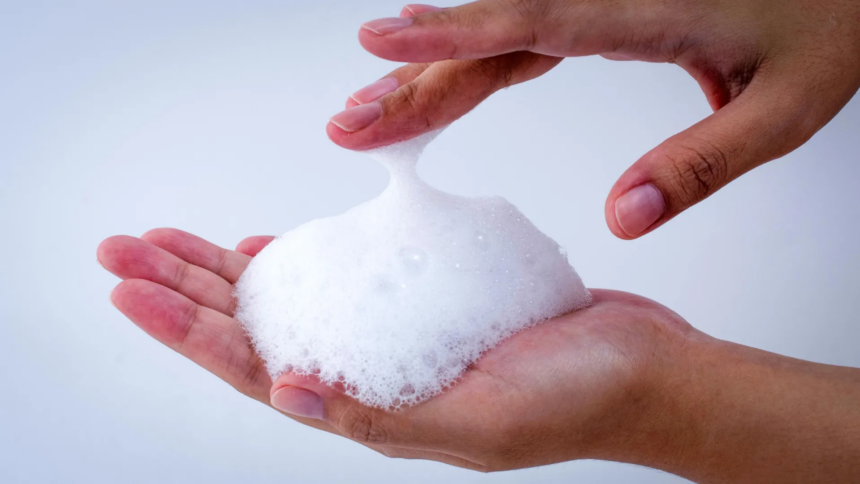
Anyone who has sprayed foam on a surface has likely noticed droplets forming and dripping from the bottom. This happens because foam is made up of tightly packed bubbles separated by thin liquid films, creating a complex network of pathways. Liquid can move through these pathways, either draining out or being absorbed into the foam when it comes into contact with it. Scientists have long believed that this process is controlled by the "absorptive limit," which depends on "osmotic pressure," a measure of the energy change when bubbles are compressed and the contact area between liquid and gas shifts.
Why Old Models Did Not Match Reality
However, this explanation has not matched what researchers observe in real life. Calculations based on osmotic pressure suggest that foam would need to be about a meter tall before liquid begins to drain. In practice, even foams just a few tens of centimeters high can leak easily. This gap between theory and reality has puzzled scientists for years. Since foams are widely used in products ranging from cleaning solutions to pharmaceuticals, understanding how they behave is essential for improving their performance, such as creating foams that resist drainage.
Experiments Reveal a Universal Pattern
The research team, led by Professor Rei Kurita, studied simple foam systems created using different surfactants to produce a range of foam types. They placed these foams between transparent plates and positioned them upright, allowing them to directly observe how liquid moved inside. Their experiments revealed a consistent pattern: the height at which drainage begins is inversely related to the liquid content of the foam, regardless of the type of surfactant or the size of the bubbles. They also calculated an "effective osmotic pressure" for this process, which turned out to be much lower than predictions based on bubble size and surface tension alone.
Bubble Movement Drives Foam Leakage
To better understand what was happening, the researchers recorded video inside the foam. At the point where drainage begins, they saw that liquid was not just flowing through static channels. Instead, it was causing the bubbles themselves to shift and rearrange. This led them to identify "yield stress" as the controlling factor, which is the amount of pressure required to move and reorganize the bubbles. Their model, based on this idea, accurately predicts the foam heights at which drainage occurs.
A New Way to Understand Soft Materials
These findings change the way scientists think about foam drainage. Rather than viewing foam as a fixed structure with liquid flowing through it, it should be seen as a dynamic system where the structure itself can change. The researchers hope this new perspective will lead to deeper insights into soft materials and help guide the design of improved foam-based products.
This work was supported by JSPS KAKENHI Grant Number 20H01874.
Story Source:
Materials provided by Tokyo Metropolitan University. Note: Content may be edited for style and length.
Journal Reference:
Cite This Page:
Revolutionary Submarine Mysteriously Disappears Without a Trace – Scientists Are Now Preparing for a Bold Return
Scientists Discover a Better Way To Reduce Dangerous Belly Fat in Older Women
New Study Reveals Surprising Effect of Drinking Coffee at Night
The Surprising Reason Balance Gets Worse With Age and Parkinson’s
Stay informed with ScienceDaily’s free email newsletter, updated daily and weekly. Or view our many newsfeeds in your RSS reader:
Keep up to date with the latest news from ScienceDaily via social networks:
Tell us what you think of ScienceDaily — we welcome both positive and negative comments. Have any problems using the site? Questions?
A surprising foam discovery could change everyday products – ScienceDaily



Leave a Comment