Published : Mar 21, 2026 09:43 IST – 24 MINS READ
COMMents
SHARE
READ LATER
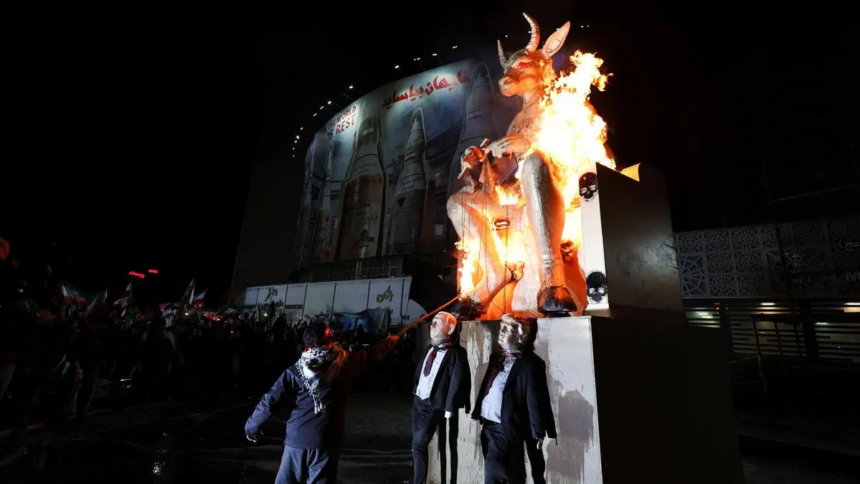
A man sets fire to figures depicting US President Donald Trump and Israeli Prime Minister Benjamin Netanyahu during a rally against the US and Israel, in Tehran, on March 17, 2026. | Photo Credit: ALAA AL-MARJANI/REUTERS
On February 28, a day after President Donald Trump declared himself dissatisfied with the outcome of the discussions with Iran on the nuclear issue, Israel unleashed its weaponry on targets in Iran, being closely followed by US aircraft spewing lethal firepower on diverse personalities, infrastructure and institutions. In the first round of Israeli attacks, Iran’s Supreme Leader Ali Khamenei was killed along with some family members and several senior political and military leaders. US aircraft also hit a girls’ primary school and killed about 180 students aged between 7 and 12 years.
Iran’s response was immediate: it showered drones and missiles on Israel, US military establishments in the Gulf region, and airports and some iconic structures in different countries of the Gulf Cooperation Council (GCC).
In the two weeks since the conflict began, a pattern of military exchanges is in place. Israeli and US aircraft have free run of Iran as there is no Iranian air force or air defences to oppose them. Several thousand targets have been hit, with Israel announcing that several hundred targets remain. Its latest victims have been Ali Larijani, the Secretary of the National Security Council Secretariat, and a militia commander, Gholamreza Soleimani.
Surprisingly, Iran has also continued its robust counterattacks on Israeli, US and GCC targets, though no details have been provided about the extent of damage inflicted. The official Israeli and US position is that most Iranian attacks have been neutralised by air defences.
The GCC states find themselves particularly vulnerable. Almost all of them have American bases with military personnel, weaponry and support facilities, but have directed their US guests not to target Iran from their territories. But this does not seem to have deterred Iran. Numerous missiles and drones continue to disrupt normal activity, particularly travel, as airspaces and airports are closed for long periods. Israel, on its part, has expanded the war to Lebanon with air attacks and ground troops, declaring its intention to annihilate Hezbollah as a military threat. Several hundred Lebanese citizens have been killed and many cities have sustained severe damage.
Also Read | Whose holy war?
Iran signalled that its normal constitutional processes were in place when, on March 8, it was announced that Mojtaba Khamenei, the son of Ayatollah Khamenei, had been elected unanimously as the next Supreme Leader by the Assembly of Experts. Trump responded that he was disappointed with this selection and that he needed to be part of the selection process. He threatened that the new leader “cannot live in peace”.
On March 12, Mojtaba addressed his people through a recorded message. He warned that Iran would avenge its martyrs, would continue to attack US bases, and close the Hormuz Strait. US and Israeli sources say that Mojtaba was badly wounded after the first attacks that killed his father and is possibly non-functional.
From March 13, the US began attacks on military facilities on Kharg Island, Iran’s principal oil export terminal. However, even four days later the US had not hit the oil facilities to avoid further disruption in the oil markets.
The focus of the conflict has now shifted to the Strait of Hormuz. This was closed by Iran soon after the Israeli-US attacks. This blocked all movement of oil tankers from the Gulf waters, so that by March 8 oil prices had crossed $100/ barrel and even reached $126 for a while. To enforce the closure, Iran’s Islamic Revolutionary Guard Corps (IRGC) have also attacked oil tankers and other merchant shipping. On March 4, the IRGC announced that Chinese ships would be allowed to cross Hormuz and later said that only American, Israeli and Western vessels would be blocked from using the strait.
This situation is obviously unacceptable to the US. Trump said on March 3 that US warships would escort merchant shipping through the strait, but this has not yet been implemented. Trump has called on NATO members to send their war ships to break the blockade, but so far no NATO member has responded positively. Trump has threatened dire consequences for his partners for this dereliction. He has also said that US troops could occupy Kharg to force the opening of the Hormuz.
On March 20, in a move to ease oil prices, the US Treasury Department has lifted sanctions on 140 million barrels of Iranian crude already loaded onto vessels and bound for China. This relaxation of sanctions will also boost Iran’s revenues for its war effort. To add to the confusion, Trump has indicated he could ease the intensity of the conflict with Iran, given that the US has achieved its war aims. He also seems to have backed away from opening the Hormuz through military effort by saying that responsibility for safeguarding the Strait of Hormuz should lie with nations dependent on the route, adding that the United States is not one of them.
Separately, there have been reports that the Central Intelligence Agency (CIA) and Israeli agents are encouraging Iranian Kurds located in Iraqi Kurdistan to unite and lead an insurrection against the Iranian government. In early March, it was reported that US officials had formed a new coalition of Iraq-based Iranian Kurdish groups. However, the Iranian Kurds have been reluctant to initiate any insurrection; many have expressed loyalty to their mother country. Recent reports suggest that Trump may have abandoned this project, though Israel could still pursue it to promote instability in Iran.
Cargo ships in the Gulf, near the Strait of Hormuz, as seen from northern Ras al-Khaimah, near the border with Oman’s Musandam governance, amid the US-Israeli conflict with Iran, in United Arab Emirates on March 11. | Photo Credit: REUTERS
All through January, Trump had threatened to attack Iran and effect regime-change. This was in response to the tough actions taken by the Iranian security forces to crush widespread protests across the country. Once the demonstrations faded away under state pressure, Trump began to focus on Iran accepting an agreement to give up nuclear weapons “forever”. He authorised his confidants Steve Witkoff and Jared Kushner, his son-in-law, to conduct negotiations with the Iranian foreign minister, Abbas Araghchi.
Three rounds of talks took place—one in Muscat and two in Geneva—in the background of a continuous chorus from Trump threatening war if his wishes were not fully met. To back his remarks, Trump also directed the mobilisation of a significant American military force in the Gulf waters.
The last round of talks took place in Geneva on February 25 and 26. Trump quickly declared that he was not happy with what Iran had offered and gave the green signal for war.
A detailed report in New York Times on March 2 by Mark Mazzetti and others has confirmed what several observers have suspected—that Israeli Prime Minister Benjamin Netanyahu played a central role in ensuring that the US joined Israel in the war on Iran. His most important intervention took place on February 11 when he met Trump in the White House and persuaded him about the futility of obtaining an acceptable deal on the nuclear issue. He also persuaded the President that regime-change would be a desirable war aim. As the New YorkTimes report says: “The US decision to strike Iran was a victory for Mr Netanyahu, who had been pushing Mr Trump for months on the need to hit what he argued was a weakened regime.”
As Netanyahu pushed for war, he was conscious of the narrow time frame available to him to initiate the offensive. The most important consideration for him was that he finally had in the White House “a President stupid enough to attack Iran”, as Senator Chris Van Hollen has said. The problem for Netanyahu was that the mid-term elections in the US in November could yield a change in Congress that would deprive the President of the freedom he asserts to take his country to war without Congressional approval.
Also Read | The rules they broke
At the same time, Netanyahu was concerned about the rising tide of opinion in the US that was hostile to Israel, largely due to Israeli atrocities during the Gaza war, a shift that was apparent among Republicans as well. Netanyahu was also worried about the decline in his own political fortunes at home, with large sections of Israelis blaming him for the major casualties inflicted on them by Hamas during the October 7 attacks. He calculated that a decisive war on Iran would rehabilitate him in the national elections in November this year and extend his political standing for another term.
As a footnote to the Israeli manoeuvres in the US capital, it is useful to recall that the negotiations in Geneva on the nuclear question were remarkably successful and, but for Netanyahu’s commitment to the war option, could have prepared the basis for a settlement of the nuclear issue and opened the doors to discussions on other matters of concern to the US and the region.
On February 27, Omani Foreign Minister Badr Al-Busaidi told CBS in an interview: “… I can see that the [nuclear] peace deal is within our reach. … if we allow diplomacy the space it needs to get there.” The Omani minister said that Iran had agreed that it “will never, ever, have any nuclear material that will create a bomb”, that is, it would accept “zero stockpiling”. The minister said that technicalities would be discussed in Vienna from March 2, and within a week of that there would be another round of discussions among the negotiators. Al-Busaidi described this as “very historic opportunity to really crack this issue diplomatically”. The Trump-Netanyahu decision to go to war ended the diplomatic option.
When the US-Iran talks on the nuclear issue are reopened, the agreements in Geneva at the end of February will be the basis to take the discussions forward.
Soon after the attacks on Iran began, called “Operation Epic Fury” by the US and “Operation Roaring Lion” by Israel, it became obvious that Trump had not fully comprehended the dimensions of the conflict, the Iranian capacity to retaliate and widen the war, and the implications this would have on the interests of the US and its allies in the Gulf. On February 28, the editorial board of New York Times criticised Trump’s war as “reckless” and with “ill-defined” goals. It added that the President had failed to muster international and domestic support and had disregarded both domestic and international law.
A New York Times report of March 18 says that Trump and his advisers “misjudged how Iran would respond to a conflict that the government in Tehran sees as an existential threat”. Specifically, they failed to plan for Iranian control over the Strait of Hormuz and for attacks on regional oil facilities. This has had dire consequences.
As a World Economic Forum report points out, over 20 million barrels per day pass through the Hormuz as also 20 per cent of global LNG. Oil prices going over the $100-mark will have a “cascading economic fallout” that will reverberate well beyond the Gulf. It will initially impact on energy, shipping and aviation; next, it will affect inflation, manufacture and food security, and, finally, it will influence supply chains, investment decisions, and even political stability in some instances.
The near-total absence of reflection and preparation is patently obvious from Trump’s confusing and even contradictory explanations for the war. On day one of the war, Katie Stallard wrote in New Statesman that Trump said he had wanted to hear the “secret words” from Iran: “We will never have nuclear weapons.” Stallard notes that Ali Khamenei had said this numerous times and it was reflected in the preamble of the JCPOA of 2015. As noted above, this position was also reiterated by Iran in the latest talks in Geneva.
Under the heading “Operation Epic Confusion”, John Haltiwanger and Rishi Iyengar have written in Foreign Policy that Trump’s goals in Iran “are expansive, shifting, and potentially impossible”. Trump has often mentioned regime change as his principal war aim and has called for a popular uprising in the country after the regime has been sufficiently weakened by US-Israeli attacks.
Though Trump and Netanyahu have enthusiastically advocated it, hardly any observer views regime change as a viable war aim. The Israeli commentator Yossi Alpher has pointed out that Iran’s Islamist regime “is layered with redundancy; it is built around institutions that guarantee an orderly transfer of power and orderly functioning in an emergency”. In a detailed review of leadership and succession in Iran, Ali Hashem has described “the deliberate network of overlapping bodies” in the Iranian political order that is designed to provide “resilience” to the system while ensuring that the order does not depend on just one person to survive.
At the start of the war, Trump had expected a quick collapse of the regime, declaration of victory by him, and a victory lap with the new pliable bunch ruling Iran that would include the latter conceding the principal points on the Trumpian agenda. After two weeks, the conflict appears to have reached a stalemate.
What Trump now needs to decide is whether to declare victory based on what he has already achieved—the killing of the Supreme Leader and several senior officials, the widespread destruction of Iran’s capacity for war, the damage inflicted at Kharg Island—and restart negotiations with Iran. Or, alternatively, to continue the conflict with even greater use of US and Israeli firepower, including lethal attacks on Iran’s energy facilities and even civilian targets.
Continuation of war would mean aggravating the global energy security scenario and inflicting greater damage on the global economy. It could also bring the Houthis into the conflict, which would almost immediately lead to the closure of the Bab al-Mandab and further global economic disruption. The Houthis, as Joaquin Matamis recently noted in a Stimson report, are equipped with missile launchers, radars, and long-range capabilities along the Red Sea coast and at the Saudi border.
Israeli left-wing activists attend a silent vigil with pictures of child victims killed in the latest war in Israel, Iran, Lebanon and the occupied West Bank, during an anti-war protest in Tel Aviv on March 19. | Photo Credit: ILIA YEFIMOVICH/AFP
Most voices are advocating a quick end to the war. Israeli commentator Yossi Alpher has said that “it is a virtual certainty that Trump will ultimately agree to end the war with a nuclear deal that leaves out Iran’s missiles and proxies like Hezbollah and the Houthis”.
While noting the spectacular success of Israeli and US attacks on Iran in the early stages, Robert Pape has pointed out in Foreign Affairs that these allies were ill-prepared for Iran’s retaliatory strategy of “horizontal escalation”, described by him as transforming the stakes in a conflict by widening its scope and extending its duration, the strategy having earlier demonstrated its effectiveness in Vietnam and Serbia against superior US air power.
Iran has already displayed its own staying power against its formidable foes. By attacking targets in the Gulf, it has both widened and politicised the conflict and given it a global dimension, to the US’ disadvantage. What Iran has gained is to compel the Gulf states to review their long-standing security ties with the US, while forcing a questioning of the long-term value of ties that some states have set up with Israel.
The war so far has demonstrated some features that are like US-led conflicts in West Asia over the last few decades, such as the first Gulf War and wars in Afghanistan and Iraq. As in the case of the ongoing Iran war, the US had entered the earlier war theatres without clear war aims, timeline for the conflict, the resources required for the conflict, the endgame and exit plan. Israel was a major behind-the-scenes influence in the wars. After the first Gulf war, Israel ensured that US sanctions embraced both Iraq and Iran under the dual-containment regime. It had then urged the assault on Iraq in 2003, even when the latter posed no threat to US interests. This was in line with Israel’s agenda of using US power to destroy its potential enemies in the region.
The war on Iran is part of this long-standing agenda, which Israel has persuaded the US is in its interest as well. But the Iran war also has some unique features. Now, the US and Israeli militaries are partners in a joint enterprise—coordinating on strategy and tactics and sharing targets, as also agreeing on a political agenda on nuclear and missile destruction and even regime change.
What needs to be emphasised is that most conflicts in West Asia have a single root cause: the refusal by Israel to address the aspirations of the Palestinian people. Israel has so far had its way despite the fact that large sections of the international community support the two-state solution. This proposal is warranted by the simple demographic fact that the Israeli and Palestinian populations in Israel and the Occupied Territories is roughly the same – about 6.5 to 7 million each.
Though largely isolated internationally, Israel has obtained support for its obdurate position from large sections of the US political establishment, so much so that ties with Israel are an integral part of US domestic politics. Fearing being stigmatised as “antisemitic”, no American public figure can question his country’s unstinting backing for Israel’s maximalist agenda, which includes subjecting Palestinians to onerous legal, economic, and social disadvantages, regular incarceration and abuse, and periodic acts of harsh violence.
The Iran war could emerge as the first major threat to US-Israel ties. Most Americans oppose the war against Iran and see it as Israel’s war. This divide has now become apparent even within Trump’s political base. As Robert Pape has said, many of Trump’s followers see US entanglements in West Asian conflicts as US leaders “simply following Israel’s lead”.
US polls reveal that questions are being raised about “the very value of the US-Israel relationship”, as Dana Stroul has written in Foreign Affairs. This steady disenchantment with Israel had become particularly palpable during the Gaza war: in late February, for the first time in 25 years, the Gallup World Affairs Survey found that a larger proportion of Americans said their sympathies were “more with Palestinians” than with the Israelis.
In the same month, a CNN poll found that 60 per cent Americans disapproved of the Iran war and insisted that Trump seek Congressional approval for continued military collaboration with Israel. Another poll had found in August 2025 that 60 per cent Americans, including half Republicans, opposed military assistance to Israel. Increasing expressions of anti-Semitism among the far right in the US, including some at the centre of Republican politics, should also ring alarm bells in Israel.
The Iran war has brutally exposed the vulnerability of the GCC as the Gulf states have borne the brunt of Iranian counterattacks. This has ended once and for all the general sense of security that has been pervasive across the region over several decades: despite numerous inter-state conflicts in West Asia, no GCC state was hardly ever extensively targeted by the principal belligerents during the Iran-Iraq war, the first Gulf war, or the US attacks on Afghanistan (2001) and Iraq (2003). Now, as Iran has hit diverse targets in the GCC states—US military facilities, energy facilities, and iconic infrastructure—the states have expressed solidarity with each other and reserved the right to hit back.
Every GCC state accommodates American military bases, but their purpose has never been clear—in Trump’s first term, Iranian and Houthi missiles had hit GCC shipping and even some oil facilities, but there had been no US response to defend its partners. As doubts about the US as a credible regional security guarantor increased in the late 2010s, the GCC states sought to improve ties with Iran and its allies. The Saudi-Houthi ceasefire of 2022 and the Saudi-Iran rapprochement of March 2023 were the most important expressions of this approach.
In the context of the present war on Iran, several GCC commentators have castigated Iran for the attacks. However, it is interesting that, while there is a sense that the war will have significant geopolitical implications, there is hardly any suggestion from commentators that the GCC states should seek deeper ties with the US or expand normalisation of relations with Israel. The GCC scholar Hussein Ibish has pointed out that, since the start of the Gaza war, the GCC states see Israel “as being a major source of insecurity and instability in the Middle East, at least on par with Iran”. The factors they take into account are the genocide in Gaza; the expanding annexation of the West Bank; periodic attacks on Lebanon and Syria, and visceral hostility towards Iran, and its attack on Doha last year, all of which have affirmed Israel’s status as the regional military hegemon and exposed the region to long-term insecurity and instability. .
Commentators have noted that, despite their uneasiness regarding Iranian attacks and fears that, if the conflict gets prolonged, the attacks could become more lethal, the GCC states have not expelled the resident Iranian ambassadors and closed their embassies nor joined the US in attacks on Iran. There can be little doubt that with the regular killings of senior Iranian officials, Israel hopes to provoke harsh Iranian retaliations on GCC targets that will compel the Gulf states to join the US and Israel in attacks on Iran and permanently alienate them from Iran.
However, what is still missing from the GCC security discourse are specific proposals to enhance their own and regional security capabilities. For instance, it is surprising that none of the GCC writers has spoken of the states giving up their crucial dependence on the US and other security umbrellas and, instead, unitedly building their own defence and security capacity and shape formidable military forces that would be capable of safeguarding their collective security. The GCC states are the world’s principal weapons importers; they should now emerge as a credible fighting force in their own right.
A demonstration against the war in Washington on March 18. | Photo Credit: DAVID RYDER/Bloomberg
Iran’s popular will and its strategic options will be largely shaped by the timing of the ceasefire and the extent of damage to its economic and military infrastructure and potential capabilities. However, the broad consensus among commentators is that, regardless of the damage, the country’s status as an “Islamic Republic” will remain intact. Linked with this, regardless of the average Iranians’ support for or hostility towards the Islamic Republic, the popular will will be made up of three principles: no domestic tyranny; nonviolent transition towards a democratic order, and, above all, no foreign interference.
These principles have been set out by Mir Hossein Mousavi, the father of Iran’s Green Revolution of 2009 when popular demonstrations had swept Iran’s towns to protest against what was seen as vote-rigging in favour of incumbent President Ahmadinejad to prevent Mousavi from becoming President. In the background of the ongoing conflict, despite Trump’s sharp rhetoric exhorting Iranians to rise against their government, there are no takers in Iran for foreign intervention.
Assuming that elements of the present order will remain to lead Iran, the key question remains: what kind of order will it be? Given Iran’s history of making pragmatic choices in difficult circumstances, it would be fair to anticipate that its new rulers will shed many of the hardline and extremist positions that have been so odious to large sections of the Iranian people and, instead, espouse an approach that is benign and moderate, particularly on matters of public deportment.
The regime will face two principal challenges: one, economic reconstruction and development at home, and two, repairing ties with its Gulf neighbours. In fact, the two challenges are linked in that Iran will need substantial resources from its neighbours to support its economic development initiatives at home. Restoring confidence with the Gulf monarchies will need considerable diplomatic skill and genuine assurances to the Sheikhdoms on matters relating to their security and well-being. Perhaps, China and Russia could be useful intermediaries in this regard.
Observers are also suggesting other less benign scenarios—largely emerging from continued Israel-Iran hostility. Daniel Byman points out that both countries could find valid reasons for regular low-level conflict—cyberattacks, sabotage, terror attacks—and even overt military strikes. Iran might find Israel and the US to be its visceral enemies regardless of the assurances it extends to them, while Israel might believe that its interests are best served by keeping its enemies weak and try to achieve this through periodic armed attacks. After the attacks on Iran last year, Netanyahu had hailed the results as a “historic victory” that would “stand for generations” and claimed that two existential threats had been removed: Iran’s nuclear weapons and its ballistic missiles. Eight months later he is back at war and has proclaimed the same achievements as before.
Also Read | The war in West Asia: What it means for India
It is in this background of “zero-sum logic of deterrence” that the commentator Sina Toosi has suggested that, after the war, Iran might reconsider its approach to developing nuclear weapons. Having seen the failure of its policies of “strategic patience”, Iran might opt for a more aggressive regional posture, backed by a nuclear weapons capability. Toosi warns that this would lead to “a far more dangerous era [in West Asia] in which nuclear weapons are viewed as the ultimate form of deterrence and nuclear proliferation can no longer be stopped”.
An Iran that has been significantly weakened in the present conflict has led an American writer, Steven Erlanger, to speculate in the New York Times about the possible emergence of “a new and more moderate government” in Israel following the elections later this year. Without having to face any real threat from Iran, Erlanger says that this government “may feel it has the mandate to build on the ceasefire in Gaza and negotiate seriously with the Palestinians, under pressure from Washington and the Saudis”. Though perhaps overtly optimistic, this is a very rare reference in mainstream US media to Israel seriously discussing their aspirations with the Palestinians.
Amidst the ongoing carnage of death, destruction and displacement, it is at once both sobering and alarming to realise that many of the decisions affecting the war and world affairs in general are being taken by Donald Trump. As Trump has dramatically reminded us, in pursuing the US’ overseas interests, he will not be influenced by conventional considerations of sovereignty or international law; he will be influenced only by: “My own morality. My own mind. It’s the only thing that can stop me.”
How feeble these constraints are is clearly brought out by Trump viewing attacks on foreign targets as a video game. As he recently pointed out, US attacks had obliterated all targets of military value on Iran’s Kharg Island, but he would still order further attacks “just for fun”. US General Stanley McChrystal, who commanded NATO forces in Afghanistan, has said that, seeing Trump’s recent record, he believes “we might be in a period where we [the Americans] think what we can do, we should do because we can”. He was recalling recent US strikes in Nigeria, Venezuela, and Iran, and threats of war against Ecuador, Cuba and Greenland.
People displaced from southern Lebanon eat a meal on the occasion of Eid al-Fitr at a shelter in Sidon, Lebanon, amid the ongoing war started by Israel and the US on Iran. | Photo Credit: AMR ABDALLAH DALSH/REUTERS
Trump is recognised worldwide as a megalomaniac, consumed with hubris. Totally devoid of intellectual depth or gravitas, Trump has hardly ever provided evidence of reflection and weighing of pros and cons before announcing important decisions. Recall how he failed to understand what Iran had agreed to in Geneva and how he has fumbled when setting out his war aims and the endgame when he can declare “Mission Accomplished”.
Also Read | Iran watches Venezuela: Could it be next?
Also Read | The rules they broke
More worryingly, how easily he has been manipulated into two wars by Netanyahu—in June last year and now in February—often against his wishes, even his instincts. He has been easily allured by the promise of military victory by Netanyahu who pandered to Trump’s vanity and desperate desire to strut on the world stage as a later day Augustus Caesar seeking a place in the vanguard of the world’s heroes. He remains, as always, a rather sad and ridiculous cartoon figure—more Don Quixote than Sir Lancelot.
As the US loses its moral purpose and laws, norms, rules and lives are trampled into dust by US military might and Israeli chicanery, observers suggest we could be witnessing the apex of imperial power, a climactic position that heralds the forthcoming decline; Mehran Kamrava says that Donald Trump’s foreign policy and Trumpism “are doing their level best to jumpstart and perhaps to expedite it” as their follies suffuse West Asia in bloodshed and destruction.
Talmiz Ahmad is former ambassador to Oman, the UAE and Saudi Arabia, and is Distinguished Professor for International Studies, Symbiosis International University, Pune.
Also Read | When law fails, conscience convenes: Eyewitness account of International Gaza Tribunal hearings
Also Read | With Iran under attack, Modi’s Jerusalem visit will haunt India
CONTRIBUTE YOUR COMMENTS
SHARE THIS STORY
COMMents
SHARE
BACK TO TOP
Terms & conditions | Institutional Subscriber
Comments have to be in English, and in full sentences. They cannot be abusive or personal. Please abide to our community guidelines for posting your comment
We have migrated to a new commenting platform. If you are already a registered user of The Frontline and logged in, you may continue to engage with our articles. If you do not have an account please register and login to post comments.