




Podcasts
Sections
By region
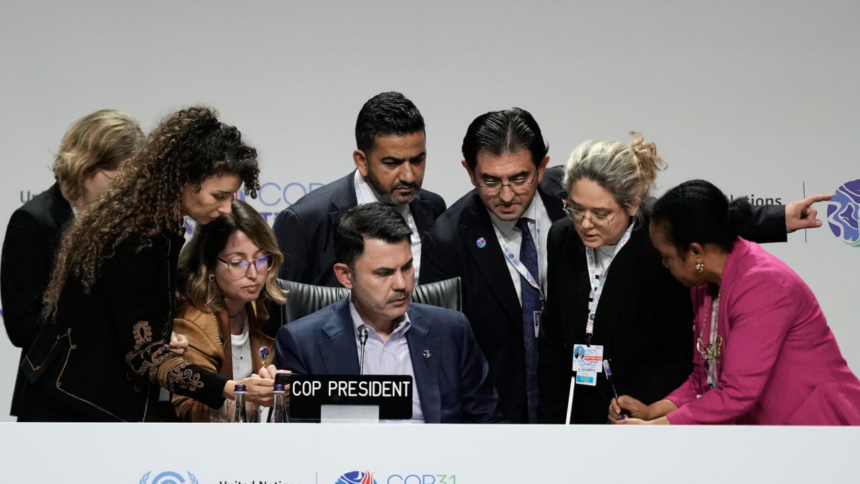
A last-ditch agreement at the Cop31 climate summit in Turkey has drawn criticism for failing to explicitly address fossil fuels, raising fears that two weeks of negotiations could end without meaningful progress on tackling the main cause of global warming.
Issued on: Modified:
Negotiators are scrambling on Sunday to salvage a deal after a new draft released in the early hours omitted any direct commitment to move away from coal, oil and gas.
France’s environment minister described the proposal as “a step backward”, adding to mounting pressure on the Turkish presidency of the summit to strengthen the text before its expected adoption.
The latest draft, presented by Turkish Environment Minister and Cop31 co-president Murat Kurum, was circulated shortly after 3am, with delegations given just three hours to raise objections or propose amendments.
The talks in Antalya were originally scheduled to conclude on Friday but have continued well into Sunday, nearly 40 hours beyond their official deadline.
UN climate talks run into overtime as countries clash over fossil fuel cuts
The central sticking point is the absence of an explicit commitment to phase out fossil fuels, despite an agreement reached at Cop28 in Dubai in 2023 to transition away from them.
Although the new 10-page proposal refers to the Dubai agreement, it makes no direct mention of fossil fuels, oil, coal or their phase-out.
Several countries have objected, with Panama threatening to block any agreement that fails to address oil production, acknowledge shortcomings in global climate targets and strengthen financial support for vulnerable nations.
Panama’s Environment Minister Juan Carlos Navarro accused the fossil fuel industry of holding negotiations hostage.
“It would be a real setback if we come out of here with no signal that we were serious about what we agreed to do three years ago,” said Alden Meyer of climate think tank E3G.
The draft nevertheless contains proposals to accelerate electrification, increasing electricity’s share of global final energy consumption from around 21 percent to 35 percent by 2035.
It also sets a target for capturing, using and storing one billion tonnes of carbon dioxide, although campaigners warn that carbon capture technology risks prolonging dependence on fossil fuels.
Cop31 negotiators unveil draft deal as fossil fuel divisions persist
Another major source of disagreement is financial support for developing countries facing worsening floods, droughts and extreme heat.
Climate-vulnerable nations are demanding clearer commitments from wealthy countries to increase adaptation funding, including a concrete financial baseline against which progress can be measured.
“Floods and heat waves won’t wait,” said Harjeet Singh of the Satat Sampada Climate Foundation. “Rich countries are offering a conversation instead of cash.”
With delegates preparing to leave Antalya, organisers also face concerns that too few negotiators may remain to approve a final agreement.
Any deal requires near-unanimous consensus, leaving the summit’s outcome uncertain as negotiations enter their final stages.
The next UN climate summit, Cop32, is scheduled to take place in Addis Ababa, Ethiopia, in November 2027.
(with newswires)
Daily newsletterReceive essential international news every morning
Keep up to date with international news by downloading the RFI app
Related content
On the same topic
Read more on related topics:
© 2026 Copyright RFI – All rights reserved. RFI is not responsible for the content of external websites. Audience ratings certified by ACPM. ACPM
The content you requested does not exist or is not available anymore.
Cop31 draft deal sparks backlash as France warns of 'step backward' – RFI


Leave a Comment

