




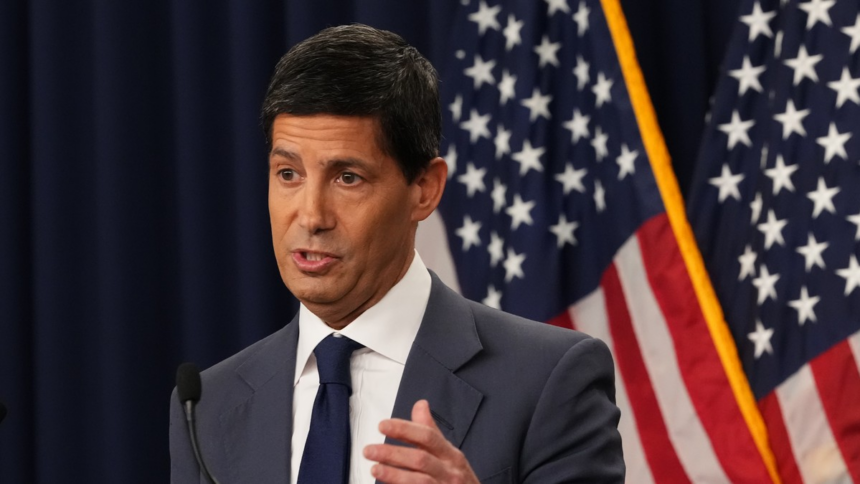
WASHINGTON, D.C. — Artificial intelligence could accelerate innovation and usher in an era of faster economic growth, Federal Reserve Chairman Kevin Warsh said Monday in remarks that also acknowledged risks from the technology.
The adoption of AI could also lead to widespread job loss or a steep drop in the stock market if the healthy returns expected from the huge investments in AI infrastructure don’t materialize, Warsh said. But he did not mention inflation, even though many of his colleagues blame the buildout of data centers for accelerating price increases.
Warsh’s remarks kicked off a one-day conference on AI and productivity at the Fed’s San Francisco branch. The Fed chairman did not comment on what the Fed’s next steps would be on interest rates, nor did he say anything about recent government data showing that inflation accelerated last month. That data led many of Warsh’s colleagues on the Fed’s rate-setting committee to signal their support for additional interest rate hikes, including at the Fed’s next meeting in December.
“What might set SI apart, as an economic influence, is that it could supercharge idea generation,” Warsh said. “It appears to be changing the method — and, at least as important, the speed — of innovation. If idea generation broadens, growth could be sustained at a level substantially higher than the long-run average.”
The Fed refers to AI as “super intelligence” following an executive order issued by President Donald Trump requiring federal agencies to use the term.
Yet Warsh also spent more time in his remarks considering the downsides of AI than he has in previous speeches. The chairman has previously touted AI as a technology that could significantly boost the economy’s efficiency, which would enable it to grow without worsening inflation. In turn, the Fed could potentially lower interest rates under that scenario.
“As policymakers, we have to be mindful that great opportunities rarely come risk-free,” Warsh said. “And the risks in this case, if overlooked, can be highly disruptive and economically costly.”
For example, “after significant capital investment and stock market gains, expected returns could turn down and equity valuations could fall, leading to an economic slowdown and a more notable rise in unemployment,” he said.
Fed staff has begun evaluating different scenarios for how AI’s impact may play out, Warsh added.
The conference Monday was part of a task force Warsh set up to evaluate AI and its impact on the economy’s efficiency. Warsh appointed five different task forces soon after taking the helm at the Fed.
Warsh on Monday did not address AI’s impact on inflation, a top concern of many of his Fed colleagues. Last week, several policymakers expressed concern that AI is fanning inflation because the buildout of AI infrastructure has sharply raised demand for computer chips, electronic components, electricity and copper.
Those increases, in turn, have lifted the cost of smartphones, computers and other consumer electronics. Smartphone prices rose last month at the fastest pace on record, the government said last week.
In addition, Fed Vice Chair Philip Jefferson said last Friday that if AI does accelerate economic growth, it could lead to higher interest rates over time, even if inflation declines.
“If the new technology leads to permanently higher levels of productivity growth, it may increase firms’ desire to invest and, hence, their demand for funding, raising the level of interest rates,” Jefferson said.
MOORE: Donald Trump is making Harvard and Yale rich
© 2026 North State Media LLC – Elevate The Conversation
Warsh grapples with AI’s potential economic impact, steers clear of inflation risk – The North State Journal


Leave a Comment

