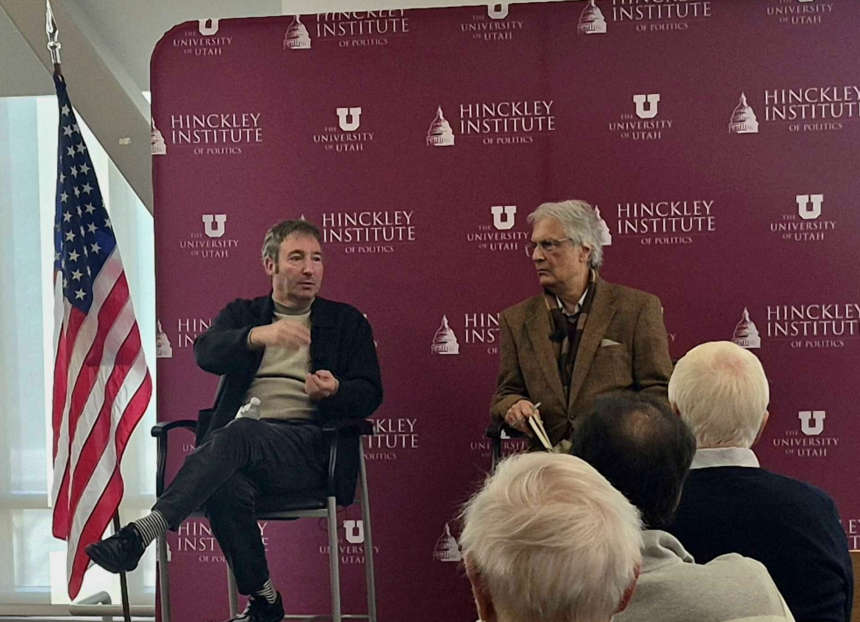
On Nov. 12, Mathias Risse visited the Hinckley Institute of Politics to present on human rights and international policy within America. Risse — a professor of Human Rights, Global Affairs and Philosophy at Harvard University — outlined the way international relations and America’s stance on human rights have changed across presidencies.
Risse emphasized the important role international politics plays in a student’s life. “Although Utah is in the middle of the country, it’s the country itself that generates much of the welfare that people studying at Utah universities will have in their adult lives, and that all depends on international affairs,” Risse said in an interview with The Daily Utah Chronicle. “So, even though in Utah it may not feel this way, international affairs are at everybody’s throat.”
In the early 1940s, President Franklin Delano Roosevelt suggested the idea of the United Nations (UN) in the Declaration of the United Nations. The idea became officially realized in 1945. Risse overall considers this a period of prosperity for both human rights and international affairs.
In the late 1940s, tension within the U.S. increased with the Civil Rights Movement. African American writer W.E.B. Du Bois’s “Appeal to the World” pushed this issue from internal to international. Because of this, Risse stated that the Southern Democrats and President Dwight D. Eisenhower’s Republicans began pushing back against foreign involvement in American politics. “A lot of people in the United States are getting cold feet [at this time] when it comes to international organizations,” Risse said during the lecture.
Risse said the collapse of the Soviet Union pushed the United States to rejoin the world stage. As its power grew, the U.S. established itself as a global hegemon. Risse said the question is “what kind of global hegemon should the U.S. be?”
He said that the answer depended on the president. Risse said that Reagan and Bush worked to define the U.S. as a “human-rights-abiding hegemon.”
However, this changed in the early 2000s. Risse called this a time of “American Exceptionalism,” wherein the U.S. “creates these institutions and then exempts itself,” he said.
Following the events of Sep. 11, 2001, and the subsequent U.S. invasion of Iran and Afghanistan, Risse said international tensions rose. He called the U.S. invasion an “overreaction.” He said this is where the U.S. began losing international credibility.
Risse called the period from 2009 to 2024 one of “oscillation.” He said policies changed drastically from one president to another as their differing views on American foreign policy clashed with each other. “For Trump, the golden rule is that whatever Obama or Biden did, he is doing the opposite,” Risse said.
Risse called the present day a time of “repudiation.” He said the U.S. has a complex relationship with human rights. “The most dramatic thing that happened as far as the relationship between the United States and the United Nations where human rights are concerned is Trump’s pronouncement on Iran,” Risse said.
He went on to explain that the U.S. is again withdrawing from international affairs. “Just last week, the United States refused to undergo a mechanism of the UN known as Universal Periodic Review,” said Risse.
Rayshon Baker, a student majoring in political science with an emphasis in law and politics, said his main takeaway from Risse’s lecture was that American policy has and can continue to change over time. “The American stance on human rights isn’t permanent,” Baker said.
Risse said that the future of American politics is dependent upon the representatives that have been and will be elected in the coming years. “The midterms that we just had, I think, can be interpreted as a resounding signal that large parts of the American population do not want the package that Trump is giving them right now,” said Risse. He explained that he hopes for a future in which America embraces human rights and international relations.
Risse advised students in an interview with The Chronicle to educate themselves on international affairs. “Care about world politics. Keep yourself informed. Understand how much world politics affect what you can be and who you can be,” said Risse.
He closed with one final piece of advice for students. “Engage yourself as a citizen because if you are not doing it, other people will.”
[email protected]
@e_uquintana
Your email address will not be published.