




The European External Action Service (EEAS) is the European Union’s diplomatic service. Since 2011, the EEAS carries out the EU’s Common Foreign and Security Policy to promote peace, prosperity, security, and the interests of Europeans across the globe.
The EU High Representative for Foreign Affairs shapes the standing of the European Union on the global stage.
All over the world, the European External Action Service, in coordination with the European Union institutions, addresses EU foreign policy priorities, including civilian and military planning and crisis response.
The European Union has Special Representatives in different countries and regions of the world.
Contact the European External Action Service, ask general questions on the European Union or get information on visiting the EEAS.
The EU maintains diplomatic relations with nearly all countries in the world and undertakes a range of actions with strategic partners, key international players, and emerging and developing powers.
The Diplomatic Representations play a vital role in representing the EU and its citizens around the globe and building networks and partnerships.
Since the first CSDP missions and operations were launched back in 2003, the EU has undertaken over 37 overseas operations, using civilian and military missions and operations in several countries in Europe, Africa and Asia. As of today, there are 20 ongoing EU CSDP missions and operations, including 11 civilian, eight military and one civilian and military initiative.
Election observation missions (EOMs) provide a comprehensive, independent and impartial assessment of an electoral process according to international standards for democratic elections. The EU is a worldwide recognised credible actor in international election observation. Since 2000, the EU has deployed over 160 EOMs in more than 60 countries.
Since 2006, the EU High Representative has led diplomatic efforts between the E3/EU+3 (China, France, Germany, Russia, the United Kingdom and the United States) and Iran, which led to the conclusion of the Joint Comprehensive Plan of Action on Iran’s nuclear program (JCPOA) in Vienna on 14 July 2015. The JCPOA is designed to ensure that Iran’s nuclear programme will be exclusively peaceful and provides for the comprehensive lifting of UN, EU and US nuclear-related sanctions.
All over the world, the EU works to prevent and resolve conflicts, to support resilient democracies, to promote human rights and sustainable development, to fight climate change, and to contribute to a rules-based global order.
In an increasingly interconnected world, Europe’s security starts abroad. European citizens expect and deserve to live in a safe and stable environment. In the face of increased global instability, the EU needs to take more responsibility for its own security and increase its capacity to act autonomously.
Crises can affect EU citizens, staff and interests outside of the EU. To protect them, the EU is strengthening its response to security and consular crises. The EEAS Crisis Response Centre contributes to this work.
In a shifting geopolitical landscape, the EU has remained a strong defender of human rights. New geopolitical rivalries only serve to underline its role as a reliable and stable partner, and a champion of the rules-based international order.
Equality and non-discrimination are guiding principles of the European Union’s action on the international scene, as enshrined in the EU Treaties. Promoting gender equality, diversity and inclusion is a matter of human rights, but also of peace and security, social justice, and economic progress.
The EEAS works in close collaboration with the European Commission and the EU Member States, and with the support of the EU Delegations, pursues climate, energy and environmental policy priorities through outreach and dialogue with partner countries, multilateralism and global action. This is known as EU Green Diplomacy.
In today’s world marked by major geopolitical and economic power shifts, multilateralism is still the most effective means to govern global relations in a way that benefits all. The EU stands committed to a renewed multilateralism fit for the 21st century.
Migration is a global phenomenon presenting a unique set of challenges while offering substantial benefits to countries of origin and destination as well as migrants. The EU works to ensure that migration takes place in a safe, regular and sustainable manner.
The EU prioritises development and stability in the wider region and neighbourhood, working in close partnership with its neighbours to the East and South and supporting the reforms required by countries that want to become EU members.
The European Union together with its Member States is the world’s leading humanitarian donor. New challenges, same principles, humanitarian aid is a key pillar of the EU’s external action and an important part of its ability to project its values globally.
The European Union, more than ever, needs to work closely with partners to face the global challenges and build together a safer, greener, more prosperous and equal world.
Building bridges between the European Union and the rest of the world
Cultural diversity is one of the emblems of the EU and its Member States and a tool to strengthen cultural relations beyond our borders, to connect people worldwide, to share values, to improve international relations and to learn from each other’s practice.
The Global Gateway is a new European strategy to boost smart, clean and secure links in digital, energy and transport sectors and to strengthen health, education and research systems across the world.
Digital technologies have brought new opportunities into the lives of people around the world. They have also become key competitive parameters that can shift the balance of power. The goal of EU Digital Diplomacy is to secure the EU global role in the digital world, to protect its strategic interests and to promote its dynamic, human-centric regulatory framework for an inclusive digital transformation.
In its trade relations, the EU promotes a sustainable growth model as defined by the European Green Deal and the European Digital Strategy, which can help the recovery from the COVID-19 economic crisis.
Restrictive measures, or sanctions, are one of the EU’s tools to promote the objectives of the Common Foreign and Security Policy (CFSP).
Since 2015, the EU has significantly improved its capacity to tackle Foreign Information Manipulation and Interference (FIMI), protecting the EU’s democratic processes, security and citizens.
International days are key moments on the global calendar dedicated to celebrating, raising awareness and taking action on pressing issues that affect us all. From honouring human rights to championing environmental sustainability, these days unite organisations, communities, and individuals worldwide for change – one celebration, one cause, one action at a time.
For media inquiries, please contact the EEAS press team
Subscribe to our Press Alerts & Newsletters
Read recent EEAS stories from around the world.
Campaign pages are created around specific topic and actions.
Job opportunities, grants and tenders at the EEAS, EU Delegations and Missions and Operations.
Looking for an exciting job in the field of external relations, foreign affairs and security? Find our vacancies
Interested in one of the tenders? See how to apply for an EEAS call for tenders.
Grants can be awarded as donations to third parties that are engaged in external aid activities. Grants are managed by EuropeAid (DEVCO) or DG Near, the EEAS does not manage any grant.
The EU supports projects worldwide covering a range of sectors.
Every day, events are organised worldwide by the European Union Delegations and its partners.
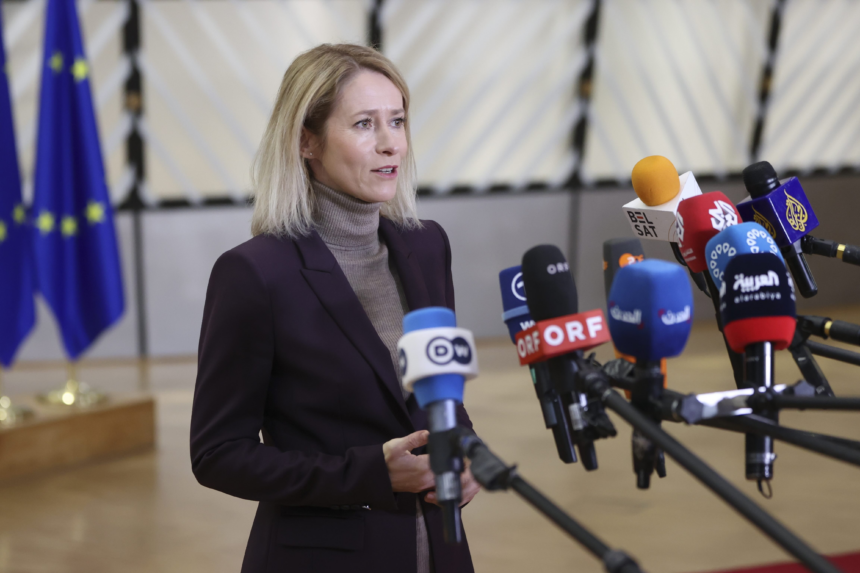
Check against delivery!
Good morning,
We have a long day ahead. So first, Foreign Affairs Council.
This time we start with Syria and the Middle East. We hope to elevate our relationship with Syria to the level that we have with other Mediterranean partners, and then we of course discuss Ukraine and what is happening at the moment.
[On] Friday the leaders decided on the format, but we need to work on the substance, like we have done before until this moment.
Then we have also Central Asia, Black Sea, South Caucasus Ministerial. I think this is very timely, considering again the attacks that we have right now on the Black Sea, happening just last weekend. We [will] talk about the security of the Black Sea, but we [will] also talk about connectivity. What more can we do together? Because everybody is looking to diversify their energy portfolios, their trade routes, supply chains. So I am really happy to welcome so many ministers here.
And then afterwards, we also have a Ukrainian Demining Conference. This is very important because it is not only regarding Ukraine, but it is also the experience and knowledge that can be shared regarding the demining that is done elsewhere in the world as well. So, these are really important topics.
In the discussions that we will have today and talks, I think it is important when we talk about Ukraine. In 2021 there was a clear pretext for war that the Russians were giving a list of their demands, and now they are presenting the same demands and adding to it. This is also a clear pretext for keeping the war going. So, we have to be clear-eyed about this. We will discuss with the Foreign Ministers the substance, like we have proposed the maximum demands to actually also reply to the maximum demands that Russia is still presenting. There is a lot work ahead, and of course you will see me next days a lot.
Q&A
Q. On the security architecture with Russia, does it bring more risk or more chances?
We have a security architecture in place and Russia has agreed to it in many agreements, if you think about the Helsinki Final Act, if you think about Budapest Memorandum – the list is long. The problem is that Russia is not keeping to this agreement. That is why we need to see clear concessions from the Russian side that they would keep to this. But again, let us not blur the picture right now. What we need to see is [a] ceasefire. [A] ceasefire to actually start the talks about anything else. We do not see it at the moment. We see that Russia is really escalating, attacking infrastructure when it comes to trains, when it comes to bridges, when it comes to the energy infrastructure to cause as much suffering for the civilians so that Ukrainians would surrender before this hard winter.
Q. [Inaudible]
Well, yes. What we have heard is that the Americans say that that Europeans will be included in the next round of talks, and that is why the format was agreed. But I think the most important right now is to keep on talking about the substance and again, insisting on the ceasefire and insisting on the future talks about really keeping peace so that Russia cannot attack again.
Q. [Inaudible]
I am not aware of this plan. Sorry, maybe I missed this. At the moment, what we have with the Foreign Ministers is the list of maximum demands that we have proposed to equal the maximum demands. But I really want you to look at how the Russians are playing it. They are saying that we are waiting; the Europeans have not offered us anything. This is exactly the playbook that they always do. Suddenly, it is up to us to offer them something. Although, they started the war. They are the aggressor, and there is one victim. We need to seek concessions from their side, so that we would have a just and lasting peace in Ukraine and also in Europe.
Q. You are not part of the negotiation team that has been decided last week. What do you say about this?
Well, the leaders decided so it is their decision. But, like I said, I have the Foreign Ministers every single month. I have the experts in the External Action Service that know the previous negotiations that are experts also on Russia. So, I can continue working on the substance to keep the focus also on the substance.
Q. When you talk about high demand, do you still mean, for example, withdrawal of Russian troops from occupied territories like Georgia and Moldova? And the second question on the connectivity meeting. As we know, Georgian Dream refused to take part because level is lower. How do you estimate? They always tell people that connectivity is the key priority for them.
Well, in our maximum demands, yes, we have also the troop withdrawal from all the countries that currently Russia is holding their troops in, because again we have the UN Charter and we should stick to it. So, yes, this is there. When it comes to your other question, we have a lot to discuss with all these Black Sea, South Caucasus and Central Asia partners. Sometimes some are missing, but we have a lot of ministers coming. So, I hope also that we can push for real deliverables in the future.
Q. Can you talk about the Russian demands in these peace negotiations, and what about the US proposal [inaudible]?
Well, the Russian demands are maximum demands and really absurd because again, if we look at the history, none of these countries has ever attacked Russia, so they are using this usual playbook that they have, that they present a lot of asks, and then even put additional asks, so that then if they walk back from them, then they kind of seem like reasonable, which is not. We have to be very clear-eyed, and that is why also keeping the maximum demand – whoever is the team that is negotiating – we should ask them always: did you ask something in return? So, did you actually ask those things if they are demanding the maximum? Not only that “what can we offer them” because again we have leverage. That is our sanctions. That is frozen assets. I hope that we are not doing any step without getting anything in return, when it comes to Ukraine but when it comes to also the European security because it is a longer-term issue.
Q. On the sanctions against the ICC [inaudible]
Well, now we have the six months period. So, clearly, we are working on the alternatives as well to actually have the ICC running. For us it is very important, especially now when we see wars across the world. The underlying problem there is that we have the UN Charter, that is very clear, but we have lack of accountability, and that is why we need the ICC working. And we are doing everything on our side, also trying to convince the Americans that the arguments that they are making against the ICC are actually not relevant because they are saying something that the ICC is not doing. It does not have competence over the country. So, clearly this is what we are working, and also alternatives to provide the services that the ICC needs, and then, of course, the blocking statute is also in our toolbox, but that is really the last resort.
Q. [Inaudible]I do not think the Russian demands are serious. These are absurd demands that they have presented. Again, if it is a pretext to keep the war going, just to have as much destruction as possible. Then we need to be sure and pushing whoever the negotiation team is, to push for ceasefire. We are not talking about anything else. We are wanting to see ceasefire, stop the killing of Ukrainians, stop attacking the civilian infrastructure. Stop this, and we can then sit down and negotiate the peace agreement.
Q. At this year, the EU has repeatedly expressed its support for Syria. But what concrete steps can we expect from today’s meeting to transition political support into real commitments and also is the EU considering moving towards a more structured partnership with Syria and are there any future agreements with Syria governments?
We have proposed elevating our relationship with Syria to another level, and that is because we really see that Syria needs a lot of investments. Syria needs support to build up their institutions, to do their reforms, and I was just there a month ago and saw the destruction that is there. So, on the European side, we also want to see the Syrian refugees to return, and Syria wants to see them return to build up Syria. But at the same time, they need conditions to return. So, there is a lot that we can do together because the stability of Syria is also in our interest. It is in the interest of the region, and it is also good that they have managed to stay out of the current conflict so far. So, this is the essence of our discussions.
I will see you later. Thank you very much.
Link to the video: https://audiovisual.ec.europa.eu/media/video/I-297844
Foreign Affairs Council: Press remarks by High Representative/Vice-President Kaja Kallas upon arrival – European External Action Service (EEAS)


Leave a Comment

