Nov 20, 2026
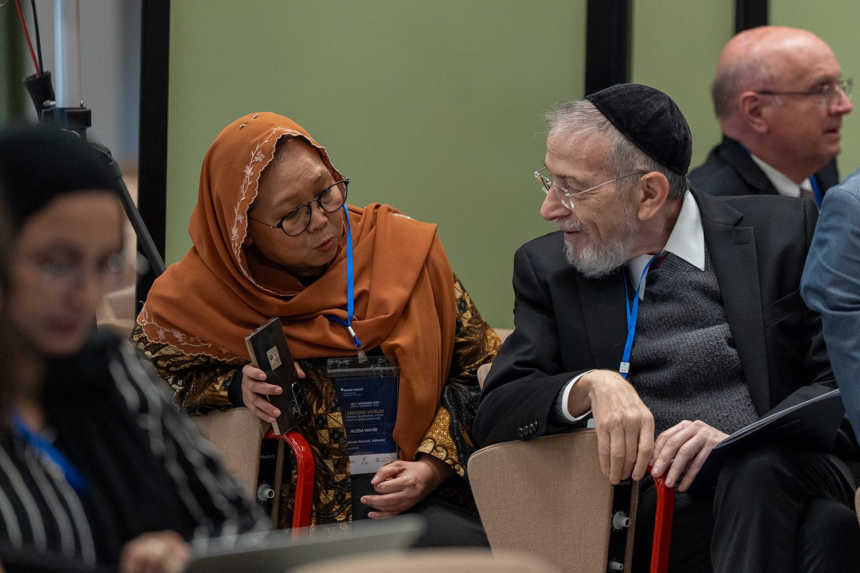
On November 10–11, 2026, an unusual event took place in Castel Gandolfo (Rome): “Bridging Worlds: Religion, Development, and the Future of Global Partnership,” organized by the Atlantic Council, the Ansari Institute, the Focolare Movement, and Sophia University. Leading global experts gathered to discuss the powerful and promising resurgence of religions as a positive force within international relations. Long viewed primarily as obstacles or sources of danger, religious communities are increasingly becoming indispensable, crucial factors in building peace, fostering development, enhancing human well-being, strengthening social cohesion, and promoting the common good.
Against this backdrop, I met with Fabio Petito, an academic and professor of religion and international affairs at the University of Sussex in England. Over the years, he has specialized in the growing role that interreligious collaboration can play in international politics—a subject that, until two decades ago, was not even considered worthy of study by experts in international relations.
How did your interest in interreligious collaboration begin?
In the 1990s, while studying economics and social sciences at Bocconi University in Milan, I encountered Samuel Huntington’s theory on the “clash of civilizations.” In his book, he presented the Mediterranean as the primary fault line separating two worlds—two civilizations destined to collide. Having been born in Naples, I would look out from my home every day at a magnificent sea—a space that my school teachers had taught me was, in fact, a place where civilizations meet. In fact, my city has far more in common with cities in the southern Mediterranean than with those in Northern Europe. The notion of an inevitable clash did not convince me, and—given the scarcity of research on the subject—I began to study it. In 2000, while serving as an editor for the English journal Millennium: Journal of International Studies, I oversaw the first special issue dedicated to the role of religion in international relations—one of the first instances in which this topic was addressed within the academic discipline. Shortly thereafter, the events of September 11, 2001, took place, and I was asked how I had managed to foresee the disruptive role that religion would come to play on the international stage. The subject began to be studied, particularly in the English-speaking world, though almost exclusively through the lens of Islam and terrorism—a narrow and partial perspective. From that point on, I began collaborating with two think tanks hat bridge the gap between government and academia—serving as conduits for new ideas and leadership—namely, ISPI in Italy and the Atlantic Council in the United States. Then, 15 years ago, following the Italian translation of my book on religion and international relations, I was contacted by Pasquale Ferrara—then Director of Analysis and Planning at the Italian Ministry of Foreign Affairs—who sought my assistance in raising awareness among Italian diplomats regarding the potential positive role that religion can play in the world.
But among ordinary people, this perhaps hasn’t yet become a shared consciousness—given that, all too often, the arrival of a migrant or a follower of another faith is met as if they were an enemy…
Over the last quarter-century, in many parts of the world, a quiet shift has taken place among the people themselves—a “dialogue of life” expressed through concrete action. Young people and women, in particular, are collaborating on small-scale projects that nonetheless advance this vision of interreligious unity. My goal is to shine a spotlight on these existing realities—on experiences of fraternity and cooperation involving immigrants and the poor, or initiatives focused on the environment, and so on. Unfortunately, we live in an era marked by the intense politicization of the nationalistic and populist dimensions of religion. Politicians and media figures often do not help, as they focus exclusively on news stories that highlight the negative aspects of religions.
What conditions are necessary for a form of religiosity to be positive?
Essentially, two elements are required: the first is a deep understanding of the richness of one’s own tradition. At the same time, there is a need for openness toward the values of other religious traditions. The theological reflection of any given religion can no longer take place in isolation from dialogue with other religious traditions. This balance creates the conditions for various spiritualities to engage positively in the pursuit of unity, peace, and the common good.
Are politicians and international organizations open to engaging in dialogue with religions?
We must establish forms of partnership and collaboration that involve governments, international bodies, and religious actors in order to achieve shared goals, such as sustainable development. However, religions do not collaborate solely within frameworks defined by states and international organizations. They also contribute insights from a different level—such as the Christian concept of “integral human development”—which resonates with the sensibilities found in Asian religious traditions, Islam, and Judaism, precisely because it places human dignity at the center. In their dialogue with religions, secular policymakers must be willing to risk changing their own perspectives; they must remain open to innovative solutions proposed by spiritual traditions that emphasize human dignity and an integral relationship with nature. These are ideas that can help address some of our global challenges, such as climate change, as well as the issue of growing discrimination and persecution rooted in religious divisions. These are the challenges of our era. While religious traditions are certainly not all the same, they share a significant core of ideas across many issues—ranging from economics to politics—such as the “Golden Rule,” which Chiara Lubich also highlighted. Today’s global challenges are so vast that they cannot be resolved without collaboration with and among religions, requiring the bold assumption that a common path is possible. This has been evident over the last 15 years through the encyclicals of Pope Francis on the environment and the documents from the Holy See regarding artificial intelligence—interventions that resonated well beyond the Catholic sphere, reaching many other religious traditions as well.
Is an appropriate language needed?
That is part of the challenge: we must develop a new language capable of shifting the dominant paradigm—a language born from dialogue among diverse cultural, religious, and civilizational traditions. Today’s challenge is technology—the materializing paradigm that threatens to engulf us—yet, fortunately, we possess a wealth of voices that declare: “No! Human beings and their dignity are inviolable, as is our relationship with nature.” Religious leaders have a prophetic role to play; they are called to take a more public stance and to assume the responsibility of speaking out and taking action. If they do not, who will protect humanity from what is currently unfolding?
Why hold the “Bridging Worlds” conference at Castel Gandolfo, in partnership with the Atlantic Council, the Ansari Institute, the Focolare Movement, and Sophia University?
We aim to translate certain ideas—which have emerged within intellectual circles—into the realm of political decision-making. For this conference, we have invited representatives from governments and development organizations, such as the World Bank. The idea is to showcase examples of integral human development at the local level—initiatives born from multi-religious collaboration. These include compelling cases such as those of the Focolare Movement, organizations like Consulus, projects in Africa—such as the Bethany Institute in Uganda—or in Indonesia, as well as the Shanti Ashram. All these represent local development efforts inspired by a fresh vision that places human dignity and the “integral” nature of the human person at the center—an approach aligned with how various religions conceive of development. It is about “bridging worlds”—connecting spheres that typically do not engage with one another—because that is the only way to build the common good. We aim to establish a platform and a research project to explore this insight further, while securing funding to strengthen international collaboration.
Why did you involve the Focolare Movement in this international event?
I did so with great pleasure, having come to know the Focolare Movement over the years through personal friendships and various encounters. What struck me is that they possess a wealth of significant experiences across the globe, all inspired by a “spirituality of unity”—a vision that, over the decades, has increasingly embraced a multi-religious dimension. It seemed to me that these initiatives were not widely known beyond their immediate circles, even though they hold valuable lessons for other organizations. The goal is to find every possible way to nurture these “seeds of hope” so that they may grow and flourish. The Focolare Movement’s experience—with its practical projects fostering unity and interreligious collaboration—is truly significant.
What is your final assessment of this international event?
The conference held at the Mariapoli Center in Castel Gandolfo highlights the urgent need to bridge two worlds: the realm of religion and the realm of development practice and policy. We live in a context where, regrettably, development is becoming an ever-lower priority for governments and international organizations. Yet, in recent days, we have also seen how many religious organizations—from all cultural and spiritual traditions and from every continent—are making concrete efforts to address the great challenges of our time, ranging from climate change and rising poverty to providing support for the most vulnerable communities. These are seeds that inspire hope for a global interreligious collaboration aimed at integral human development. In this light, we can no longer rely on the models of the past. This conference has opened up new perspectives in this direction, and I hope that we will be able to continue and expand our collaboration with our Christian, Muslim, Buddhist, Hindu, and Jewish partners, in order to strengthen interreligious cooperation for the common good of humanity.
edited by Giulio Meazzini
Originally published by cittanuova.it
Photo: © Joaquín Masera – CSC Audiovisivi
Your email address will not be published.
By submitting this form you agree that this site stores and manages your data. You also agree to our privacy policy and to receive emails according to the preferences you have expressed. Remember that you can unsubscribe or change these at any time.
Care for the “little ones”
Nov 18, 2026
“Welcome, everyone. Go and proclaim the Good News.” This is the atmosphere that Argentina continues to breathe after the visit of Pope Leo XIV. The motto chosen for the trip accompanied every moment of the 96 hours spent by the Holy Father in the country between 8th-11th November, leaving a deep impression on the communities and people he met along the way.
Nov 17, 2026
The opening ceremony for the 2026/27 academic year at the Sophia University Institute provided an opportunity to reflect on the purpose of the work carried out by the Loppiano-based university and on its contribution to building the common good.
Nov 14, 2026
This month’s Word of Life is the verse from the Gospel of John chosen as the theme for World Youth Day 2027 in Seoul, South Korea, for which many young people are already preparing. It is a call to courage that does not come from our own strength, but from the space we choose to make for Jesus in our lives. It is a journey of hope which, as the Focolare community in Aklan (Philippines) tells us, has already begun.
The Emergency Coordination Team of the Focolare Movement has launched a special fundraising campaign:
If you would like more information or to get in touch with us, please send us your details.
By submitting this form you agree that this site saves and manages your data.
Via di Frascati, 306
Rocca di Papa (RM)
Italy – 00040
Tel. +39 / 06 947 989