




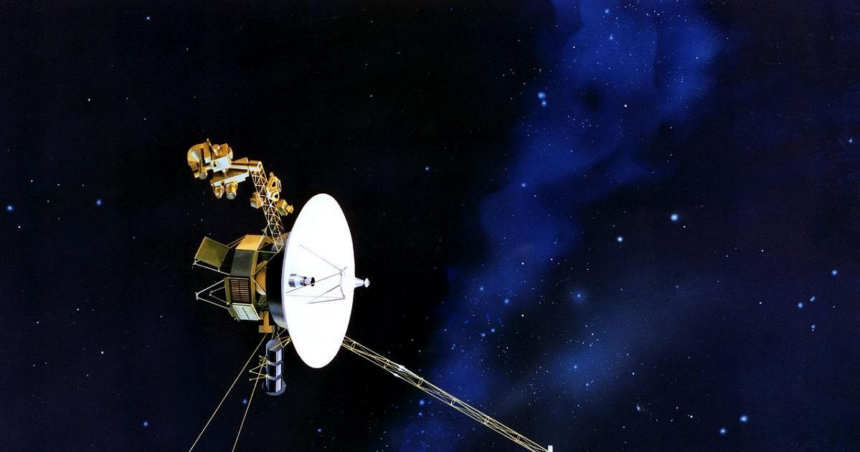
NASA’s iconic Voyager 1 spacecraft has achieved an unprecedented milestone, reaching a staggering one light-day distance from Earth, marking a new chapter in interstellar exploration.
Traversing the vast unknowns of the universe, NASA’s Voyager-1 spacecraft scripted history on Wednesday as it crossed a milestone measured in time, not kilometres.
Launched in 1977, the Voyager-1 is now over 26 billion kilometres from Earth — a distance now calculated in light-days, the time light takes to traverse that length.
“Nov. 18, 2026, 5:16 am EST. The Voyager 1 spacecraft has reached a distance of one light-day from Earth,” the US space agency said in a post on X.
“It’s never happened before, and it may never happen again — it’s that kind of extraordinary,” said Kareem Badaruddin, Voyager mission manager at NASA’s Jet Propulsion Laboratory in Pasadena, California.
Since it lifted off in September 1977, Voyager 1 has racked up an impressive list of achievements.
The probe and its twin spacecraft, Voyager 2, which launched a month later, were originally built to last just five years and explore Jupiter and Saturn.
Both have extended their missions nearly 10 times longer than expected.
The Voyager probes are currently studying interstellar space, having left the heliosphere — a vast protective bubble generated by the Sun’s magnetic field — in 2012 and 2018, respectively.
Voyager 1 is headed toward a star more than 17 light years away from Earth called Gliese 445. It’s an obscure star now in the constellation Ursa Minor, and Voyager 1 is expected to pass within about 1.7 light-years of it — in 40,000 years.
Even though the spacecraft, in flight since 1977, is cruising at nearly 61,000 kmph through the vacuum of space, that’s a relative crawl compared to the speed of light.
Voyager 1 crossed the light-day threshold on Wednesday after being in flight for 49 years, two months, and 11 days.
Voyager 1 continues to communicate with NASA’s Deep Space Network and send data back from four still-functioning instruments — the cosmic ray telescope, the low-energy charged particles experiment, the magnetometer, and the plasma waves experiment.
The Voyager Interstellar Mission (VIM) began on January 1, 1990. The goal was to extend exploration to the outer limits of the Sun’s sphere of influence and beyond.
Mission managers have continued to estimate that the Voyager 1 mission would last three to five more years.
‘BJP Isn’t In A Weak Position In UP’
‘Are Muslims Against Ram?’
When Pranab Told Sonia It Was Time To Change Manmohan
Message in a bottle: How one golden disk carries human history into the cosmos
You May Not Be Able To Board Your Flight Because…
Would You Buy A TV For 15 Lakhs?
8 Sinful Strawberry Desserts!
At 1 light day away, Voyager 1 has gone where nothing has gone before – Rediff



Leave a Comment

