by | Nov 16, 2026
In a world first, scientists have created a titanium structure capable of floating. The new material has shown an unusual combination of strength, lightness and buoyancy that makes it a promising candidate for marine infrastructure such as buoys, floating sensors and other equipment that needs to be both lightweight and robust.
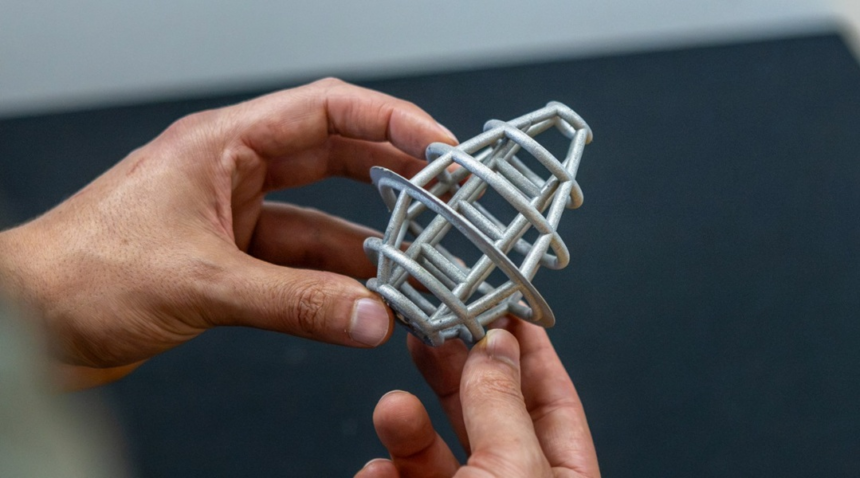
While titanium is strong, lightweight and resistant to corrosion, conventional titanium structures are too dense to float. Engineers at RMIT University in Australia have found a way around that problem by 3D-printing titanium as a lattice of hollow, interconnected struts filled with foam.
“Although metallic lattices can be incredibly light, with densities less than one-tenth the density of water, their open, interconnected spaces allow water to enter, causing them to sink,” said Jordan Noronha, lead researcher at RMIT’s Centre for Additive Manufacturing. “This has made these strong, lightweight structures unsuitable for marine infrastructure — until now. By filling only the hollow titanium struts with polyurethane foam, we created a structure that allows water to flow through it while remaining buoyant even after significant cracking and damage.”
Normally, a material’s density determines whether or not it will float. But for lattice structures, conventional density calculations take into account open spaces that can be occupied by water and therefore do not contribute to buoyancy.
To address this, Noronha and his team developed a new concept called skeletal density to predict whether or not open structures will float in water. Rather than counting every empty space in a lattice, this measure only considers the parts of the structure that exclude water. In the case of the new material, this includes the titanium walls and the sealed, foam-filled channels where water cannot enter.
“This gives engineers a simple design rule: if the skeletal density is lower than that of the surrounding liquid, the structure will float — even when water flows through all its external openings,” Noronha said.
Usually, reducing a structure’s density can improve buoyancy but compromise its strength. However, the new titanium lattice proved 70% stronger than stainless steel or high-density polyethylene — two materials widely used in marine infrastructure with a similar overall density.
The researchers successfully tested the material’s buoyancy in freshwater for more than two months. A short-term corrosion test using natural seawater from a Melbourne port further showed that the lattice lost only 0.15% of its mass and less than 1% of its strength after two weeks of immersion.
The titanium structure remained buoyant even after the engineers inflicted significant damage to it, including cracking, failure at key connection points, and the fracture of an entire lattice layer. Only after being severely crushed and compacted did the material sink.
“Tiny, sealed cells in the foam trap gas and prevent water from flooding the hollow struts,” Noronha said. “In this way the foam acts as a distributed barrier that helps the structure remain afloat after damage — unlike conventional hollow marine structures, which can rapidly fill with water after cracking.”
To demonstrate its potential applications, the team 3D-printed a small marine buoy using the hybrid material. The titanium buoy remained stable in a turbulent seawater tank even without a conventional sealed casing, protective coating or any additional flotation system.
Next, the researchers plan to scale the structure up and determine how it performs over much longer periods in realistic marine and deep-sea conditions.These tests will help determine whether the material can withstand the demands of real-world marine infrastructure. If successful, the same design principle could extend to applications beyond floating structures.
“By changing the material inside the titanium framework, we could tailor a similar structure for energy absorption, thermal management, vibration control and other applications,” said Ma Qian, professor of advanced manufacturing and materials at RMIT University’s Centre for Additive Manufacturing.
Reference: Jordan Noronha et al., Breaking the Surface: Buoyant Metal–Polymer Open–Cell Hybrid Lattice Metamaterials, Advanced Materials (2026). DOI: 10.1002/adma.74641
Featured Image Credit: Sara Tan, RMIT
Sign up for our newsletter and receive the latest science news.
Related posts:
Galiffi, a Wiley Nanophotonics Early Career Award recipient, explores how spatiotemporal photonics offers new ways to control light.
Innovative nano-engineering uses biocompatible materials to simultaneously monitor cardiac signals and measure sweat metabolites.
Bo Xiong uses engineered noise and AI to expand the multiplexing capabilities of metasurfaces.