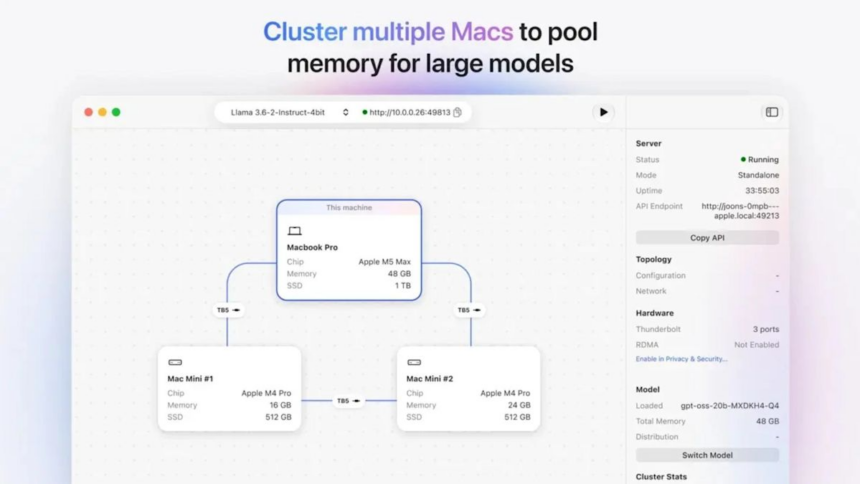
I love the idea of AI that never leaves my computer, especially since more and more tools use cloud servers for heavier processing. However, I hate the homework it takes to get there. Well, it looks like Apple heard me.
Claris, Apple's FileMaker subsidiary, is testing Harbor. It's basically a Mac app that turns Apple silicon computers into private AI servers. How do we know this? Via an App Store listing that briefly appeared on November 10, 2026, and then disappeared (via a MacRumors analyst on X).
Apple is working on a new app called Harbor
Harbor turns your Mac into a private AI inference server. Run open-weight models locally on Apple silicon—your data never leaves your hardware, and nothing reaches the cloud. Connect multiple Mac computers over Thunderbolt 5 to pool… pic.twitter.com/UYJBQeX4Nf
— Aaron (@aaronp613) November 10, 2026
Harbor lets a Mac run open-weight AI models, whose trained parameters are publicly available for anyone to download and host, effectively turning it into your very own private AI server. More importantly, it does so while keeping your data and requests on your hardware.
There's no cloud-based inference or per-token billing involved (via Claris). The App Store listing promised setup in minutes, without touching the command line. One screenshot also showed Harbor downloading OpenAI's gpt-oss-20b model from Hugging Face. After the Terminal misadventures I've heard of, that alone should win people over.
The bigger trick, I'd say, is clustering or daisy-chaining multiple capable computers.
Plug two or more Thunderbolt 5-compatible Macs together, and Harbor detects them and pools their unified memory together. This lets you unlock substantially faster local processing, especially when compared to a single Mac's CPU and memory capacity.
Apple added RDMA (remote direct memory access, which lets one Mac read another's memory directly) over Thunderbolt 5 in macOS Tahoe 26.2, and from what I'm seeing, it speeds up exactly this kind of linking.
Apple has taken down Harbor from the App Store nowhttps://t.co/VwaZKwTYzd https://t.co/Gi2FTVRvnf pic.twitter.com/gvY2nPE6n1
— Aaron (@aaronp613) November 10, 2026
Aaron, the source that I quote in the beginning, spotted the App Store listing on November 10 and shared screenshots. However, it was gone by that evening. Neither Apple nor Claris has said why.
If I were to guess, the page went live quite early. Pulling it while keeping the sign-up page intact is a tidy way to keep a private preview, well, private. Don't read the delisting as the project's death, as that doesn't appear to be what's happening here.
As for you, Harbor isn't public. Claris runs an early-access form. You can fill it out with your name, email, company, phone, and country. For now, there's no price, no release date, and no word on whether it'll be free.
If you want something similar today, LM Studio gives you a simple window on one Mac, and open-source Exo handles clustering but expects you to work in a terminal. And that's exactly why Harbor sounds like a big deal: it looks like an attempt to give you both the capabilities in one.
Spotify's AI DJ gets new voices, including Indian accents, and a mute option
Google Pixel phones are getting custom AI widgets, new icons, and a useful HiLight upgrade
Google's Pixel 10 update lets Gemini order groceries, book cabs, and make calls on your behalf
FBI looks into Nvidia CEO's alleged spy affair as report claims $7.5 billion in smuggled AI chips to China
AI
Audio
Computing
Gaming
Home Entertainment
Phones
Puzzle hints
Science
Streaming
VPN
Wearables
Deals
Advertise (opens in new tab)
About our ads (opens in new tab)
Licensing (opens in new tab)
Careers (opens in new tab)
Help (opens in new tab)
Feedback (opens in new tab)
Sitemap (opens in new tab)
© 2026 Yahoo. All rights reserved.