




Kaja Kallas says Moscow is trying to divert attention from its aggression by raising issue of European security
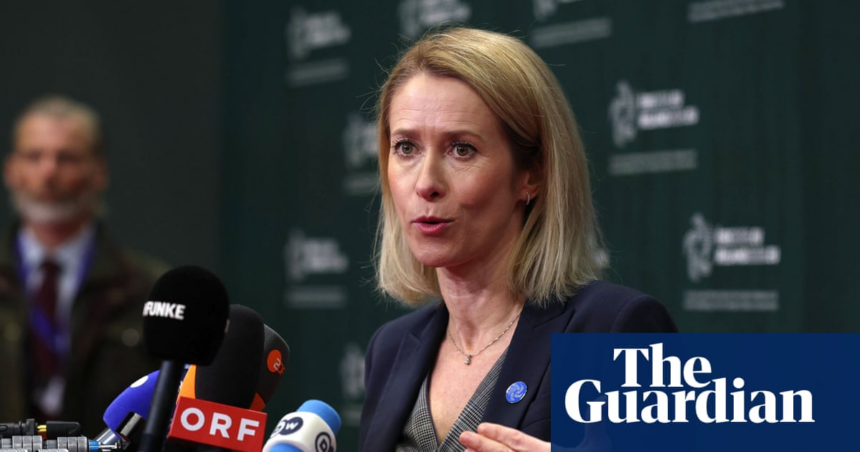
The EU’s foreign policy chief has warned against “walking into the traps that Russia is setting” as she said Moscow was trying to start a debate about European security in order to divert attention from its aggression.
“We have one aggressor and one victim, and the aggressor does not have security concerns,” Kaja Kallas said on arrival at an EU leaders’ summit in Dublin. “Nobody has ever attacked them. They have attacked others. I mean, keep the focus, people.”
In talks on the Ukraine war, Russia has revived its hardline demands for a total overhaul of European security – demands that were rejected in 2021 because they were seen as an infringement of the sovereignty of central and eastern European countries. The latest round of talks between Ukraine, Russia and the US was held this week in Abu Dhabi.
Donald Trump’s envoy and son-in-law, Jared Kushner, said on Thursday night that Russia and Ukraine had agreed to expand the next round of peace negotiations to include the Europeans. However, Russia quickly contradicted that assurance.
European leaders have long said they will support Ukraine in any peace talks, but want to see a ceasefire before negotiations. They also stress the continent has an extensive web of security agreements that Russia has violated.
Friedrich Merz, the German chancellor, said: “Russia wants to talk about questions of a European security architecture. We do not need to discuss that; it already exists.” He added that it was a “given” that his country would be part of any European delegation.
The European Commission president, Ursula von der Leyen, said it was “self-explanatory that Europe is included in the peace talks to safeguard our interests, but also to support Ukraine”.
The Kremlin said on Friday: “Once we understand [Europe’s] real intentions and their willingness to contribute to the peace process, then we can make a decision on holding talks in an expanded format.” Russia’s lead negotiator in Abu Dhabi, Vladimir Medinsky, said it was “unclear what there is to discuss” with Europe.
The US call to involve Europe in talks has turned the spotlight on who would represent it.
Speaking after a summit of EU leaders in Dublin on Friday, the European Council president, António Costa, said leaders had agreed on a negotiating team: the EU institutions and E5 countries, namely Britain, France, Germany, Italy and Poland.
“Europe must speak with one clear and united voice in all discussions that shape the future of Ukraine and the security of our continent,” he said. “This is ultimately a team effort.”
The format had already emerged in recent months, but the need to formalise the grouping gained momentum after Ukraine’s president, Volodymyr Zelenskyy, this week urged his European allies to decide who will represent Europe in negotiations.
Kushner also mocked the absence of a single person to speak for the entire continent. “If Europe could identify one person to speak on their behalf, that would be a bigger achievement than getting the Russians to include them in the negotiations,” he said earlier this week.
Sign up to Headlines Europe
A digest of the morning’s main headlines from the Europe edition emailed direct to you every week day
after newsletter promotion
But there was an increasingly settled view that Europe would not be represented by a single person, but by different interlocutors from the wider continent. Paris and Berlin had argued for a continued role for their own envoys in the E3 format of Britain, France and Germany, alongside EU representatives. Smaller member states put the emphasis more firmly on the EU representatives: Costa and Kallas, the EU’s high representative for foreign affairs and security policy.
Earlier in the day, Sweden’s prime minister, Ulf Kristersson, said the discussion on who should represent Europe was “slightly overstated” as it had differing interests.
Some of the issues in peace talks were “pure EU interests”, he said, citing financing Kyiv and Ukraine’s future membership in the bloc. He also supported other formats, such as the “pretty uncomplicated” E3 and the “very legitimate” E5, which includes Italy and Poland, as well as a role for EU representatives. He said: “I am quite flexible on that. I think what we actually say is more important than the exact configuration of the people in the room.”
Several at the summit, including Kallas, also pointed to the importance of including the UK, a founder member of the coalition of the willing, a broad group of countries committed to future peacekeeping in Ukraine.
Ireland’s taoiseach, Micheál Martin, said the UK and Norway each had a significant role and “that all has to be taken into consideration because it’s a European, continent-wide issue”.
The British prime minister, Andy Burnham, said it was for the EU to decide who would represent the bloc. He said there was a strong view among European leaders that it was for Europe – in the wider sense – “to decide its own arrangements” on security.
Russia is ‘setting traps’ in Ukraine talks, EU foreign policy chief warns – The Guardian



Leave a Comment

