




If you step outside tonight and flick a flashlight toward deep space, that split-second pulse will race through the void at 186,000 miles per second.
The light will continue its journey while you sleep, while you eat, while you go to work. Only when you reach the same time tomorrow could its photons potentially wash over a spacecraft more than 16 billion miles away.
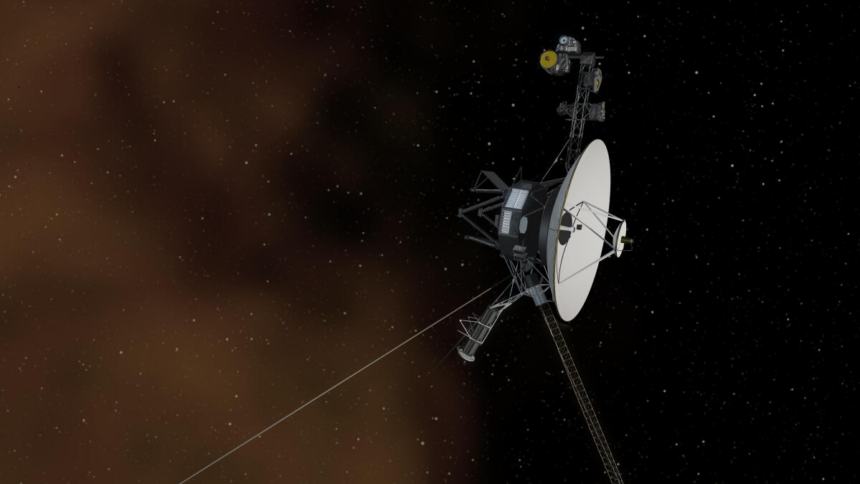
That robotic probe is NASA‘s Voyager 1, the farthest human-made object in the universe. It will cross the one light-day-away milestone at 5:16 a.m. ET on Wednesday, Nov. 18. One light-day is the distance light travels over 24 hours. Radio signals move at the speed of light, so any message from Earth would need a full day to reach the spacecraft. Considering Voyager 1 never stops moving, that communication lag will only increase.
To mark the occasion, the U.S. space agency has a couple of things planned, one of which involves pointing that flashlight toward the sky. The day after the milestone, you can watch the mission team talk about where the spacecraft has been and how it keeps going.
Voyager 1 left Earth in 1977 to explore the giant outer planets. NASA timed the launch to catch a lineup of those planets that comes around only once every 176 years. The probe finished its tour decades ago but kept going at nearly 38,000 mph. In 2012, it left the heliosphere, the protective bubble the sun blows around our solar system, and entered interstellar space.
Its twin, Voyager 2, took a different path past Uranus and Neptune and left the solar system in 2018. But Voyager 2 won’t reach a light-day until November 2035, most likely after it has depleted its fuel.
That’s the bittersweet reality of Voyager 1’s historic achievement: Both probes are dying, nearly tapped out of their nuclear power sources that turn heat from decaying plutonium into electricity. Since 2024, the team has shut off two science instruments on each spacecraft to stretch what’s left. Sooner or later, the power will run out, and no one will be able to talk with the twins at all, regardless of time delays.
For now, though, the mission team is only thinking happy thoughts. The first way to get involved comes after sunset on Tuesday, Nov. 17. NASA is asking people around the world to point a light at the sky to spell out VGR, Voyager’s call sign, in Morse code. Morse code is an old telegraph language that turns each letter into a pattern of short and long signals.
The easiest way to do this is with a phone or tablet. NASA built an online flasher that blinks the code for you. After sunset, open the flasher in your device’s web browser, point the device’s screen at the sky, and let it send the signal. (You can bookmark this story to keep the flasher link handy.)
If you’d rather tap it out yourself, grab a flashlight, and switch it on and off or use your hand to block and unblock the beam. Short flashes, called dots, should last less than a second. Long flashes, called dashes, should last about one second.
Then, follow this pattern:
V: Dot, dot, dot, dash.
Pause.
G: Dash, dash, dot.
Pause.
R: Dot, dash, dot.
You can repeat the pattern as many times as you like.
Now, even if you were to point your flashlight in precisely the direction of Voyager 1, the beam would fan out into a cone billions of miles wide, scattering its photons across the void. Because the light is diluted in space, virtually every photon would sail past the tiny 12-foot spacecraft without ever hitting it.
But it’s a symbolic gesture for wishing the old mission godspeed. You can tag @NASA on your photos and videos if you post them to X, Instagram, Facebook, TikTok, or other social media.
The second way to join in the celebration comes at noon ET / 9 a.m. PT on Thursday, Nov. 19. Mission leaders and top NASA science officials will meet at the Jet Propulsion Laboratory in Southern California to talk about the twins. They’ll explain how the spacecraft are holding up, what they’re still learning beyond the sun’s bubble, and how engineers keep such old hardware running from far away. The public can watch on NASA’s streaming service, NASA+, or Youtube.
The team has plenty to talk about. This year, engineers tried a fix they nicknamed the “Big Bang.” They turned off three power-hungry devices on each probe that help keep it warm, and at the same time they switched on three lower-power replacements. The swap should keep them running for at least another year.
But at this stage, the team has come to expect the unexpected. Last month, Voyager 1 had a mysterious issue with its thrusters that briefly caused a communication blackout. Engineers are still trying to figure out what caused the problem.
If the distant spacecraft could send you a Morse code message back, perhaps it would say the one recorded on its Golden Record: “ad astera per aspera.” In Latin, that means “to the stars through struggles.”
Want more science and tech news delivered straight to your inbox? Sign up for Mashable’s Top Stories newsletter today.
Topics NASA
Elisha Sauers writes about space for Mashable, taking deep dives into NASA’s moon and Mars missions, chatting up astronauts and history-making discoverers, and jetting above the clouds. Through 17 years of reporting, she’s covered a variety of topics, including health, business, and government, with a penchant for public records requests. She previously worked for The Virginian-Pilot in Norfolk, Virginia, and The Capital in Annapolis, Maryland. Her work has earned numerous state awards, including the Virginia Press Association’s top honor, Best in Show, and national recognition for narrative storytelling. For each year she has covered space, Sauers has won National Headliner Awards, including first place for her Sex in Space series. Send space tips and story ideas to [email protected] or text 443-684-2489. Follow her on X at @elishasauers.
Two ways to celebrate Voyager 1's one light-day milestone – Mashable



Leave a Comment

