




Emergency
Backstory
Newsletters
中文新闻
BERITA BAHASA INDONESIA
TOK PISIN
Topic:Climate Change
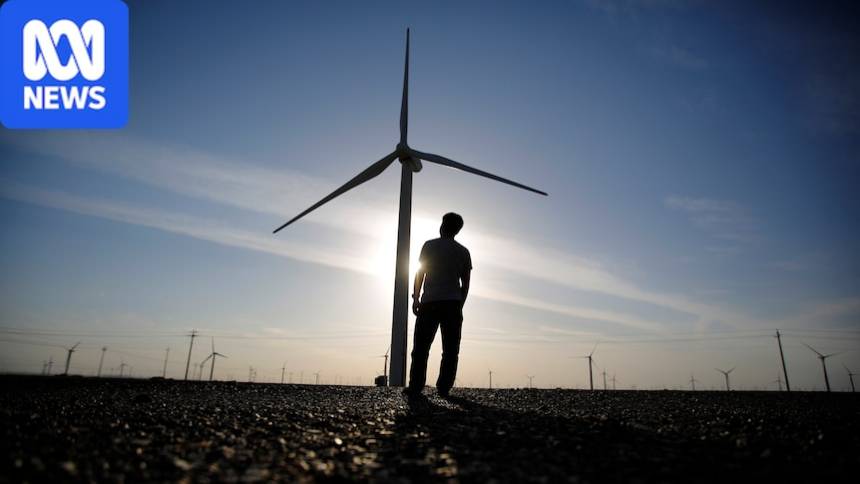
Renewable energy growth is meeting rising demand for power across the globe. (Reuters: Carlos Barria)
The 2026 edition of the global carbon budget shows fossil fuel emissions are set to drop, but the world is on track to reach 1.5 degrees Celsius of warming within four years.
Renewable energy uptake and the war in Iran are driving the decline, but there are doubts it will last.
Energy experts say accelerated electrification efforts could lead to a lasting shift in emissions.
Increasing renewable energy capacity and the Iran war have spurred a drop in oil, gas and coal emissions, but experts say a geopolitical shock could make the reduction short-lived.
Research released by the Global Carbon Project projects emissions from the burning of fossil fuels to decrease by 0.4 per cent compared to 2025.
Oil emissions, down 2 per cent, are the main driver of the drop, likely due to prolonged disruptions in the Strait of Hormuz.
The world's need for energy is growing and clean sources, mainly solar and wind power, are increasingly meeting that additional need.
A tanker anchored in the Strait of Hormuz, off the coast of Qeshm Island, in April. (AP: Asghar Besharati)
But lead researcher and director of the Global Carbon Budget Office at the University of Exeter, Pierre Friedlingstein, said clean energy was not growing fast enough to for a durable drop.
"A decline in fossil CO2 emissions is encouraging, but a reduction driven partly by geopolitical shocks is not a sustainable climate solution," he said.
"While renewables and electric vehicles are increasingly offsetting growth in energy demand, further acceleration is needed if global emissions are to peak and enter a sustained decline."
Total carbon emissions are set to rise from 42.8 billion tonnes last year to 43.3 billion tonnes in 2026. El Niño-linked peat fires and forest degradation in South-East Asia are driving the increase.
The amount of carbon that can be emitted before warming reaches 1.5 degrees Celsius above pre-industrial levels is now 150 billion tonnes, which will be reached within four years at the current rate.
This year the United Nations found the world was on track to reach 2C warming by about 2050 and move towards 2.6C warming by the end of the century.
"The point the report is trying to make is that we need to change these policies and be a little more aggressive in the way we look at the transition to net zero," CSIRO chief research scientist and Global Carbon Project executive director Pep Canadell said.
Some experts say Donald Trump's decision to start a war with Iran did more than briefly interrupt the world’s oil flow — it created a tipping point for accelerated global electrification efforts.
The 1970s oil shocks sparked by conflict in the Middle East produced vast changes in how the global energy system worked, and drove innovations in fuel efficiency.
And this time renewables and electric vehicles offer market-ready alternatives, with the cost of installed solar and batteries falling by 90 per cent since 2010.
The Iran war might have cost Trump the midterm elections, but it inadvertently helped the climate.
Solar and wind together are now the largest sources of growth in global electricity generation, overtaking coal and gas to meet over half of new electricity demand, according to a dedicated report on electrification by the International Energy Agency (IEA).
According to Gabrielle Kuiper, an energy researcher affiliated with CSIRO, consumer-level electrification of transport is well underway.
"I think the momentum is unstoppable," she said.
"We've reached the tipping point, particularly on EVs."
A report released by the International Energy Agency (IEA) last week found the shift to renewables is most pronounced in emerging economies, where the continued high oil price caused by the Iran conflict has accelerated uptake.
The report forecasts global renewable capacity to grow by almost 4,800 gigawatts (GW) in the 2026-2031 period, 57 per cent more than in the previous six years.
Growth in emerging and developing economies outside China is expected to match that in advanced economies for the first time, the report said
"Off-grid solar PV capacity is expected to increase by 2.5 times to around 80 GW by 2031, led by Pakistan, sub-Saharan Africa and Southeast Asia."
But as the UN's annual climate summit, COP 31, gets underway, growth in renewables still lags the pledge at COP28, where nearly 200 countries agreed to triple renewable capacity by 2030.
"Current policies, market developments and cost trends boost cumulative renewable energy capacity to around 9, 710 GW by 2030, a 2.6-fold increase from 2022, in line with last year's forecast," the IEA said.
The annual global carbon budget update found China's emissions are set to fall by 0.9 per cent in 2026 due to a plunge in oil emissions, and growth in electricity generation from renewable energy.
While the world's largest emitter produces 32 per cent of global emissions, it was found to be the most active in deploying clean technologies and increasing carbon sinks, which are systems that absorb more carbon from the atmosphere than they release, through reforestation.
Emissions across the United States are projected to decrease by 1.3 per cent, mainly due to dropping coal emissions, which spiked last year.
India's emissions are expected to increase by 4.4 per cent, higher than its annual average growth of 3.5 per cent over the past decade.
The European Union's emissions are expected to drop by 1.5 per cent, Japan's are expected to drop by 1 per cent, while emissions for the rest of the world are set to go down by 0.7 per cent.
"This year, for the first time, we saw 40 countries which, over the last 10 years, had emissions declining from fossil fuels; at the same time, they had an economy that has been growing," Dr Canadell said.
As United Nations climate talks commence in Türkiye, Australia's position as a climate leader will be tested.
"That is double the amount of countries as the previous decade, so certainly things are happening."
Emissions in aviation and shipping are projected to decrease by 1 per cent, partly due to reduced flights across the Middle East, while total emissions have grown at a slower pace over the past decade.
Oceans and vegetation remove about half of all carbon dioxide emissions from human activities from the atmosphere.
The dark, red tongue spreading in the Pacific is growing at a rate not seen in living memory. The uncertainty over what is driving it has alarmed experts.
But as El Niño exacerbates drought and bushfire conditions in many regions, plants absorb less carbon dioxide via photosynthesis when they are stressed by low rainfall and higher temperatures.
Bushfires also release large amounts of CO2 back into the atmosphere.
Dr Canadell said the Amazon's absorption rate declined by 66 per cent during the El Niño of 2023/24, which has since returned to normal.
But he warned that a drop of that scale could repeat towards the end of the year.
"We'll see the full force of El Niño in the sinks, particularly in the tropics, in the Amazon specifically, early next year," Dr Canadell said.
"It's not good news for us because we know that the future of our climate is a warmer climate.
"Therefore, those land sinks will be less effective in removing that part of the 50 per cent carbon discount that these natural sinks are doing."
See more ABC coverage in your search results
Topic:Air Transport Industry
Topic:Cricket
Topic:Federal Government
Topic:Explainer
Topic:The Greens
Topic:UN Climate Change Conferences
Topic:Electric Vehicles
Topic:Hydro Energy
Topic:Renewable Energy
Topic:Renewable Energy
Topic:Energy Industry
Australia
Climate Change
Greenhouse Gases
Turkiye
Topic:Air Transport Industry
Topic:Cricket
Topic:Federal Government
Topic:Explainer
Topic:The Greens
Topic:Courts
Topic:Accidents and Emergency Incidents
Topic:Explainer
Topic:Courts
Your home of Australian stories, conversations and events that shape our nation.
This service may include material from Agence France-Presse (AFP), APTN, Reuters, AAP, CNN and the BBC World Service which is copyright and cannot be reproduced.
Get the latest ABC News delivered to your email inbox
Stay informed and connected with the ABC. Covering a wide range of topics and brands including News, iview, listen, and more.
Renewables and Iran war help drive fall in global fossil fuel emissions – ABC News & Headlines – Australian Broadcasting Corporation



Leave a Comment

