




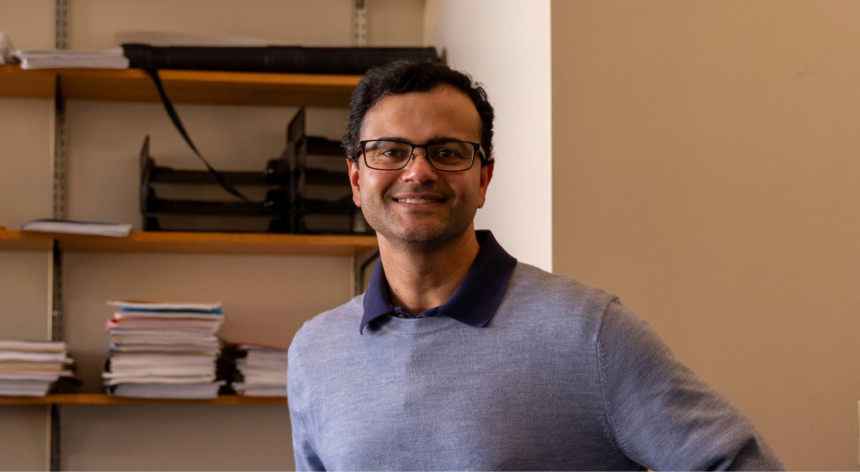
Boston College chemistry Professor Abhishek Chatterjee received a $1 million grant through the 2026 Ono Pharma Breakthrough Science Initiative Award for his lab’s work in developing genetic switches to control gene therapy activity.
“I believe in thinking about the most impactful thing that you can do and going after that without worrying too much about how difficult it is,” Chatterjee said.
The competitive award supports scientists—primarily chemical biologists—involved in innovative research that could lead to breakthroughs in disease treatment, according to the foundation.
The foundation accepts up to two submissions from 66 universities each year and confers three awards. Chatterjee joins Harvard University’s Emily Balskus and the University of Texas at Austin’s Brian Belardi as the 2026 recipients.
Traditionally, genetic disorders, including cystic fibrosis, muscular dystrophy, and some types of cancer, have been difficult to treat due to the complexity of treating a disorder someone is born with, Chatterjee explained.
“What traditional treatments are good at is coming up with a drug that will block a function, right?” Chatterjee said. “But it cannot replenish a function, like a function that is not there. You cannot get that back. You can manage the symptoms, but you can’t really truly cure the disease.”
Gene therapy, however, is a breakthrough in genetic disease treatment, Chatterjee said, and works by correcting the malfunctioning gene rather than only treating disease symptoms. As Chatterjee explained, gene therapy often utilizes viral vectors to deliver corrected or therapeutic genes to patients.
“It sounds like science fiction, but now there’s like six therapies in the clinic that are FDA-approved, where you’re taking a human virus, and you are filling them up with, you know, these genes that can cure various diseases like blindness, muscular dystrophy, etc.,” Chatterjee said. “And then you’re giving it to a patient where the virus, which is very harmless, can deliver the gene, and the patient gets the function back, and it can kind of cure the disease.”
Chatterjee explained, however, that a caveat of gene therapy is the inability to control the therapeutic gene’s expression.
“Once it’s in the patient, they just express at a certain level, and that’s it,” Chatterjee said. “If you’re making too much or too little, you have no lever—you cannot sort of tune the level of it that is needed to get the right benefit. And if it’s causing problems, and you want to turn it off? There is no way to do that.”
Compared with other top universities that sent nominations for the 2026 Ono Award, BC has a relatively small research ecosystem, which made Chatterjee even more grateful to receive the award.
“BC does well in recruiting good scientists and good scholars, which creates a small but mighty community that can build around specific areas of strength and make backbone discoveries,” Chatterjee said. “BC’s research community isn’t big, but we are doing research that is world-class.”
The Chatterjee lab has spent 10 years using directed evolution to address this expression issue, developing RNA-based molecular switches incorporated into the therapeutic gene that can bind an already approved small-molecule drug to control its expression.
“We built this switch that can bind to this small molecule, and in response to that, either turn on or turn off the production of the protein,” Chatterjee said.
Chatterjee’s work in molecular switches stemmed from a breakthrough in designing virus-assisted evolution to mimic natural selection within human cells.
“So the aha moment for us was being able to develop a platform that allows us to do these kinds of natural evolution in the context of a human cell, and the way we do that is by piggybacking on viruses,” Chatterjee said. “Once we knew that we can run these kinds of evolution experiments in a human cell, then the question was, what else can you do with it?”
Chatterjee noted that while these controllable gene therapies are not yet available, he hopes this grant will change that.
“Our goal is to take this proof that it is possible to make a switch that works in human cells and make a therapeutic out of it,” said Chatterjee. “But it requires a lot of development to go into preclinical evaluations. Thankfully, this award comes with a substantial amount of resources that will allow us to be flexible in our approach to try many different things.”
Over the past 10 years, Chatterjee has gained a deeper appreciation for the power of evolution to address core biological and societal issues.
“All of the crazy things biology can do is so inspiring, and all of that is a product of evolution,” Chatterjee said. “We started thinking that if we could harness the power of evolution in the lab, we can solve other problems like disease or food insecurity—we can always find beautiful solutions developed through biology.”
The Heights use cookies to improve your experience on our site. By using our site, you consent to cookies.
Websites store cookies to enhance functionality and personalise your experience. You can manage your preferences, but blocking some cookies may impact site performance and services.
Essential cookies enable basic functions and are necessary for the proper function of the website.
These cookies are needed for adding comments on this website.
These cookies are used for managing login functionality on this website.
Statistics cookies collect information anonymously. This information helps us understand how visitors use our website.
Google Analytics is a powerful tool that tracks and analyzes website traffic for informed marketing decisions.
Service URL: policies.google.com (opens in a new window)
Your email address will not be published.
BC Chemist Abhishek Chatterjee Awarded $1 Million Grant for Research on Gene Therapy – The Heights



Leave a Comment

