


This live page has now closed – read more in our news story
US markets have been steady so far as they reopen following the value of tech stocks plummeting worldwide amid fears of a slowdown in AI development
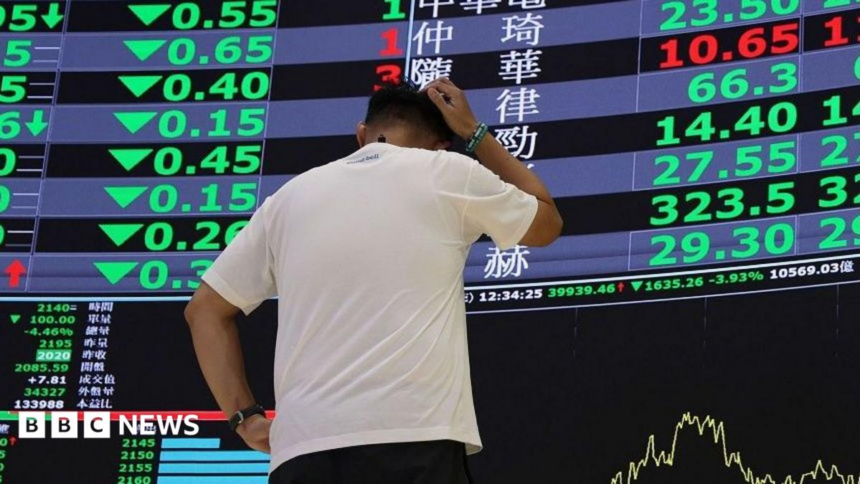
The Nasdaq index, of the largest tech firms listed in the US, was down by more than 5.5% on Thursday; Japan's Nikkei 225 was down 6.3% earlier; and the UK's FTSE 100 index has fallen by around 2.2%
It comes after the US midterm elections, won by the Democrats, where data centres became a key issue for voters – BBC Verify looks at polling data
US President Donald Trump has restated his support for the AI sector in a social media post, saying only "foolish leadership" would "say no to the riches they bring"
Tech bosses and investors have dominated the AI narrative for so long – could voters now prove to be the pin that bursts the bubble, asks our technology and AI editor
Despite its dramatic drop, Nasdaq is still higher now than it was last year – this chart shows how it has changed
Tudor Brown, a UK tech founder, tells the BBC there were "jitters" around "infinite AI growth" before the midterms. He says there's "a lot of money still being made in these companies and we'll start to see it coming back a bit"
Edited by Alex Smith, Angus Thompson and Jenny Matthews, with business reporter Michael Race Tara Mewawalla
Live reporter
US tech stocks have shown signs of a partial recovery after the value of shares in artificial intelligence and technology firms plummeted worldwide.
The drop off came after the Democrats' resounding win in the US midterms, which sparked fears of a reduction in AI development – more on that here.
On Thursday, the tech-heavy Nasdaq composite index closed down by more than 5.5%, losing an estimated $2.5tn (£1.9tn) in market value, according to Dow Jones data.
Businesses closely linked to artificial intelligence development, particularly makers of key computer chips and semiconductors, took the hammering, business reporter Rachel Clun highlights.
But when US markets opened on Friday, share prices in a number had edged up.
Chipmaker Nvidia's share price jumped by over 7% and Elon Musk's SpaceX was up 6.19% – though both are yet to recover their heavy losses from yesterday. It's a similar story for chipmakers AMD and Micron.
As business reporter Michael Race notes, things can change quickly and there's a full day of trading ahead, but the big losers from yesterday look to be regaining some ground.
Chief strategist at American investment management firm AlphaSimplex Katy Kaminski
It is not unusual to see "a lot of volatility" in these types of events, says strategist at investment management firm AlphaSimplex Katy Kaminski after tech stocks edged back up when trading reopened in the US.
It came after Thursday's major sell-off of shares following concerns of an AI slowdown after the Democrats' midterms win.
"People tend to sway [on] the extremes until they kind of figure out what this really means," she tells BBC News.
On the AI industry more generally, Kaminski says it's has been "under some investigation" over the past few months, and rapid shifts in politics can also cause "an even larger shifts in terms of where the valuations are going to be".
"Investors aren't just on the AI train now. They're really trying to determine which of these companies are actually going to be profitable, which are priced at a value that can actually deliver in the future," she says.
But Russ Shaw, founder of Tech London Advocates, tells BBC News that he thinks there is a fundamental rethink around AI that "surfaced in a very extreme way" after the US midterm elections.
"The big tech players have to do a much better job to make the case for AI because it's become a significant political liability," he says.  Liv McMahon
Technology reporter
Members of the action group Geef Tegengas protest against the construction of a Microsoft data centre in Sloterdijk in Amsterdam
With tech stocks dropping down yesterday, big tech’s big bet on data centres is under the spotlight.
Executives have argued in recent years that the rapid build-out of these giants of infrastructure is needed to stay ahead in AI development.
Many governments have agreed, some taking action to speed up planning and construction of data centres dedicated to AI workloads.
But tech firms and governments perhaps didn’t expect such intense backlash from people concerned about the cost to their local communities, their local resources and the environment.
We’re seeing this backlash play out in real-time today with protests over proposed AI data centre development in parts of Europe.
Today, for example, activists breached the site of a proposed Microsoft data centre in Amsterdam, as a wider “Stop Dirty Data Centres” campaign begins.
It shows just how much work tech giants may need to do to – and money they'll need to spend – to convince those daunted by the prospect of a data centre on their doorstep of its benefits. Rachel Clun
Business reporter, in New York
On Thursday, businesses closely linked to artificial intelligence development took a hammering on stock markets, particularly makers of key computer chips and semiconductors.
Chipmakers AMD and Micron both dropped by more than 17% – but AMD shares have risen by about 12% on Friday, while Micron is up more than 8%.
The Philadelphia Semiconductor Index, which tracks the performance of 30 of the largest companies involved in semiconductor production, fell by more than 12% on Thursday but was up by about 5% in early trading on Friday. Michael Race
Business and economics reporter
Some more details of early trading figures in the US…
The chipmaker Nvidia has rallied in early trading, with its share price jumping more than 7%.
Elon Musk's SpaceX is up 6.19% and his electric car maker Tesla is up 3.38%.
However, all of the above are yet to recover their heavy losses from yesterday.
Elsewhere, Apple shares are marginally down again, as well as those for Microsoft.
Things can change quickly and there's a full day of trading ahead, but the big losers from yesterday look to be regaining some ground. Faisal Islam
Economics editor
Just like a reusable space rocket, the tech and AI stocks that fell so sharply yesterday, rose again upon the opening of markets in New York.
The 7% rise in the likes of chipmaker Nvidia and rocket maker SpaceX were somewhat predictable, a sign of resilience, but they had not recovered yesterday’s losses in the first 15 minutes.
Overall stock markets were steady, but the same factors that sparked the sell-off yesterday remain. There has been a fundamental shift in the political backdrop to the build out of AI data centres.
It is not just the local votes against individual centres, it is the confidence with which a range of winning Democrats defined themselves against AI in general.
It’s also notable that Elon Musk’s Tesla did not recover as much, recovering 3% having lost a tenth of its value yesterday.Michael Race
Business and economics reporter
There are signs of a partial recovery in share prices in early trading on US stock markets. Here's the current picture:
The tech-heavy Nasdaq share index, which sank 5.5% on Thursday, is up 1.33%.
The S&P 500, which is the home of the largest publicly-traded companies in the US and represents most of the country's stock market value, is marginally up 0.4%.
However, the Dow Jones index is down 0.87%.Michael Race
Business and economics reporter
Ding, ding, ding – the opening bell has sounded on Wall Street and the US stock market is open.
We will bring you the latest market moves here as traders get to work following yesterday's heavy losses for tech companies.Rachel Clun
Business reporter, in New York
As well as the fallout of the midterms and the plunge in artificial intelligence stocks, US traders will also digest the latest jobs figures when markets open shortly.
And those numbers were better than expected: US employers added 165,000 new jobs in October, well above the average monthly increase and more than double what analysts had expected.
Overall the unemployment rate, which counts the number of people who are out of work but actively looking for a job, eased slightly to 4.1% from 4.2% in September.
The Bureau of Labor Statistics (BLS) says the unemployment rate has remained in the narrow range of 4.1% to 4.3% since March.
The increase in jobs was led by the professional and business services sector, which added 70,000 jobs in areas including professional, scientific and technical services as well as administrative and support, waste management and remediation services.
There were also 42,000 jobs added in healthcare, and jobs were also added in transportation and warehousing as well as manufacturing.
Yesterday, the tech-heavy Nasdaq index fell in value by around 5.5% after the US midterm election results sparked fears of a slowdown in AI growth.
The index features a large number of technology stocks – it's where you’ll find listings for companies like Apple, Alphabet, Microsoft, Meta and Nvidia.
Stock markets have been closed in the US overnight – but Nasdaq futures, which gives an indication of where the market could go when it opens, are currently up – hinting at a possible bounce back.
US markets will reopen in around 15 minutes – at 9:30 ET (14:30 GMT). We'll bring you the latest figures here once they do.
Anuk Weerawardana
Business reporter
Prime Minister Andy Burnham says artificial intelligence (AI) will remain "on the top of the agenda" in the UK, despite fears of a possible slowdown in development in the US.
He tells the BBC: "There is a case for AI […] but you also have to be very clear eyed about the potential risks."
Referencing the UK's presidency of the G20 next year, he says: "We need a global code to capture the benefits while safeguarding people against the risks, and that's what we'll see to do."
In last month's Budget, Chancellor John Healey announced more than £600m of investment in projects related to AI – including an extra £120m for the UK's AI Security Institute and £100m for a national AI Biosecurity Lab.
By Barbara Metzler
BBC Verify has been tracking the scale and spread of data centre development across the US – and satellite imagery shows the scale of some of ongoing megaprojects.
One data centre campus being built near the Texas city of Abilene will have eight buildings with more than four million sq ft (370,000 sq m) of internal space when complete.
The project, part of OpenAI’s Stargate program, is already running AI workloads and is expected to have a total power capacity of 1.2 gigawatts, about how much is generated by a nuclear reactor.
In Louisiana, Meta is building a data centre campus known as Hyperion on a site more than three times the size of New York’s Central Park.
Data Center Map’s latest figures for the US, shared with BBC Verify, shows there are 3,041 operational data centres across the US – 499 under construction and 1,603 planned.
Virginia has the most existing and proposed data centres with 710, followed by Texas with 612.
Anuk Weerawardana
Business reporter
US government borrowing costs have fallen since Wednesday’s midterm results, with analysts suggesting investors are looking to put their money in lower risk assets such as bonds.
The yield on a 10-year US Treasury bond – effectively the interest rate charged on a 10-year loan to the US government – has fallen from 4.95% to about 4.85%.
"Bond investors look for fiscal discipline and no surprises, and the midterm election result points to more order in Washington," says Dan Coatsworth, head of markets at investment platform AJ Bell.
High levels of government debt are worrying for bond investors, but the midterm results suggest the US's deficit "won't spiral beyond what was already expected", according to Coatsworth.
Other countries have also seen borrowing costs fall.
The yield on 10-year UK government bonds has slipped from around 5.26% on Wednesday to 5.16% on Friday – which means it’s slightly cheaper for the UK government to borrow money too. Jonathan Josephs
Business reporter
If this is a major sell-off, why are US futures pointing up?
They are suggesting that when the New York stock markets open at 1430 GMT the major indices will have recovered some of Thursday’s losses.
Well, for some investors the dip in prices – especially for tech stocks – is a golden buying opportunity.
They see the building of AI data centres as something of a runaway train that can be slowed but not stopped.
The prominent Wall Street tech investor Dan Ives says the reality is that the amount of US data centre capacity is set to double by the end of next year.
Roughly a third of that is in Texas, and any data centres that already have permits and are under construction won’t be stopped.
“Demand is three to four times the capacity at this rate of the build over the next 3 years”, he explains.
He also points out that even if 10% of the 800 – 1,000 data centres that are currently planned in the US no longer get built, those that do exist will be able to charge more for their use, increasing their profitability.
Overall he says this setback “does not cancel Christmas and the AI revolution will continue to happen, just at a slower rate”.
The AI data centres already under construction in the US won't be halted, says Dan Ives.
Tommy Lumby
Business data journalist
Several major stock markets in Europe and Asia have reacted negatively to the US tech turmoil but are still up compared with the start of the year.
Several European indexes recorded modest losses by late morning on Friday, while the Japanese stock market Nikkei also closed around 6% down.
However, all but France’s Cac 40 are still performing better than they were at the start of 2026.
This Flourish post cannot be displayed in your browser. Please enable Javascript or try a different browser.
This Flourish post cannot be displayed in your browser. Please enable Javascript or try a different browser.
Trillions of dollars have been wiped off the stock value of major tech firms in the US, Europe and Asia after the US midterm elections sparked concerns of a slowdown in artificial intelligence (AI) development.
The Nasdaq index, which features major tech companies, was down by more than 5.5% on Thursday; Japan's Nikkei 225 was down 6.3% earlier; and the UK's FTSE 100 index had fallen by 2.26% this lunchtime.
The market reaction follows the success of Democrat candidates across the US who campaigned on new rules and regulations for data centres and AI, and an end to tax deals for tech companies.
US President Donald Trump has blamed the market plunge on his political opponents. In a Truth Social post this morning he writes that data centres are "gold" and "only foolish leadership will say 'NO' to the riches they bring!"
A US midterms voter poll has suggested data centres were a highly motivating issue for many Americans – our technology and AI editor asks whether people power could prove to be the pin that bursts the AI bubble.
Some are also questioning if the current fall in AI stocks is the stock market correcting itself, or points to a more long-term fall.
Our international business correspondent writes it's also worth putting the recent market falls into context, with the Nasdaq still up 4.6% since the start of the year.
All eyes will be on the Nasdaq when trading opens again at 09:30 ET (14:30 GMT). There are signs that a recovery could be under way, with futures up 1.68%. Futures give an indication of where the market could go when it opens.
This video can not be played
Trump rebrands artificial intelligence to super intelligence
US President Donald Trump has reiterated his support for what he has been calling "super intelligence".
Just over a month before the midterms, Trump insisted the term artificial intelligence (AI) makes the technology "sound fake" and instead wants it to be called "super intelligence" (SI).
"From this point forward, all of United States' documents, and hopefully the world's, will be changed to use the more accurate term 'super' as opposed to 'artificial'. So it's 'super intelligence'," Trump said in remarks to the United Nations General Assembly.
Trump has also called fears around the safety of AI a "hoax" after campaigners called for more guardrails to be placed on leading AI firms.
After arguing the only safeguards required are a "strong and smart" president, Trump wrote in September: "There is a SICK conspiracy going on against AI and Data Centers, and the only one that is happy about it is China. WHOEVER WINS AI, WINS!"
The US president has this morning criticised "foolish leadership" that would scale back AI development – after successful Democrats including Texas's Governor-elect Gina Hinojosa campaigned with promises to halt construction of data centres in her state.Michael Race
Business and economics reporter
The stock markets currently open for trading are all down this lunch time.
Germany's Dax is down by 2.39%, while France's Cac 40 is down 1.8%. Meanwhile in the UK, the FTSE 100 index of the UK's biggest publicly-listed companies, is down 2.26%.
While global stock markets are reacting to events in the US and the sell-off in tech shares, there are also other factors at play.
In the UK, the Bank of England raised interest rates for the first time in more than three years yesterday, and signalled a further rise could be on the cards.
But all eyes will soon look across the pond where the US markets will reopen in a couple of hours.
There are signs that a recovery could be under way, with Nasdaq futures up 1.68%. Futures give an indication of where the market could go when it opens.
Texas Senator-elect James Talarico and Governor-elect Gina Hinojosa both campaigned for greater tech regulation
We've just heard from US President Donald Trump, who says that he is "100%" in favour of AI.
Here's a reminder of what has happened with tech stocks since Tuesday's midterm elections:
Tuesday: Democrats are victorious in the US midterms
The Democrats win the Senate and the House in the US midterm elections, taking control of Congress.
A number of Democrats campaigned for new rules and regulations on AI and data centres in recent months.
Wednesday and Thursday: Stock markets react as investors sell off tech shares
In the US, the tech-heavy Nasdaq share index sinks 5.5% on Thursday.
The sell-off in US stocks means the so-called magnificent seven tech companies, including Apple, Nvidia and Tesla, shed a trillion dollars in value in a single trading day, with Nvidia shares sliding more than 9%.
Shares in Elon Musk's companies SpaceX and Tesla also plunge, falling 8% and nearly 11% respectively and shaving more than $300bn off the firms' market value.
Friday: Asian markets see hefty falls and European markets open lower
The Nikkei share index in Japan closes down 6% as shares in memory chip makers Kioxia and Tokyo Electron saw big falls.
In South Korea, the Kospi index plunges more than 8% at one point, triggering a so-called circuit breaker, a mechanism that temporarily halts trading to curb panic selling.
Meanwhile European markets open lower on Friday, although the falls are not as severe as the indexes contain fewer tech stocks.
We've just heard from US President Donald Trump, who writes on his social media platform Truth Social:
"As President, I am 100% in favor of Super Intelligence (SI), and will work with the many States in the U.S. that want to become RICH by having them. They are GOLD, and only foolish leadership will say “NO” to the riches they bring! President DJT".
"Super intelligence" is the phrase the president uses when referring to artificial intelligence
Copyright © 2026 BBC. The BBC is not responsible for the content of external sites. Read about our approach to external linking.