


Brookdale Biology Student Takes Research to International Stage in Iceland
Christina Weber presents microplastics research alongside leading scientists from around the world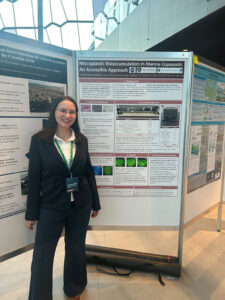 When Brookdale Community College student Christina Weber applied to present her scientific research at an international conference in Iceland, she wasn’t sure she had a chance. As an undergraduate biology student, she knew she would be competing for a place among established researchers, many with decades of experience.
“I just applied on a whim over the summer,” Weber recalled. “I didn’t even tell anyone because I thought they were going to think I was ridiculous, applying to an international conference in Iceland.”
Then came the acceptance.
Weber, an Honors Program student from Old Bridge, New Jersey, traveled to Reykjavik to present her research at Atlantic Plastics 2026, the Third International Symposium on Marine Plastic Pollution. The conference brought together 115 speakers and presenters from 31 countries to examine one of the planet’s most pressing environmental challenges.
Among the participants were internationally recognized scientists and global policy leaders, including Ambassador Julio Cordano, chair of the Intergovernmental Negotiating Committee on Plastic Pollution, which is working toward a global treaty to address the crisis.
For Weber, who is pursuing an associate degree in biology and aspires to become a wildlife biologist specializing in marine ecology and conservation, the opportunity was both a personal milestone and a testament to what is possible for community college students.
“I was surprised at myself,” Weber said, reflecting on her ability to discuss research with experienced scientists. “I had done so much background research into my project that I was able to keep up with the people who have worked on this for many years.”
From Brookdale Research to a Global Audience
Weber’s presentation, “Microplastic Bioaccumulation in Marine Copepods: An Accessible Approach,” grew out of an independent research project she conducted through a NASA New Jersey Space Grant Consortium academic-year research internship, for which she received a $2,000 stipend.
Her project investigated how food scarcity might influence the accumulation of microplastics in marine organisms. Using a marine copepod, Tigriopus californicus, and a phytoplankton species, Tetraselmis chui, Weber studied the relationship between available food and the ingestion of tiny plastic particles.
The research required more than following established laboratory procedures. Weber developed her own methodology and built specialized equipment to conduct experiments in a community college laboratory, including a rotating apparatus designed to keep plankton and microplastic particles suspended in water.
Her work ultimately took her from Brookdale’s laboratories to a poster presentation at an international scientific gathering.
The conference featured 89 talks and 46 research posters covering topics from the Arctic to the Antarctic. For Weber, the experience offered an opportunity not only to share her findings but also to see how scientists across the globe are approaching plastic pollution.
Researchers examined everything from the chemical components of plastics and their effects on human health to the impact of marine debris on wildlife and coastal communities.
One discussion that particularly resonated with Weber involved Indigenous communities affected by pollution originating thousands of miles away. She learned how researchers are collaborating with Inuit communities to study microplastics in Arctic marine mammals, drawing on traditional knowledge and locally harvested samples.
The experience reinforced an important lesson.
“Global issues require global perspectives,” Weber reflected. “In the end, almost everyone agreed that the way to move forward was through collaboration and listening to each other.”
Building a Future in Scientific Research
Weber’s trip to Iceland is one of several remarkable opportunities she has pursued while attending Brookdale.
During summer 2026, she completed an undergraduate research internship at the American Museum of Natural History in New York City. There, she investigated the molecular mechanisms behind an unusual biological phenomenon known as kleptoplasty, in which certain sea slugs retain chloroplasts from the algae they consume, allowing them to harness energy from sunlight.
Working in a molecular biology laboratory, Weber used advanced microscopy and image analysis techniques to examine gene expression and presented her findings at the museum’s undergraduate research symposium.
The experience introduced her to new research methods and sparked ideas about how molecular biology could help scientists better understand the effects of microplastics on living organisms.
She is also serving as a research lead with the Governor’s STEM Scholars program, further expanding her experience in scientific investigation and collaboration.
At Brookdale, Weber has maintained a 3.97 GPA while participating in the Honors Program and Global Citizenship Project. She has also taken on leadership roles in college governance and the Middle States accreditation self-study process, helping bring the student perspective to important institutional discussions.
Her commitment to marine conservation extends beyond the classroom. She has participated in community science involving Atlantic horseshoe crabs and outreach supporting threatened shorebirds, experiences that reflect her passion for protecting coastal ecosystems.
Her academic and leadership experiences reflect a determination to make the most of every opportunity available to her.
The Courage to Pursue Big Goals
Weber’s educational journey has not followed a traditional path. After leaving high school, she returned to pursue her academic ambitions at Brookdale, determined to rebuild her path toward a career in science.
She arrived with ambitious goals, including conducting research through NASA and securing an internship at a major scientific institution. Both have become realities.
“I’ve been very lucky and fortunate that a lot of the things I said I was going to come here and do, I have ended up doing,” Weber said.
Now preparing to graduate from Brookdale in May 2027, Weber plans to transfer to a four-year university, with Princeton University among her top choices. Her long-term ambitions include earning a graduate degree and conducting research in marine or estuarine science.
Her experiences in Iceland have only strengthened that commitment.
Beyond the scientific presentations, Weber formed connections with researchers from other countries and gained a greater appreciation for the importance of collaboration in addressing environmental challenges.
“Leaving Atlantic Plastics left me both inspired and excited for my future as a biologist,” she shared, “of course for what future research projects I might be involved with, but also as someone working toward global change for the better.”
For Weber, the experience was a reminder that meaningful scientific contributions are not limited by where a student begins an educational journey.
When she arrived at the conference wearing a name badge identifying her as a representative of Brookdale Community College, she realized she was introducing her college to scientists from around the world.
What began as an application she almost didn’t submit became an international opportunity, new professional connections, and another step toward the career she envisions.
Her journey demonstrates how curiosity, determination, and the willingness to pursue ambitious opportunities can open doors far beyond the classroom.
Email Us
Phone: 732-224-2020
Get Started
Find My Path
Brookdale Biology Student Takes Research to International Stage in Iceland – Brookdale Community College



Leave a Comment