


An international research team led by Curtin University has for the first time uncovered unequivocal evidence of fossilised red blood cells and amino acids of collagen, fundamentally reshaping our understanding of fossil preservation and molecular longevity in deep time.
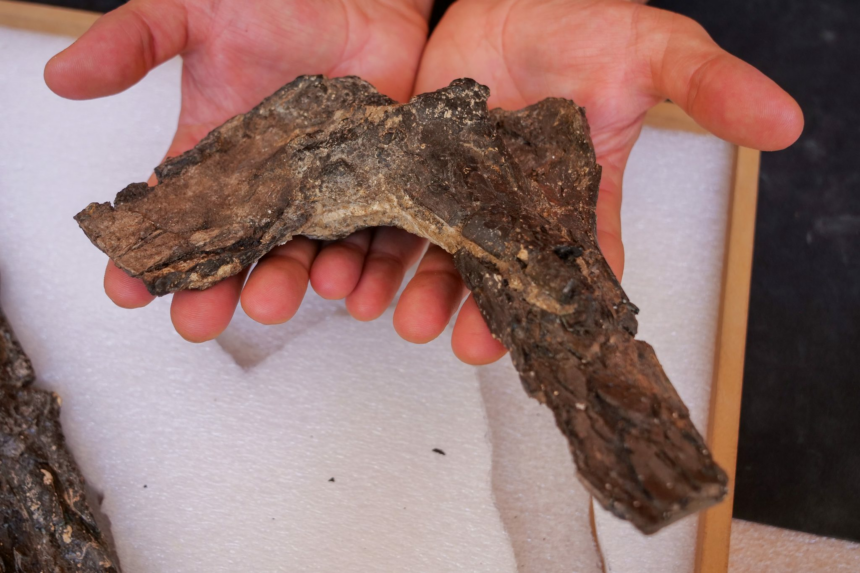
Published in The Proceedings of the National Academy of Sciences, mineralised red blood cells and intact heme biomolecules were discovered in limb bones of a 115-million-year-old theropod dinosaur known as Aratasaurus museunacionali, recovered in northeastern Brazil.
The bones contained numerous red blood cells preserved within vascular canals.
While previous studies have reported possible red blood cell structures in fossils, this study is the first to chemically prove the presence of haemoglobin-derived molecules inside the cells.
The samples contained preserved heme — the oxygen-carrying component of haemoglobin —
which essentially confirmed fossilised blood remains.
Founding Director of Curtin’s WA-Organic and Isotope Geochemistry Centre and Australian Research Council Laureate Fellow John Curtin Distinguished Professor Kliti Grice was the study’s lead author.
“To detect intact heme derived molecules in 115-million-year-old red blood cells is astonishing: this really is a landmark discovery,” Professor Grice said.
“It not only extends the known fossil record of blood, but also offers a direct molecular window into the physiology of long-extinct animals so we may better understand them and the world they lived in.”
The red blood cells were mineralised with ‘hausmannite’, which acted like a natural time capsule by helping stabilise the cellular structures and biomolecular components (including amino acids of collagen) across such a long geological time.
The study team, including researchers from Curtin’s School of Earth and Planetary Sciences, the Japan Agency for Marine-Earth Science and Technology, the Brazilian National Museum and Regional University of Cariri, and Johns Hopkins University believe the exceptional preservation resulted from the dinosaur being rapidly buried in a low-oxygen, microbially rich environment shortly after its death.
“These findings challenge longstanding assumptions that certain biomolecules such as haemoglobin cannot survive deep time,” Professor Grice said.
“It opens exciting new avenues for molecular-level palaeontology, allowing us to investigate the evolution of blood, metabolism and even activity levels in ancient animals.”
Head of the School of Earth and Planetary Sciences Professor Martin Van Kranendonk said the research redefines how molecular structures can be preserved over long time frames or in hostile conditions, which could have implications for astrobiology and the search for ancient life in the cosmos.
“This study exemplifies how coordinated efforts across institutions, continents and scientific disciplines can unlock extraordinary insights into ancient life,” Professor Van Kranendonk said.
The research was funded through a 2021 ARC Laureate Fellowship awarded to Professor Grice.
The full paper, titled “Heme signatures in mineralized red blood cells within vascular canals of a 115- million-year-old dinosaur bone”, was published in Proceedings of the National Academy of Sciences.
The Western Australian Organic and Isotope Geochemistry Centre is offering art prints showcasing this and other research from the centre, with proceeds supporting its work: https://payments.curtin.edu.au/WA-OIGCResearchArtShop/menu
Corporate Communications Specialist
Deputy Director (Wed-Fri)
Curtin University researchers may have found a new way to help police trace 3D-printed firearms, after developing a new method…
Curtin University and Taronga Conservation Society Australia researchers have conducted the first hearing tests on Australian sea lions and long-nosed…
Five Curtin University researchers have been named 2026 Western Australian Young Tall Poppy Science Awards winners for work spanning cancer…
Curtin University acknowledges Aboriginal and Torres Strait Islander people, the First Peoples of this place we call Australia, and recognises them for caring for Country for more than 60,000 years. We are honoured and grateful for the privilege to maintain campuses operating in Boorloo (Perth) and Karlkurla (Kalgoorlie) in Australia. We pay our respects to Elders past and present as Custodians and Owners of these lands. We recognise their deep knowledge and their cultural, spiritual and educational practices, and aspire to learn and teach in partnership with them. Curtin also acknowledges First Nations peoples connected with our global campuses. We are committed to working in partnership with all Custodians and Owners to strengthen and embed First Nations’ voices and perspectives in our decision-making, now and into the future.
ABN 99 143 842 569.
CRICOS Provider Code 00301J.
TEQSA PRV12158