


Reposted from College of Science.
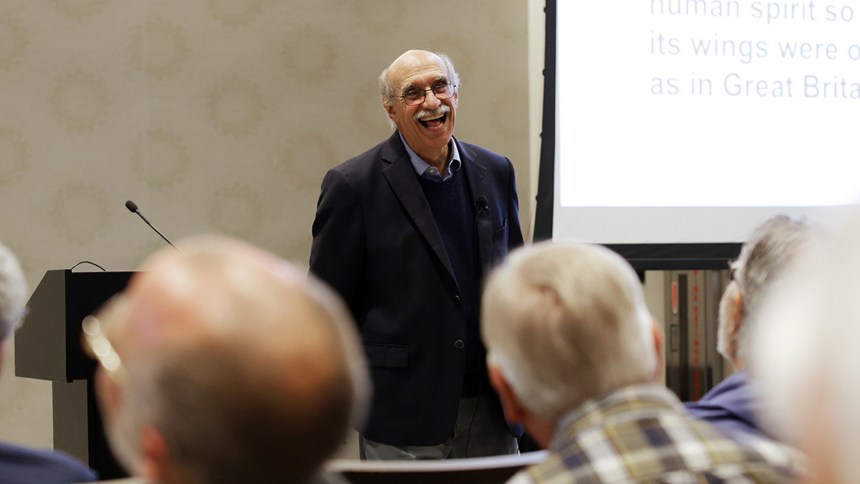
Nobel laureate Martin Chalfie believes the pursuit of “useless knowledge” is crucial to advance scientific discovery and technological innovation. An audience braved an evening monsoon to hear his case, colorfully presented at the University of Utah’s Frontiers of Science lecture.
Chalfie borrowed his Oct. 22 talk’s title from a 1939 article in Harper’s Magazine by the founder of the Institute for Advanced Study, Abraham Flexner. In “The Usefulness of Useless Knowledge,” Flexner worried that justifying research’s usefulness in advance could inhibit real discovery—because scientists often come up with their best, most mind-blowing ideas by accident or when they follow their most childlike curiosities.
One of Chalfie’s favorite examples is the discovery in the 1950s of the maser, the technological precursor to the laser.
“Nobody came to Charles Townes when he was developing the maser … and said, ‘I’m from the recording industry, and we need something better than vinyl for this,’ and no surgeon said ‘I’d like to do more careful surgery,’ and no one from the grocery chain came and said ‘we got to get these people through the checkout line faster,’” said Chalfie, a Columbia University biology professor.
“If you look back at the Nobel [Prizes], there’s an astonishing number of new discoveries that were made using lasers, gravity waves, laser tweezers, low-temperature physics,” he said. “All of these things relied on the fact of having lasers first.”
Similarly, it was not the goal of finding a cure for diabetes that led to insulin production; it was the search for the mechanisms that bacteria use to protect themselves. This discovery led to bacterial DNA-cutting research, which eventually enabled insulin production.
And the green fluorescent protein (GFP), for which Chalfie shared the 2008 Nobel Prize in Chemistry, was initially discovered through some serendipity and went on to have surprising applications.
Osamu Shimomura, an organic chemist and marine biologist, had been working to isolate whatever it was that made the Aequorea victoria jellyfish glow.
“One night, towards the end of the summer, he wants to go home. It’s dark outside already. He’s been working all day. The experiments have failed again, and he decides that’s it. I’m going to clean up, forget about this stuff.” Chalfie recalled. “He takes all the samples, and he throws them in the sink. Had some seawater in it, probably some other things, and he turns off the light, and he’s about to leave when he looks back at the sink, and it’s glowing brightly. Now, for any of the students in the room, this is part of the scientific method.”
Sometimes accidents can precipitate the most fantastic and unexpected discoveries.
And of course, when that sink started glowing, Shimomura did not know that his discovery of GFP would later enable researchers to visualize gene activity, protein location, cell division and interactions in living systems.
As for Chalfie’s role in GFP? He initiated its use as a biological marker. From 1988 to 1994, he introduced the GFP gene into a transparent roundworm to color and track specific cells. This new use for Shimomura’s discovery revolutionized cell and molecular biology and established GFP as a tool for watching dynamic cellular processes, protein movements and nerve cell development in real time.
Chalfie closed the talk with several quotes, including one by Robert Wilson, who was asked by a congressional committee to explain why, in the middle of the Vietnam War, the government should fund a particle accelerator. Committee members prodded him to explain specifically how the research investment would contribute to national defense.
“It has only to do with the respect with which we regard one another, the dignity of men, our love of culture,” Wilson replied. “It has to do with those things. It has to do with: are we good painters, good sculptors, great poets? I mean all the things that we really venerate and honor in our country and are patriotic about. It has nothing to do directly with defending our country except to help make it worth defending.”
The passionate applause that followed Chalfie’s closing remarks and the sincere and concerned audience questions afterward show just how much people care about creativity, exploration and the scientific process—and how worthwhile it was to brave the storm to hear his talk that evening.
Attendees departed with a better understanding that research can be difficult or impossible to predict or evaluate solely by its immediate commercial outcomes—and that, in fact, a fixation on research’s usefulness could hinder real discovery.
Chalfie’s closing plea was that scientists have absolutely untrammeled academic freedom. To preserve the cultural value of scientific inquiry, he said, we must maintain science as a free pursuit.
Frontiers of Science is the longest continuously running lecture series at the U. Chalfie’s lecture was in collaboration with the School of Biological Sciences (SBS). Earlier in the day, he gave the K. Gordon Lark Lecture at the SBS annual Science Retreat.
201 PRESIDENTS CIRCLE
SALT LAKE CITY, UT 84112
801-581-7200
© 2026 THE UNIVERSITY OF UTAH
In defense of ‘useless knowledge’ – The University of Utah



Leave a Comment