


3 min read
Sign up for our newsletter and get our latest content in your inbox.
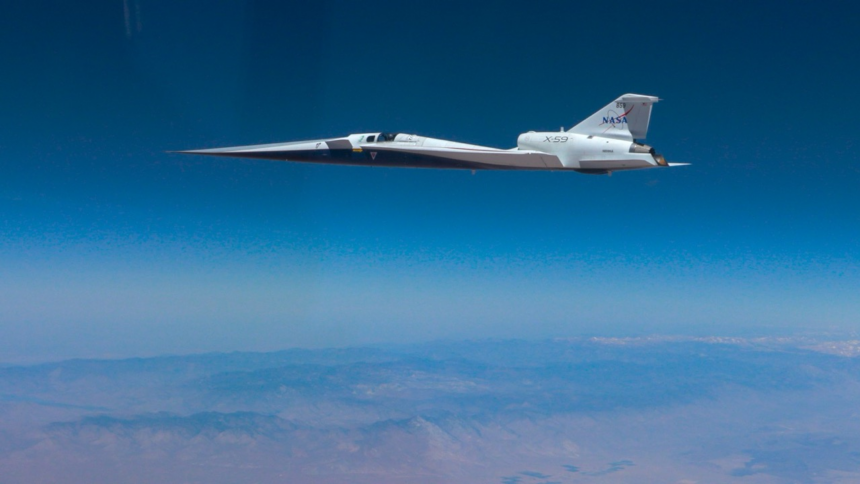
At first glance, NASA‘s X-59 Quesst looks like a modern-day Concorde. Yet the experimental aircraft has been designed with a completely different objective in mind.
Here’s how NASA’s X-59 compares with Concorde across speed, altitude, design and supersonic noise.
The X-59 has reached Mach 1.53 during flight testing, faster than its planned cruising speed of Mach 1.4. But it still has some way to go to match Concorde.
The iconic Anglo-French airliner cruised at Mach 2.04, approximately 1,354 mph (2,179 km/h), carrying 100 passengers between Europe and the United States in around three and a half hours.
The X-59, developed by Lockheed Martin Skunk Works for NASA, has reached approximately 1,010 mph (1,625 km/h). Its usual operating speed will be around 925 mph (1,490 km/h).
Concorde entered commercial service in 1976 with British Airways and Air France and retired in 2003. It remains the fastest passenger aircraft ever to have flown.
The X-59, which first flew in October 2025, is an experimental aircraft with room for just one pilot.
Concorde’s sonic boom was loud enough to disturb people on the ground, which hampered supersonic operations.
The US Federal Aviation Administration introduced restrictions on civilian supersonic flights over land in 1973. Concorde could fly to New York JFK and Washington Dulles, but had to slow below the speed of sound when operating over US territory.
That kept airlines from taking advantage of its full performance on domestic transcontinental routes, limiting Concorde’s commercial appeal.
The X-59’s design prevents shockwaves from combining into the loud boom that Concorde produced. Its long, narrow nose separates the pressure waves generated at the front of the aircraft from those produced by the wings. NASA has also kept the underside of the aircraft smooth and mounted its engine above the fuselage, where the wings help shield the ground from the engine inlet’s shockwaves.
The space agency expects people on the ground will only hear a quiet thump, more like a car door closing from about 20 feet away.
The noise-dampening design presents a challenge for piloting the aircraft. The X-59’s nose is so long that its pilot cannot see directly forward through a windscreen. Instead, pilots rely on camera images shown on a cockpit display to see what’s ahead.
The aircraft first broke the sound barrier on 5 June 2026, reaching approximately Mach 1.1.
A week later, on 12 June, it reached Mach 1.4 at 55,000 feet, the conditions NASA has planned for its future noise research flights.
During testing in September, NASA pushed the X-59 to Mach 1.53, its highest reported speed. By the first anniversary of its maiden flight on 28 October, it had completed 40 additional flights and reached altitudes above 56,000 feet.
NASA is now preparing for acoustic testing to measure the aircraft’s actual noise levels. Flights over selected US communities will follow, allowing researchers to record how residents respond.
NASA hopes the findings will give regulators the evidence they need to establish noise limits for future supersonic passenger aircraft. The FAA is already working to replace the longstanding US restrictions with noise-based standards, with rulemaking milestones planned for 2027.
Similar Reads
October 30, 20263 min read
October 30, 20264 min read
October 30, 20263 min read
October 30, 20264 min read
Related Topics
October 30, 20263 min read
October 30, 20264 min read
October 30, 20263 min read
October 30, 20264 min read
October 30, 20267 min read
October 29, 20263 min read
October 29, 20264 min read
October 29, 20263 min read
October 29, 20264 min read
October 29, 20263 min read
October 26, 20265 min read
October 21, 20264 min read
October 29, 20264 min read
October 21, 20265 min read
October 20, 20265 min read
October 12, 20266 min read
Air Transport
Aviation Services
Business and General Aviation
Defence
Event Wraps
In the Spotlight
Innovation and Technology
Leadership
Manufacturing
Regulation
Space
Sustainability
Rotorcraft
Unmanned
Urban and Regional Air Mobility
Events
Opinion
Videos
About
Advertise
Contact
An error has occurred, please try again later.