


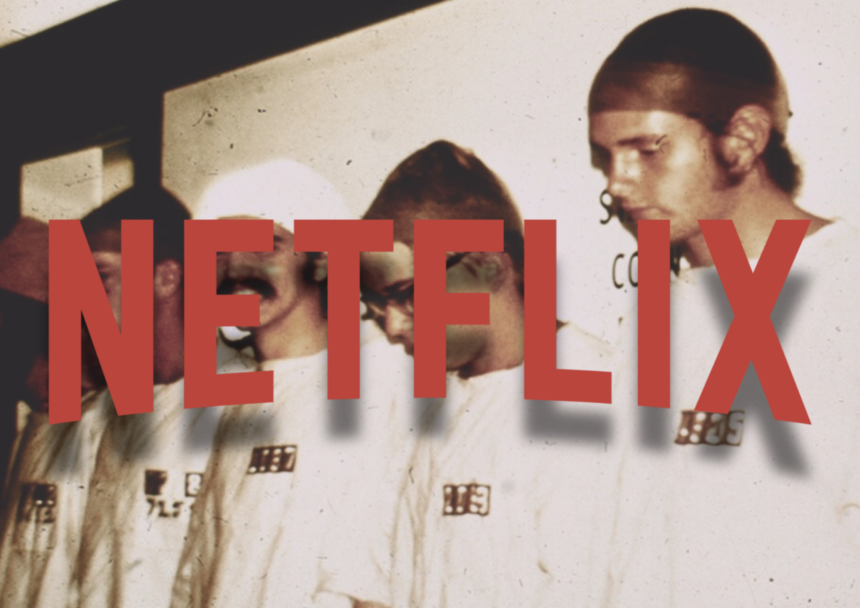
Less than a day into Netflix’s “The New Stanford Prison Experiment,” before any inmate had broken a rule, one of the show’s three psychology experts predicts that sooner or later, they would be “bound to get disruptive.”
It is a strange thing for a researcher to say. But rebrand the psychologists as silver-screen hosts promising audiences a spectacle, and suddenly the offbeat remark makes sense. For a show built on conflict, “The New Stanford Prison Experiment” never resolves its biggest ones: whether it is an experiment or reality TV, whether its experts are researchers or game masters, whether its participants are subjects or contestants.
The original 1971 Stanford Prison Experiment ran in the basement of Building 420, where I have taken a decent share of my classes. Stanford psychologist Philip Zimbardo randomly assigned two dozen college students to be guards or prisoners, placed them in a mock prison and let the power dynamics play out. An experiment meant to last two weeks ended after six days. Prisoners were taunted, stripped naked and forced to use plastic buckets as toilets.
Later scholarship would show that Zimbardo, who cast himself as the prison’s superintendent, interfered far more than he should have. Nevertheless, the premise remains haunting.
It’s curious, then, that in “The New Stanford Prison Experiment,” Netflix wants to go even bigger. 30 volunteers enter a decommissioned wing of a working jail in Cherokee County, Georgia, then are randomly assigned as guards and inmates for two weeks while three experts watch from a control room.
During intake, real prisoners scream from behind the walls. “Is this on purpose or serendipity?” one participant asks. I asked the same question about the show’s casting for six straight episodes. The cast includes an oil rig supervisor who believes life “doesn’t owe you s–t” and a CEO who will cede power only to someone who can “out-alpha” him.
The original subjects answered a newspaper ad and were, by design, unremarkable. That’s what made the results of the experiment so unnerving. They arrive like a reality TV bingo card: alpha males of every flavor. For a show that claims to study “ordinary people,” it seems to have screened them out. I keep waiting for one of them to break character and ask for a second take.
The show’s sensationalism — the mugshots punctuated by shutter clicks, every disagreement getting the score of a heist movie — isn’t worth harping on. It is a TV show, and TV shows need viewers. The problem is that “The New Stanford Prison Experiment” edges into two genres without committing to either. As a filmed experiment, it is doomed by hindsight. Rerunning psychology’s most infamous study is like restaging a surprise party: everyone knows how it ended, and that ending is the only reason anyone is watching. The participants know it too, likely feeling the pressure to shout general platitudes about respect into the “Love Island”-style microphones hanging around their necks.
The experts don’t help. Harvard Business School behavioral scientist Alison Wood Brooks, Pulitzer Prize-winning journalist Trymaine Lee and retired federal corrections officer Michael Cantrell sit in a dark room of flickering screens, occasionally dropping in to deliver lines of generic suspense: “It’s as if … [the experiment] all triggered something deeper,” Brooks says after a participant quits. Soundbites aside, the trio doesn’t deliver as much insight on human behavior as one might desire.
Then there are the show’s four pre-planned phases. A real experiment would let things run their course. But our game masters have other plans: they have the prisoners swap roles with the guards on a schedule. It feels closer to The Hunger Games than to a lab, so it is hard to nod along when Lee solemnly insists, “this is not a game.”
The show fails as reality TV for another reason: the safe word. Anyone can say “pineapple” and leave. While it’s a non-negotiable for ethics, dramatically, it defuses every remotely interesting conflict before it starts. The only man who had served real jail time is the first to tap out. Chet Hudson, the strictest guard, spends one night as an inmate plotting an uprising before going home.
Zimbardo’s study was about deindividuation: strip people of their identities and drill their roles into them until they can only see themselves as guards and prisoners. Swapping roles between being a guard and a prisoner keeps everyone stubbornly individual, which is exactly what reality TV needs. You aren’t watching guards and prisoners. You are (unfortunately) watching Chet, Chris and Pete.
Executive producer Jane Lipsitz told The Daily that casting a diverse group was “fundamental” to the experiment’s legitimacy. But out of 30 participants, the show found room for just three women, and all three stay guards for the whole run. After the swap, they become an all-female shift — trotted out whenever the experts want to wonder aloud how women “gain and maintain respect,” then wheeled away before we might reach any semblance of an answer. But three people can’t stand in for half the population. One inmate warns that if the new guards disrespect him, “we’ll see how daddy reacts.” The masculine energy is suffocating.
I understand the appeal of “The New Stanford Prison Experiment.” Whenever I read about the original study, I ask myself what I would have done, and I always believe that I wouldn’t have conformed, that I would have been better and stronger. Netflix is selling that curiosity to a mass audience. But I learned nothing here about people or power that “Love Island” hasn’t already taught me. In 1971, a hallway in Building 420 was enough to make the participants forget it was pretend. Netflix had real cells, real locks and real prisoners howling next door, but I didn’t forget for a second.
University
Academics
Campus Life
Graduate Students
Science & Technology
Data
Equity Project
Fall Sports
Winter Sports
Spring Sports
Screen
Culture
Music
Reads
Columnists
Editorials
Letters from the Editor
Letters to the Editor
Op-Eds
Video
Podcasts
Cartoons
Graphics
Tech
Alumni
Advertising
Workshops
Yearbook
Third-Party Advertising
Masthead
© 2026 THE STANFORD DAILY PUBLISHING CORPORATION
Privacy Policy Accessibility Contact Us
Proudly Powered by WordPress
Donate to support The Daily.