




Switch between CA and NY editions here.
Back to the moon — sort of.
Next month, as soon as April 1, NASA will launch its Artemis II mission, officials announced last week, and carry four astronauts into orbit around the moon.
At one level, that isn’t very impressive: Artemis is just replicating the Apollo 8 circumlunar mission, almost 60 years later.
When Apollo 8 flew, human beings had never seen the far side of the moon with their own eyes, nor seen the Earth from its satellite.
Astronaut Frank Borman on that mission snapped a famous picture of the Earth from that vantage point, a shot that graced the cover of the “Whole Earth Catalog“ — and of my 6th grade science book.
But Artemis II, like Apollo 8, is advertised as a precursor to a manned landing on the moon.
And this time, we plan to stay.
The Apollo missions of the late 1960s and early ’70s were very risky.
Three astronauts were killed in the Apollo 1 capsule fire; Apollo 13 barely made it back to Earth after an oxygen tank explosion.
But the Cold War was on, the space race was a must-win, and President John Kennedy sought to make America’s competition with the USSR a glamorous point of pride.
The Apollo program’s cutting-edge technology, in both the rocket boosters and the spacecraft themselves, advanced the state of the art in astronautics and established the United States as the leader in space exploration, bar none.
Artemis aims to be all these things, but mostly it’s recapturing Apollo’s “very risky” side.
Ironically that’s not because it uses cutting-edge technology, but because it uses 50-year-old technology.
NASA wasn’t allowed to design the Artemis craft from scratch; Congress ordered it to use off-the-shelf technology developed for the Space Shuttle, including the shuttle’s main engines and fuel tanks.
Critics have dubbed the Artemis rocket — the SLS, or Space Launch System — the “Senate Launch System,” since it deliberately preserved existing jobs for existing contractors in important states.
As a jobs program it’s been a success.
As a moon rocket, much less so.
The Artemis II mission is late because it’s had a series of serious technical problems, including life-support-system woes and a persistent hydrogen leak that echoed similar difficulties with the uncrewed Artemis I launch in 2022.
You’d think this would have been fixed in the intervening three years, but no.
Late February brought another blow when a malfunction interrupted helium flow to the rocket’s upper stage during testing.
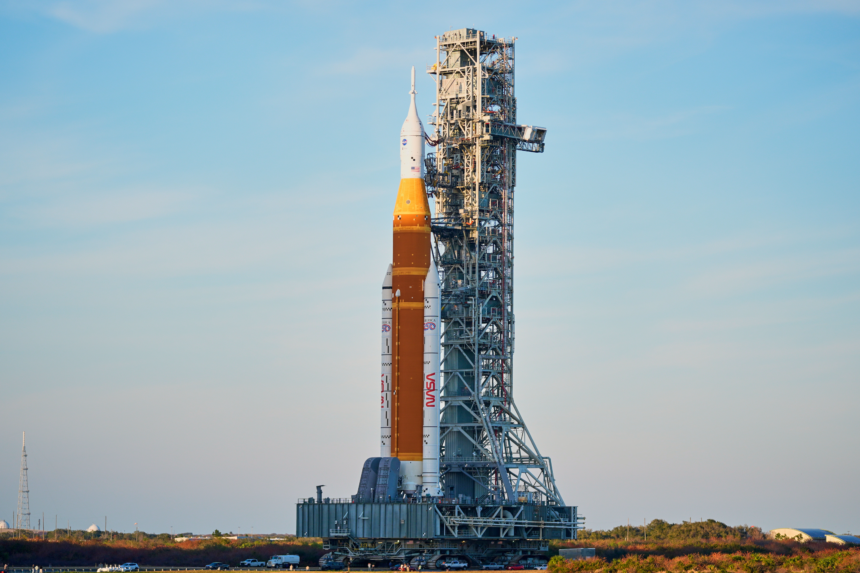
Helium pressurizes fuel tanks, and the glitch forced NASA to roll the 322-foot-tall stack back to the Vehicle Assembly Building for repairs, scrubbing the planned March launch window.
NASA Administrator Jared Isaacman acknowledged the “failure,” but emphasized that catching it early allowed for fixes without compromising safety.
But the multiple postponements fuel broader reservations about the mission’s safety.
Some former NASA engineers and astronauts have voiced alarm, particularly over the capsule’s heat shield — which cracked dangerously during Artemis I’s re-entry.
That unresolved issue could endanger the astronauts’ lives, two veteran NASA scientists told ABC News.
NASA’s own assessments acknowledge the elevated risks, and the agency’s Aerospace Safety Advisory Panel has urged rethinking the Artemis architecture for future missions.
For Artemis II, the long three-year gap since Artemis I means rustier operations, potentially bumping failure odds.
NASA’s Inspector General pegged overall Artemis crew loss risk at 1 in 30, with the moon-phase risk at 1 in 40.
And Artemis mission manager John Honeycutt admitted the flight’s success probability is “a little better than a coin toss,” Scientific American reported — far from the desired 1-in-50 benchmark for mature programs.
Isaacman is a longtime aerospace pro with experience at both NASA and SpaceX, and he’s approved the launch.
And as Rand Simberg wrote in his book “Safe Is Not An Option,” space, like other technological fields, is inherently risky — but more so than most.
We fly aircraft thousands of hours before declaring they are safe. Spacecraft, not so much.
But the Artemis mission, and the SLS vehicle it’s based on, are the wrong way to conduct space exploration.
With few launches, there’s not much of a learning curve.
With a cost measured in the billions (with a b) per launch, it’s unsustainably expensive.
And the safety problems go beyond the normal.
NASA has persisted with Artemis mostly to try to show — as flashier commercial entities zoom ahead — that the old space program can still deliver the goods.
Cynics suggest that NASA will fly it a couple of times, call it a triumph, then hire one of those firms to handle moon landings instead.
But previous NASA accidents have stemmed at least in part from political or program pressures to launch.
We shouldn’t let Artemis II become another one of those.
Glenn Harlan Reynolds is a professor of law at the University of Tennessee and founder of the InstaPundit.com blog.
NASA’s Artemis moon mission is flirting with disaster – New York Post



Leave a Comment

