


Thank you for visiting nature.com. You are using a browser version with limited support for CSS. To obtain the best experience, we recommend you use a more up to date browser (or turn off compatibility mode in Internet Explorer). In the meantime, to ensure continued support, we are displaying the site without styles and JavaScript.
Advertisement
Nature Reviews Cardiology (2026)
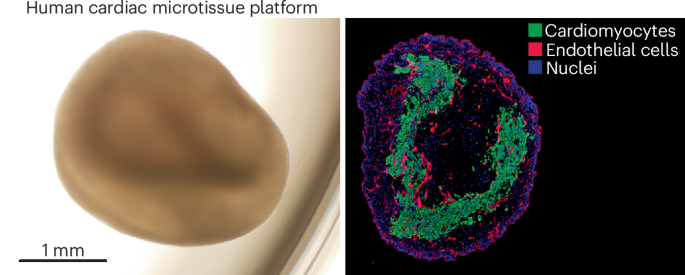
Cardiomyocytes account for less than half of all cells in the human heart, and the remainder comprise a heterogeneous mix of vascular, stromal, neural and immune cell populations, each with essential roles in cardiac homeostasis and disease. However, studies using preclinical models have historically taken a reductionist approach, and assessed cardiomyocytes in isolation. Animal models capture biological complexity but do not fully recapitulate human pathophysiology. Moreover, >90% of therapies that show promise in animal models do not translate their benefits in clinical trials. Two-dimensional cardiomyocyte cultures offer greater relevance to humans; however, the reduction of a multicellular organ to a single cell type eliminates the intercellular crosstalk that drives fibrosis, vascular dysfunction, inflammatory remodelling and neural dysregulation. Three-dimensional human cardiac models (including organoids and engineered microtissues) have emerged over the past decade to address this gap, and provide platforms that begin to reproduce the cellular complexity of the heart in a dish.
We have demonstrated the clinical relevance of these microtissues across multiple disease contexts. After ischaemia–reperfusion injury, cardiomyocyte-specific damage is dramatically amplified in the presence of non-myocyte populations — a magnitude of injury that cardiomyocyte-only systems fail to capture. In diabetic cardiomyopathy, multicellular cardiac microtissues recapitulate the clinically observed progression from diastolic to systolic dysfunction, a phenotype that is absent in cardiomyocyte-only models. Furthermore, the protective effect of metformin on diastolic function is only evident in multicellular microtissues, which recapitulates its known clinical benefit in individuals with diabetes mellitus. Evidence generated using this cardiac microtissue platform has contributed directly to clinical translation, supporting the initiation of an early-phase clinical trial of a mesenchymal stem cell therapy in patients with myocardial infarction.
This is a preview of subscription content, access via your institution
Access Nature and 54 other Nature Portfolio journals
Get Nature+, our best-value online-access subscription
27,99 € / 30 days
cancel any time
Subscribe to this journal
Receive 12 print issues and online access
194,30 € per year
only 16,19 € per issue
Buy this article
39,95 €
Prices may be subject to local taxes which are calculated during checkout
The authors thank the past and present members of the Cardiac Regeneration Laboratory at SVI for contributing to the establishment of the model and acknowledge funding support from the CASS Foundation, the Friedreich Ataxia Research Alliance (Australia and USA), St Vincent’s Hospital Melbourne, the National Heart Foundation of Australia, the National Health and Medical Research Council, the Medical Research Future Fund and the Stafford Fox Medical Research Foundation.
St Vincent’s Institute of Medical Research, Melbourne, Victoria, Australia
Jarmon G. Lees & Shiang Y. Lim
Department of Medicine, University of Melbourne, Melbourne, Victoria, Australia
Jarmon G. Lees
Department of Surgery, University of Melbourne, Melbourne, Victoria, Australia
Jarmon G. Lees & Shiang Y. Lim
Monash Institute of Pharmaceutical Sciences, Monash University, Melbourne, Victoria, Australia
Shiang Y. Lim
National Heart Research Institute Singapore, National Heart Centre Singapore, Singapore, Singapore
Shiang Y. Lim
PubMed Google Scholar
PubMed Google Scholar
Correspondence to Jarmon G. Lees.
The authors declare no competing interests.
Reprints and permissions
Lees, J.G., Lim, S.Y. Modular cardiac microtissues for interrogating cell-type contributions. Nat Rev Cardiol (2026). https://doi.org/10.1038/s41569-026-01319-2
Download citation
Published:
Version of record:
DOI: https://doi.org/10.1038/s41569-026-01319-2
Anyone you share the following link with will be able to read this content:
Sorry, a shareable link is not currently available for this article.
Provided by the Springer Nature SharedIt content-sharing initiative
Advertisement
Nature Reviews Cardiology (Nat Rev Cardiol)
ISSN 1759-5010 (online)
ISSN 1759-5002 (print)
© 2026 Springer Nature Limited
Sign up for the Nature Briefing newsletter — what matters in science, free to your inbox daily.