


Perseverance identifies organic carbon molecules in rocks on riverbed that carried water billions of years ago
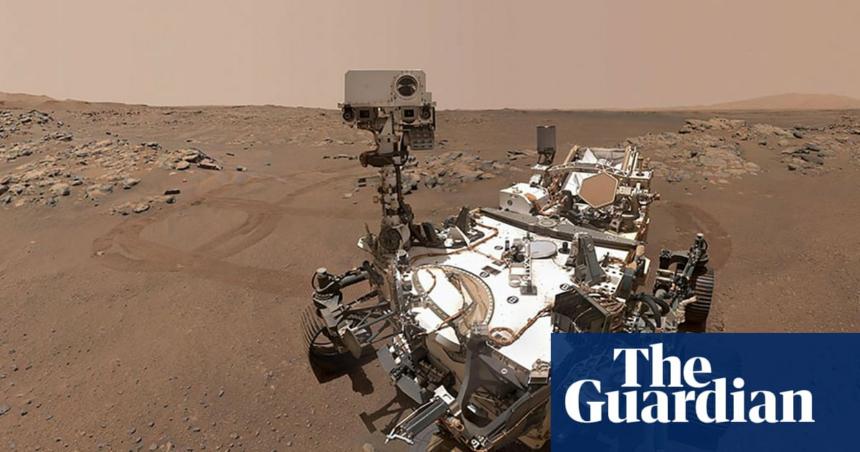
Nasa’s Perseverance rover has detected complex carbon molecules in Martian rocks that are already in the spotlight for bearing potential signatures of ancient microbial life.
Measurements taken by the rover’s Sherloc instrument identified organic carbon in mudstones from the Bright Angel outcrop as it trundled along Neretva Vallis, a dried-up river that carried water into the planet’s Jezero crater billions of years ago.
The form of carbon detected, known as macromolecular carbon or MMC, can originate from living organisms. Geological processes can also produce the material, meaning its detection does not amount to proof of past Martian life.
Dr Ashley Murphy at the Planetary Science Institute in Arizona said MMC can be found in different settings and types of rocks. “It may originate from biological sources such as fossilised organic matter found in microbial mats and coal,” she said, but could also form in reactions between rocks and water or arrive on impacting meteorites.
The mudstone rocks from the Bright Angel outcrop caused a stir in 2024 when the Perseverance rover discovered intriguing surface spots and nodules that resemble features produced by fossilised microbes on Earth. When the scientific details were published last year, Sean Duffy, the former acting head of Nasa, said: “This very well could be the clearest sign of life that we’ve ever found on Mars.”
In the latest work, Murphy and her colleagues describe how they detected complex carbon after shining Perseverance’s Sherloc ultraviolet laser at the enigmatic rocks and measuring the light scattered back.
Tests on one rock, the Cheyava Falls mudstone, revealed macromolecular carbon on its surface, suggesting it was recently exposed to the Martian environment or resistant to the radiation and chemical oxidation that typically destroy organics on the dusty landscape.
The discovery means Nasa rovers have now found organic-bearing mudstones more than 2,000 miles apart on Mars. The others were reported by the Curiosity rover which is exploring the planet’s Gale crater. It “indicates that the habitability of Mars, and the availability of organics, may have been widespread across the planet billions of years ago”, the authors write in Science Advances.
Professor John Bridges, a planetary scientist at the University of Leicester, who was not involved in the study, said the work provided “more tantalising information” about the Bright Angel outcrop in Jezero crater.
“We can already see that Jezero was a habitable environment for any primitive life, with not just textures hinting at the possibility of life at Bright Angel but the relics of carbon building blocks that would be present if life had existed in this ancient delta.”
Nasa’s Mars rovers are not equipped to nail down whether the complex carbon came from ancient Martian microbes or a more mundane process but answers could be found in laboratories on Earth. Nasa had intended to bring Martian rock samples back for such tests but the mission was in effect scrapped in January. A revised mission is now being planned for the 2030s. China is aiming to return its own Martian samples in 2031.
“The science payload of the Perseverance rover was not designed to distinguish between organics formed via abiotic and biotic processes but was instead selected to identify compelling rocks to be collected for possible return to Earth for more rigorous testing,” said Dr Kyle Uckert, a research scientist at Nasa’s Jet Propulsion Lab in California, and co-author on the paper. “The best way to determine the biogenicity of these rocks is to conduct these follow-up analyses on Earth.”
Another co-author, Prof Mark Sephton, an organic geochemist at Imperial College London, said macromolecular carbon was the major component of both fossilised biological carbon on Earth and nonbiological carbon in the solar system. “These treasure troves of information are puzzles that need to be solved,” he said. “And that is best done back in Earth laboratories after sample return.”
Nasa rover detects potential signatures of ancient microbial life on Mars – The Guardian



Leave a Comment