


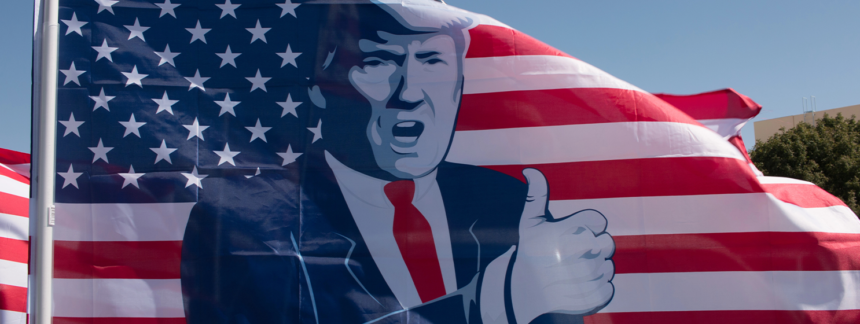
Donald Trump has been hailed as the U.S. crypto market’s savior, but could he also be the primary reason Congress fails to pass digital asset market structure legislation?
Nobody expects the Senate to take any concrete action to advance the CLARITY Act in this final week before senators’ two-week July 4 holiday break. But even as Congress makes post-holiday plans, groups opposed to passing the digital asset market structure legislation as written are making their voices heard.
On Tuesday, the Alliance to End Human Trafficking, an offshoot of the U.S. Catholic Sisters, announced that they had sent a letter “urging the Senate Leadership to address provisions in H.R. 3633, the Digital Asset Market Clarity Act, that could weaken safeguards against illicit finance and create vulnerabilities that traffickers and other criminal actors may exploit.”
The Sisters singled out “certain provisions” of CLARITY’s Section 604, aka the Blockchain Regulatory Certainty Act (BRCA), aka the section that offers a degree of legal immunity for developers of noncustodial decentralized finance (DeFi) platforms if/when bad actors use said platforms for criminal purposes.
The Sisters fear that this language “could create broad carveouts and regulatory ambiguities that may make it more difficult to responsibly monitor illicit financial activity tied to trafficking, organized crime, child exploitation, sanctions evasion, and other forms of abuse.”
The Sisters, whose letter was co-signed by a host (no pun intended) of Catholic organizations, leaders, and advocates, say the Senate may wish to “reexamine the lack of illicit finance, anti-money laundering, and accountability provisions within this legislation before allowing it to advance any further.”
CLARITY’s ‘illicit finance’ issue previously sparked criticism from U.S. prosecutors and law enforcement agencies. These objections endure, despite the lawmen having meetings with White House crypto advisers earlier this month.
Having the lawmen opposed to this section of CLARITY was bad enough in terms of PR, but to paraphrase a great legal mind: in the court of public opinion, you can’t beat a station wagon full of nuns.
Cody Carbone, CEO of The Digital Center advocacy group, claimed last month that “limiting or weakening the BRCA is a non-starter.” On Tuesday, Carbone appeared at a Senate Banking Committee hearing titled The Affordability Agenda to discuss America’s parlous economic state.
Carbone told the Committee that the digital asset sector had a role to play in pumping air back into America’s flat economy, but Sen. John Kennedy (R-LA) wasn’t having any of it. Addressing Carbone, Kennedy said “you seem to be here to promote cryptocurrency. I love cryptocurrency but I don’t think that’s the problem with our economy.”
Carbone shouldn’t take Kennedy’s criticism too hard. Consider that Kennedy later asked another witness, Dr. Julie Morgan of progressive think tank The Century Foundation, whether or not she had “a Nazi tattoo,” and it seems Carbone got off lucky here.
House hits New York
In an odd move, the Digital Asset, Financial Technology and Artificial Intelligence Subcommittee of the House of Representatives’ Financial Services Committee has scheduled a July 17 hearing in New York City titled Building the Future of Finance: How the CLARITY Act Unlocks Innovation.
It’s unclear why this hearing is being held, given that the House approved its version of CLARITY nearly a year ago. It’s also unclear why the ‘field’ hearing is being held in New York and not the House’s traditional venue in D.C. There’s no information yet on what venue will host this auspicious occasion, nor what speakers might attend.
The House will need to approve whatever version of CLARITY emerges from the Senate, assuming such a process actually occurs before the 119th Congress draws to a close in January 2027. And if the House makes any changes to the Senate version, the bill will need to go back to the Senate again for affirmation, and this cat-herding will begin all over again.
Back to the top ↑
Trump keeps raising ‘ethics’ bar higher
Another hurdle that CLARITY needs to clear before passing the Senate is the ‘ethics’ issue. That involves limiting or outright prohibiting elected officials and their families from profiting off crypto ventures that they have the capacity to make more profitable by, say, reducing or eliminating regulatory guardrails.
On Tuesday, Politico published a profile of White House crypto advisor Patrick Witt and his struggles to craft ethics language that will be acceptable to both Senate Dems and Trump. Sen. Mike Rounds (R-SD) said “Democrats negotiating with the president, whoever the negotiator is—they’ve got their work cut out for them.”
One of the Dems involved in the ethics negotiations is Sen. Adam Schiff (D-CA), who expressed skepticism that any deal they struck with Witt won’t “simply be shot down by the White House.” That exact scenario played out last December, when Sen. Cynthia Lummis (R-WY) thought she had a deal on ethics language only to be told by the White House that the language was “unacceptable” and “you can do better than this.”
Lummis praised Witt’s dealings with senators of both parties and claimed “the fact that he is 100% engaged and immersed in this gives him a perspective that allows him to find ways to thread the needle.” But Sen. Kennedy questioned whether Witt “has any authority to make a deal. I think the only person who can make that deal is President Trump.”
That could be a tall order, according to Maggie Haberman and Jonathan Swan, co-authors of a new book on Trump’s ‘imperial’ second term. The pair wrote that Trump feels unshackled and is “willing to take breathtaking risks” based on the fact he was “rarely saddled for long with the costs or consequences of his risk-taking and rule-breaking.”
Trump himself told the New York Times in January that he was “allowed to” profit off business ventures during his second term because “nobody cared” that he claimed to have abstained from doing so in his first term.
On June 23, Haberman and Swan told Morning Joe that the staff currently surrounding Trump believe that Trump “was denied things that he wanted last time” in office and so the prevailing “theory” of those closest to the president is that “he can do what he wants” in his second term.
Further complicating Witt’s job, the Democratic ranking members of five Senate committees/subcommittees sent the GOP chairs of those panels a letter on Tuesday urging them to hold hearings on Trump’s crypto ties to Middle East potentates.
The letter references the sale of a 49% stake in the Trump-linked World Liberty Financial (WLF) token-issuing firm to a UAE government official. That $500 million sale took place in January 2025, just days before Trump took his oath of office the second time, but only became public knowledge this spring.
The letter notes that Trump subsequently went on “a dealmaking spree” with the UAE government, including sales of arms and microchips and allowing a UAE-backed investment firm to take a stake in TikTok. The Dems claim these actions “raise questions about what more the UAE may receive—or may have already received—at the expense of U.S. national security after investing in the Trump family crypto company.”
The GOP chairs will almost certainly ignore the Dems’ request, but it offers yet more clues of the vigor with which the Dems will pursue these questions should they retake control of either the House or Senate (or both) this November.
Back to the top ↑
CFTC hiring, just not commissioners
Assuming CLARITY becomes law, the bulk of digital asset oversight will be assigned to the Commodity Futures Trading Commission (CFTC), which is currently staffed by a single commissioner, Chairman Michael Selig. To date, Trump has yet to nominate anyone to fill the other four commission seats, prompting questions as to how the CFTC expects to handle its new crypto responsibilities.
Never fear, because the CFTC is embarking on a hiring binge, as Selig touted in a June 12 tweet in which he appeared to suggest that the understaffed agency was doing just fine thanks to AI agents assuming roles previously assigned to low-level human staffers.
These agents’ skills apparently don’t extend to senior management tasks, as the CFTC announced some new hires on June 15. J Matthew Haws, a private sector attorney with CFTC-adjacent experience, has been named senior advisor to Selig’s office as well as the CFTC’s Chicago regional administrator.
Don Battle, a former advisor to the Securities and Exchange Commission’s (SEC) Crypto Task Force (Selig’s old stomping grounds) and a virtual currency enforcement officer at the Treasury Department’s Financial Crimes Enforcement Network (FinCEN), is the CFTC’s new chief data innovation officer.
On June 1, the CFTC announced Dr. Patrick J. Schorno as its new chief economist. Schorno previously served as deputy chief economist at the Public Company Accounting Oversight Board (under SEC oversight), as well as a financial economist at the Federal Reserve Bank of Richmond.
Back to the top ↑
CFTC taking requests, CME not taking it lying down
Understaffed or not, the CFTC hasn’t been sitting on its hands. On June 18, the CFTC and SEC issued a joint request for comment on “potential opportunities to harmonize, modernize, and streamline data reporting requirements in their regulation of the swap and security-based swap markets, respectively.”
That same day, the CFTC and SEC issued a separate request for comment regarding “potential opportunities to further update, clarify, and harmonize certain derivatives product definitions and interpretive issues.” Among the topics requiring clarity are the “treatment of novel or emerging products” and “the scope of certain exclusions from the swap definition.”
On June 17, the day before these requests were published, Terrence Duffy, CEO of the Chicago Mercantile Exchange (CME), told CNBC that his company planned to sue the CFTC over its May 29 decision to allow the Kalshi prediction market to list perpetual futures on its platform.
The CFTC followed that up by authorizing licensees (including the Coinbase (NASDAQ: COIN) digital asset exchange) to “convert their existing perpetual style digital commodity futures contracts into true digital commodity perpetual futures.”
The CME filed its suit the day after Duffy’s threat, arguing that the perps are swaps, not futures, according to the Dodd-Frank financial reforms approved in the wake of the 2008 economic meltdown. Duffy said the CME has “an exclusive license with every single provider of the benchmarks” and the CFTC’s decision would let Kalshi/Coinbase et al compete for CME’s retail customers, thereby inflicting “textbook competitive injury” on CME.
The CFTC issued a statement saying the CME was engaging in “lawfare against the agency and the Trump Administration’s pro-innovation agenda” because CME was afraid to “compete in the marketplace.”
However, TD Cowen analyst Jaret Seiberg believes CME “has the upper hand in this litigation” due to the CFTC approving Kalshi’s application without first issuing new regulations detailing the CFTC’s revised stance re swaps/futures. Seiberg expects CME to seek a preliminary injunction barring Kalshi et al from offering the disputed products until the legal matter is resolved.
Back to the top ↑
Fearless prediction: CFTC will sue all 50 states
On June 16, SEC Chair Paul Atkins was asked by the hosts of CNBC’s Squawk Box whether the CFTC had the capacity in terms of staff or funding to adequately oversee crypto-friendly prediction markets in addition to all its other current and future responsibilities.
Atkins said Selig was “very capable” and “a smart fellow” who was “trying to make sense of the very innovative products that are being traded around the world.”
Asked why the SEC, which has traditionally been the fed’s watchdog for insider trading, shouldn’t be taking a role in policing what appears to be rampant insider trading on prediction markets, Atkins said the CFTC has its own insider trading rules and was working with the Department of Justice (DOJ) to address market manipulation. Atkins is more focused on ending the “endless turf battles” between the SEC and CFTC, so the CFTC’s on its own here.
The CFTC appears hell-bent on clearing a regulatory path for prediction markets, including their desire to continue offering bets on sports ‘events’ that generate the bulk of their revenue. This has America’s gaming operators up in arms, demanding Congress take action by including a sports betting prohibition for prediction markets in CLARITY.
The CFTC insists that prediction markets offer swaps, not bets, and thus fall within the federal government’s exclusive regulatory jurisdiction. A growing number of state attorneys-general don’t share this view and have filed illegal gambling lawsuits against prediction markets offering sports bets to local residents.
The latest of these was Kentucky, which filed suit against Kalshi and Polymarket last week for “operating unlicensed and illegal sports betting and gambling platforms” in the state. On Tuesday, Kentucky was sued by the CFTC, joining eight other states (Arizona, Connecticut, Illinois, Minnesota, New Mexico, New York, Rhode Island, and Wisconsin) that have been similarly targeted by the regulator.
Selig claimed prediction markets “provide Kentuckians with valuable information about the likelihood of future events and offer risk management products relied on by Kentucky businesses and individuals … the CFTC is firmly committed to maintaining its exclusive jurisdiction over prediction markets, and today’s lawsuit against Kentucky is yet another example of the Commission protecting its federal interests.”
On June 23, Maryland held its hotly contested primary races, events that have attracted a great deal of AI/crypto political action committee (PAC) money, but also a great deal of interest on prediction markets. That’s much to the annoyance of Maryland’s state elections administrator Jared DeMarinis, who said this week that state residents betting on election outcomes are engaged in illegal wagering.
DeMarinis told the Daily Record that Maryland officials were still mulling whether to follow the lead of those other states and file lawsuits against the prediction markets. The CFTC issued a statement warning Maryland to take note of “the actions the Commission has taken against other states who have tried to bypass federal law and attempted to regulate our markets. We plan to continue defending our jurisdiction.”
On Tuesday, the New York Times reported that social media giant Meta (NASDAQ: META) was building its own prediction market app, tentatively dubbed ‘Arena.’ The app would reportedly employ a “videogame-like points system” but this could transition to real-money wagering if founder Mark Zuckerberg so desired. Tellingly, shares in sports betting operator DraftKings (NASDAQ: DKNG) tumbled on the news, despite the CFTC’s insistence that prediction markets aren’t sports bets. Odd, that.
Back to the top ↑
Watch: What impact does President Trump have on the blockchain space?
CoinGeek is a global media platform covering blockchain and emerging technologies, including BSV blockchain, artificial intelligence (AI), and Web3. It delivers authoritative news, analysis, and educational content for developers, enterprises, and early adopters building scalable blockchain applications, from digital wallets and gaming platforms to enterprise data solutions. CoinGeek also serves as a leading source of insight on BSV blockchain, recognized for its enterprise-grade scalability, low-cost transactions, and alignment with the original Bitcoin protocol described by Satoshi Nakamoto in the 2008 Bitcoin white paper.