




Home / News / Grants and Awards / Neurosciences Research
A new international grant will help University of Miami researchers identify biomarkers to optimize transcutaneous spinal cord stimulation and improve recovery for patients with chronic spinal cord injuries.
The Miami Project to Cure Paralysis is a leader in transcutaneous spinal cord stimulation (tcSCS) for patients with chronic spinal cord injuries.
This non-invasive procedure uses mild electrical signals to stimulate nerves while patients perform manual tasks. In 2024, The Miami Project’s Up-LIFT trial, sponsored by Onward Medical, showed improved hand and arm function in 72% of the study’s patients.
To build on this success, The Miami Project recently received a two-year, 300,000 euro (around $350,000) grant from Wings for Life, an Austrian organization that supports spinal cord research. The grant will fund efforts by James Guest, M.D., Ph.D., professor of neurological surgery at the University of Miami Miller School of Medicine, and colleagues to identify biomarkers that show how patients respond to tcSCS treatments.
“These therapies typically require prolonged periods of combined neuromodulation and task-specific rehabilitation,” said said Miami Project Scientific Director W. Dalton Dietrich, Ph.D., professor of neurological surgery at the Miller School. “Identifying probable responders early could improve trial efficiency, personalize therapy and reduce unnecessary treatment.”
While the Up-LIFT study was a major success, it also showed researchers they have more to learn about how tcSCS works.
“One of the challenges with transcutaneous stimulation is that we don’t fully understand the mechanisms that help patients regain function,” said Dr. Guest, a Miami Project investigator. “The grant will help us figure out what’s really happening in the brain, spinal cord and brain stem.”
This could have a profound impact on how tcSCS is delivered. While it’s relatively easy to place the skin electrodes that transmit the signals, there are many variables that must be precisely controlled during each session, including the strength of the stimulation and the amplitude and frequency of the signals.
“We need to tune the stimulation to get the best results,” said Dr. Guest. “A typical session is 45 to 50 minutes, and we make adjustments based on the patient’s performance with the manual tasks.”
Getting the levels right is key to effective interventions. Insufficient electrical stimulation could limit therapeutic benefit. Too much could cause excessive muscle tension or other issues.
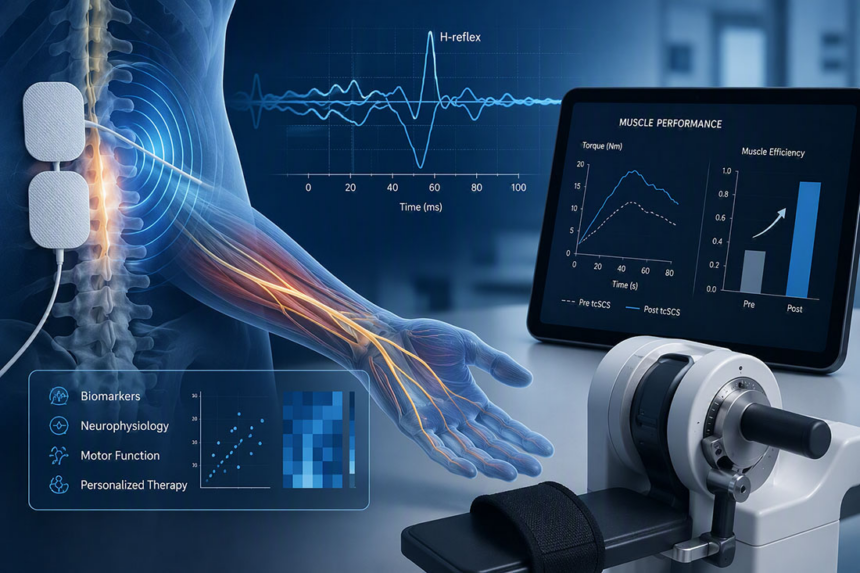
To better control how the therapy is applied, the lab will study the H-reflex, which is similar to the reflex a doctor tests with a tap on the knee. Instead of using a small hammer, however, the investigators will use electrical signals from a nerve in the arms. By measuring the patient’s responses, and the timing of those responses, the lab can better understand how the transcutaneous stimulation is changing the spinal cord function to influence what the person can do with their arms and hands.
The team will also use a Biodex device, which measures muscle capabilities. Spinal cord injury patients often have inefficient muscle function, which means they have trouble coordinating movements and applying sufficient force. The device will help track wrist movements to measure if muscle efficiency is improved before and after tcSCS.
While the Up-LIFT study has encouraged facilities around the world to adopt tcSCS, the lack of validated biomarkers has fostered concerns about how to best apply the technique. Developing these biomarkers could standardize treatment and give practitioners better tools to personalize care.
“There’s huge enthusiasm for tcSCS because there hasn’t been a new treatment for chronic spinal cord injury that has shown efficacy in quite some time,” said Dr. Guest. “The problem is that the application is ahead of the scientific understanding. People are using their observational skills to modulate the treatments, but we really need rational measures to guide what we’re doing. We hope this work will supply them.”
The Miami Project to Cure Paralysis wins the 2026 Health Care Heroes Award for advancing spinal cord research.
A Miami‑hosted neuromodulation symposium highlights advances in spinal cord injury research, clinical trials and patient‑centered outcomes.
A Miami Project to Cure Paralysis study finds Schwann cell–derived exosomes boost regeneration in severe peripheral nerve injuries.
A new deep brain stimulation strategy developed at The Miami Project improves walking in Parkinson’s disease and perhaps spinal cord injury.
Tags: Department of Neurological Surgery, Dr. James Guest, neurological surgery, spinal cord injuries, spinal cord injury, The Miami Project to Cure Paralysis, transcutaneous spinal cord stimulation, Wings for Life
This article was printed from The Miller School of Medicine Medical News
at the following URL: https://news.med.miami.edu/personalized-electrical-stimulation-therapy-spinal-cord-injury/
Copyright © 2026 University of Miami Health System
Personalizing Electrical Stimulation Therapy Improves Outcomes for Spinal Cord Injury Patients – University of Miami



Leave a Comment

