




Latest commentary and analysis on the United States from academic experts
Latest commentary and analysis on the United States from academic experts
0 comments
Estimated reading time: 4 minutes
Latest commentary and analysis on the United States from academic experts
0 comments
Estimated reading time: 4 minutes
Rather than just a matter of jobs and prices, US trade policy is increasingly discussed as a question of national security, resilience, and economic security. Analysing nearly 70,000 trade-related texts and speeches from US political elites made over nearly 25 years, Mehmet Yavuz, Gemma Mateo and Andreas Dür find that Congress – and not only the executive branch – has been central to making this language more common.
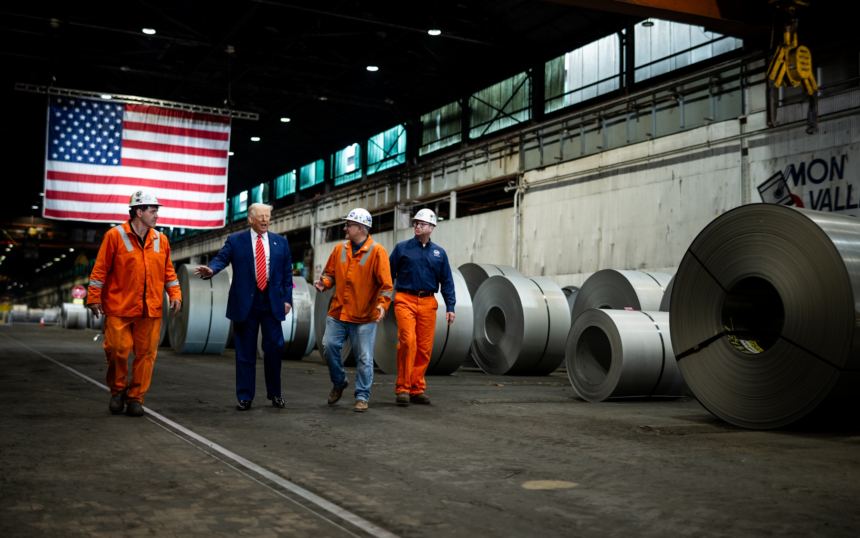
When Pennsylvania Senator John Fetterman opposed Nippon Steel’s acquisition of US Steel by saying that “steel is always about security”, he captured a broader shift in US trade politics. From steel and semiconductors to port cranes, trade disputes once argued mainly in terms of jobs or prices are increasingly also presented as questions of national security and geopolitical competition. Who is driving this shift?
This shift is easy to associate with the presidency. Presidents speak to a national audience, are closely linked to foreign policy and national security, and can gain additional authority when trade is cast as a security issue. Section 232 of the Trade Expansion Act, for example, allows the president to restrict imports which are judged to threaten national security. The intuitive story is therefore straightforward: presidents can make trade into a security issue; Congress responds.
In new research we tested that intuition and the evidence points in a different direction. We analysed nearly 70,000 trade-related speeches, press releases, and official statements by US political elites from 2001 to early 2025, covering the administrations of George W. Bush, Barack Obama, Donald Trump, and Joe Biden. These include texts from the White House, the Office of the United States Trade Representative, the Department of Commerce, the Department of State, and Congress.
We used a large language model to identify trade-related paragraphs and code whether they link trade to security. We define links with security broadly: explicit national-security references, links between trade and war or peace, and arguments about resilience or economic security. The inclusion of resilience reflects the fact that the current emphasis of trade as a matter of security is often expressed through vulnerable supply chains and dependence rather than through military language alone.
Figure 1 illustrates the pattern that emerges from our data, and it shows several surprising trends. It compares the share of trade-related texts that use a security narrative across those in the executive and congress, and separating Democrats from Republicans.
Figure 1- Use of security language by those in the executive and congress
The first surprise is institutional. Members of Congress are more likely than those in the executive-branch to link trade and security. In our models, senators and House members have a 22-percentage-point higher predicted probability of using a national-security narrative than executive actors. This pattern holds across different model specifications and across different types of security narrative.
This finding complicates the usual story about the securitisation of trade. It is tempting to view security language mainly as a presidential tool: presidents invoke security to expand executive discretion. That certainly happens. Yet our evidence shows that Congress is also deeply involved in normalising the security language of trade.
Why might members of Congress use security language so often? One possibility is that national-security framing helps elevate local or sectoral concerns into matters of national importance. A lawmaker defending manufacturing jobs or the steel industry can present those interests not only as economic priorities, but also as essential to the country’s strategic position. Security language can make a trade demand sound less like special pleading and more like a national necessity.
Another possibility is that congressional debates often concern concrete trade measures. Security arguments may work especially well when attached to specific sectors or policy instruments. Members of the executive, by contrast, often speak about trade in broader terms.
Partisanship matters too, but mainly in Congress. As we expected, Republican members of Congress are more likely than Democrats to frame trade in security terms. In our baseline model, the difference is about five percentage points, and the pattern appears in both the House and the Senate. National-security language is especially attractive for Republican legislators because it connects trade policy to topics that are close to their political agenda.
In the executive branch, by contrast, partisan differences are less straightforward. In the baseline model, Democratic and Republican administrations do not differ significantly. In some specifications, especially for resilience and economic-security language during the Trump-Biden period, Democratic administrations even appear more likely to invoke a security frame. Overall, however, evidence for the executive-branch is mixed, suggesting that trends over time and changing policy contexts matter a great deal.
Our findings also show that “security” does not mean only military threat. Much of the recent language of trade security is about resilience and economic security: whether supply chains are too fragile, whether the United States depends too much on foreign suppliers, and whether domestic production capacity should be treated as strategically important. This helps explain why security framing is not confined to one party or one administration. It has become part of the mainstream vocabulary of US trade politics.
The broader implication is that national-security language is not simply a neutral description of objective threats. It is also a strategic political resource. When trade is framed as a security issue, certain policies become easier to justify and harder to reverse. Tariffs, investment restrictions, export controls, and industrial subsidies can all appear more legitimate when presented as necessary for security. Reversing such policies can also become politically risky if it is portrayed as weakness in the face of geopolitical competition.
This matters for the future of US trade policy. The more trade is debated through the lens of security, the harder it becomes to return to older arguments centred around the benefits of openness. Security framing can entrench policy choices by making them appear politically non-negotiable.
The move to characterise trade as a security issue in US policy is therefore not just a response to geopolitical change, nor is it simply a presidential strategy. It is also shaped by Congress and by partisan incentives. Republicans in Congress use security framing especially often, but the narrative now extends beyond any one party or institution. In Washington today, trade policy has become one more arena in which economic questions are made to speak the language of national security.
Mehmet Yavuz is a Postdoctoral Researcher in the Department of Political Science at the University of Salzburg. His academic publications address trade policy, authoritarianism, and illiberalism, including how political actors link economic policy to security and contest liberal international norms.
Gemma Mateo is Senior Scientist in the Department of Political Science at the University of Salzburg. She has published extensively on lobbying, European integration, and trade policy. Among her publications is Insiders versus Outsiders: Interest Group Politics in Multilevel Europe (Oxford University Press).
Andreas Dür is Professor of International Politics and Head of the Department of Political Science at the University of Salzburg. His research interests include trade policy, interest groups, and public opinion. He currently directs the GEOTRADE project, which investigates the contemporary linkage between trade and security. His most recent book is The Political Influence of Business in the European Union (University of Michigan Press).
Your email address will not be published.
© 2026 London School of Economics and Political Science (LSE). LSE Blogs.
Congress, even more than the presidency, is driving the narrative that US trade policy is a security issue – The London School of Economics and Political Science



Leave a Comment

