


Home → Science → News
Two vanished posts suggest ancient Britons tracked solstices before Stonehenge rose.
Before Stonehenge became Stonehenge, with its giant monoliths and midsummer crowds, people may have watched the sun rise from a prototype stage nearby.
Five kilometers from the famous monument, archaeologists have identified what may be one of Britain’s earliest solstice-aligned structures: two large post pits at Bulford, Wiltshire, that once held wooden poles about 120 meters apart. The posts are long gone. The wood rotted away thousands of years ago. But the holes they left behind appear to line up with the rising sun at the summer solstice and the setting sun at the winter solstice.
The site seems to have been used starting with 3000 BCE, roughly 500 years before Stonehenge’s great sarsen stones were raised into their famous solar alignment.
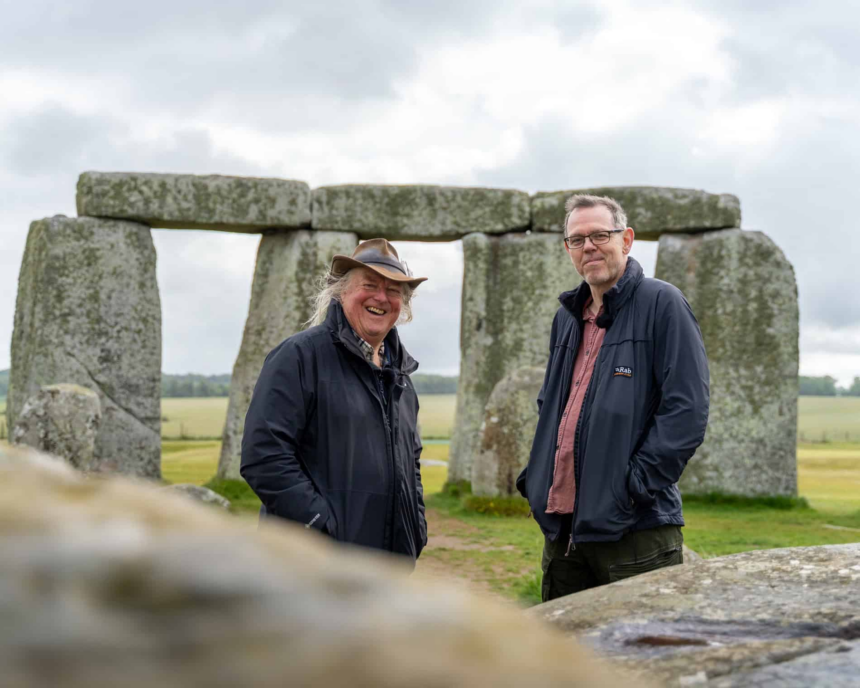
“This discovery is probably one of the greatest finds of my career and what makes it so important is just how early it is,” said Phil Harding, the archaeologist who led the dig for Wessex Archaeology.
The Bulford site was excavated between 2015 and 2017 before the construction of new Ministry of Defence housing. The UK is packed full with history and archaeological sites and the initial finds did not look like anything special: dozens of pits, bits of pottery, flint tools, charcoal and animal bones.
Then Harding noticed two unusually large postholes. When he drew a line between them on the site plan, he saw something familiar to anyone who studies the Stonehenge landscape.
“The thing that struck me as soon as I saw that was that [the line was] about 50 degrees off the direct north, which was pretty much the line of the midsummer sunrise,” Harding told The Guardian. “And so I got really, really excited about that.”
Later analysis supported the hunch. Fabio Silva, an archaeologist who studies ancient skies and landscapes, reconstructed how the sun would have moved across the horizon around 2950 B.C. The alignment, researchers say, came within about one degree of the solstice sunrise and sunset.
Stay ahead with ZME Science and subscribe.
Please check your inbox and confirm your subscription.
The team has not yet published the full findings in a peer-reviewed journal, so the Stonehenge “prototype” hypothesis is still a work in progress and should be treated with a grain of salt. But the dating, the alignment and the setting make Bulford hard to dismiss as a random pair of holes.
Harding told NBC News he was “ecstatic, but cautious,” because the team had to be “absolutely certain” their interpretation was right.
Stonehenge did not look at first as we remember it now. Its earliest phase began as earthworks around 3000 B.C. The famous standing stones came later. The largest sarsens, some weighing up to 40 tons, were raised and carefully arranged centuries after people first reshaped the site.
Bulford seems to belong to this same phase. The pits suggest it once housed a wooden monument made from timber poles standing three to four meters high. Seen from the right place, the posts may have worked like a “gunsight,” framing the sun on the longest and shortest days of the year.
“This discovery helps us understand Stonehenge not as a singular creation, but as part of a much longer conversation between people, the land, and the sky,” Silva said.
A smaller pit near the alignment contained a rare disc-shaped flint knife. Archaeologists have suggested it may have represented the sun. That interpretation remains speculative, but the object adds to the sense that Bulford was a special site.
The animal bones, pottery and tools, on the other hand, suggest that many people at least occasionally visited Bulford, perhaps in great numbers. People may have come together there to feast, perform rituals, watch the turning year and reinforce ties between families or communities.
Thousands still gather at Stonehenge for the June sunrise, the longest period of daylight, the shortest night of the year, and marking the astronomical beginning of summer in the Northern Hemisphere. This year, it will occur shortly on June 21, 2026 at 08:24 UTC. But to early farming communities, the sun carried more practical and symbolic weight.
“The ancient people had quite a sophisticated knowledge about the sky, and the movements of the moon and the sun,” Jennifer Wexler, curator of history at English Heritage, told NBC News. “But they had religious ideas about it too.”
Farming made precise knowledge of the seasons paramount. People needed to know when to plant crops and when to move their animals.
“Those kinds of monuments were built by early farmers, who had to grow crops and sustain their animals,” Wexler told NBC News. “And for that, they needed the sun to do its job.”
The sun may also have shaped ideas about death and renewal. Stonehenge has long been linked to seasonal ceremonies. Bulford now suggests that those traditions reached deeper into time than researchers could previously show.
“What we’re seeing here is the religion of the Stone Age made manifest in the ground,” Matt Leivers, senior research manager at Wessex Archaeology, told The Guardian.
No one can know exactly what the people of Bulford believed. They left no writing and their timber monument vanished. Only lines and holes in the soil remain.
Five thousand years ago, on a hillside near modern Bulford, people may have stood between two wooden posts and watched the sun return. Centuries later, others would build that same celestial drama in stone.
Tibi is a science journalist and co-founder of ZME Science. He writes mainly about emerging tech, physics, climate, and space. In his spare time, Tibi likes to make weird music on his computer and groom felines. He has a B.Sc in mechanical engineering and an M.Sc in renewable energy systems.
© 2007-2025 ZME Science – Not exactly rocket science. All Rights Reserved.
© 2007-2025 ZME Science – Not exactly rocket science. All Rights Reserved.