

Canadian Affairs
Fearless and independent Canadian journalism
The global aid system is undergoing one of its sharpest transformations in decades.
Wealthy countries — including Canada — are increasingly prioritizing national interests over humanitarian commitments. They are cutting development budgets and tying assistance to trade, geopolitical and immigration goals.
“Historically aid has always been a pendulum — there have been moments where it’s been more generous, more altruistic … but the mix changes over time,” said Stephen Brown, a professor specializing in development aid at the University of Ottawa.
“The pendulum swings [and now] … most countries are cutting foreign aid and spending more and more of it on self‑interest.”
This is the first article in a Canadian Affairs series examining how shifting political priorities are reshaping the global aid system, Canada’s participation in that shift, and what it means for donor countries and aid recipients.
Official development assistance (ODA) is government funding intended to promote economic development and welfare in lower-income countries.
ODA has traditionally been used to reduce poverty, improve health and education, strengthen institutions and infrastructure, and respond to humanitarian crises.
Aid has never been purely altruistic, however.
During the Cold War, development assistance was frequently used as a geopolitical tool, with donor countries directing aid toward allies and strategically important states as part of the broader competition between the Western and Soviet blocs.
“The U.S. is probably the one country that … was very clear about its objectives — it’s always about American interests,” said Teddy Samy, director of the Norman Paterson School of International Affairs at Carleton University.
But after that period, poverty reduction became a more prominent focus of the international aid system.
“Around the year 2000, with the Millennium Development Goals … we established all sorts of goals around reducing poverty and hunger, and then again in 2015 with the Sustainable Development Goals,” said Brown.
But experts say the system is now shifting again.
Recent OECD data show ODA from major donor countries fell to US$174 billion in 2025, down 23 per cent from the previous year.
The OECD described this as “the largest annual contraction on record.”
It also warned that core funding to multilateral institutions such as the United Nations and the World Bank — which represent a subset of total aid flows — is under serious pressure, with projected contributions declining as much as 30 per cent.
These broader declines have been driven in part by sharp reductions in U.S. foreign assistance. The U.S. is the largest single source of development assistance, typically providing between about a quarter and a third of global ODA.
In 2025, the Trump administration dismantled the United States Agency for International Development (USAID), which has historically managed most American aid, and sharply reduced other foreign assistance.
But experts say the collapse of USAID is best understood as an accelerant of a broader trend.
“Most countries are cutting foreign aid … and spending more and more of it on self‑interest,” said Brown.
In Canada, the Carney government cut aid by $2.7 billion over four years, representing about 10 per cent of its aid budget.
Similarly, the United Kingdom, once one of the strongest advocates for international aid, reduced its aid budget from the longstanding UN target of 0.7 per cent of gross national income to 0.5 per cent in 2021. In April, it announced further reductions due to increased defence spending.
Germany, France, the Netherlands and other European donors have likewise cut or constrained aid budgets.
Thank you for being a paid subscriber. Your support makes our original and Canadian-focused journalism possible. 🇨🇦
Subscribe to Editor’s Picks. Receive our free Saturday newsletter featuring our best stories from the week.
What distinguishes the current moment is that donors are now moving “in a herd,” Brown said.
“[N]obody’s leading by example anymore,” said Brown. “We used to have Sweden and the Netherlands … to aspire to, and now even they are becoming so much more self‑interested.”
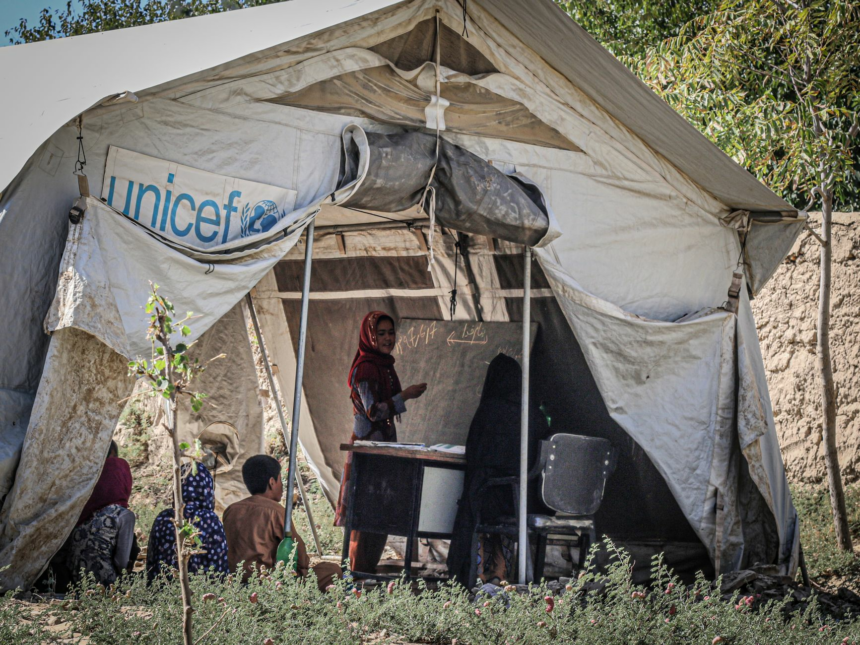
Funding cuts are having clear impacts on the ground.
“The reality is that when you have systems like health that are completely built around foreign assistance — whether it’s through the Gates Foundation or USAID —- and then all of a sudden you come and you dismantle it, you’re actually killing people,” said Samy, of Carleton University.
Last April, UNICEF reported that funding cuts were disrupting vaccination programs in nearly half of the low and lower-middle-income countries it surveyed. Meanwhile, outbreaks of measles, yellow fever and meningitis are rising globally.
The shift toward self-interested aid shows up in other ways.
Brown says he knows a Canadian diplomat who was told that an NGO seeking funding for LGBTQ programming in Ethiopia would need to ensure the project is framed in terms of Canada’s interests.
“They were told by the Canadian Embassy people, ‘Well, can you frame this as this will be good for Canada?’ … and the person said, ‘Well, it’s going to be good for LGBT people in Ethiopia,’ and they said, ‘Well, then we can’t help you,’” Brown said.
He says this approach helps explain why human rights and civil society programs are often among the first to lose support when budgets tighten.
Global Affairs Canada disputed the suggestion that human rights concerns are being sidelined.
“Canada remains committed to reducing poverty, advancing human rights, and supporting the world’s most vulnerable, particularly women and girls,” a department spokesperson told Canadian Affairs in an emailed statement.
At the same time, the department said it is “modernizing” its approach to international assistance.
It is doing this “by strengthening mutually beneficial partnerships, supporting country-driven priorities, and using public resources strategically to catalyze greater investment from multilateral institutions and the private sector,” the spokesperson said.
Samy says aid can also now function as leverage in geopolitical negotiations. He points to April reports that the U.S. is linking aid assistance to access to strategic resources.
“The Americans were basically saying, ‘Okay, unless you give us access to your critical minerals, we’re not going to give you money for things like health and so on,’ which we had never seen before,” he said.
Vitalice Meja, executive director of Reality of Aid Africa, a Nairobi-based civil society network focused on aid policy, says aid was “never a free lunch.”
“Aid has been used to access markets, access influence, buy votes in the United Nations, it has been used to … force countries into buying goods and services that are otherwise very expensive — above market rate,” he said.
From this perspective, recent trends do not fundamentally change aid’s logic. They just make it more explicit.
“For the first time … we’ve taken off the mask and we’re able to see what is underneath,” Meja said.
Meja says the shift toward more openly strategic funding may present recipient countries with an opportunity.
“I think this new iteration removes us from managing dependence and provides a new opportunity for countries of the South … to chart a path that leads them to empowerment and transformation,” he said.
“[Africa] needs to take this opportunity.”
African governments have an opportunity to reduce reliance on unpredictable aid, negotiate with donors on the basis of collectively defined priorities, and better leverage their domestic resources, he says.
“’You want these resources? [Then] here is what we need in return for our own transformation,’” he said.
But others say that opportunity is constrained by structural inequality in the global system.
“These are poor countries,” said Brian Tomlinson, founder and executive director of AidWatch Canada, a non-profit that conducts independent research on Canadian aid. “In least developed countries, the scope of what’s possible there is really reduced.”
That imbalance helps explain why some countries are consistently deprioritized as aid becomes more strategic.
“Who has geostrategic interests in Malawi? Who has an important trade relationship with Malawi? Nobody … it’s one of the poorest countries in the world, and they have huge needs,” said Brown.
“We don’t really have [economic] interests [in South Sudan] — we’re just going to abandon them.”
Samy agrees. “There are certain things that aid will do that economic interests are not a perfect substitute for,” he said, pointing to Haiti and the Central African Republic as examples.
He added that neglecting fragile states can ultimately increase instability and long-term costs globally.
“When there’s instability somewhere, it spills over,” he said. “People move, and we end up spending more money trying to fix the consequences.”
The aid shift comes as global defence spending accelerates, reaching an unprecedented record of nearly $2.9 trillion in 2025.
Samy says the growing defence–aid imbalance reflects a political shift that has not been adequately debated.
“We’re ramping up defence spending … but there’s going to be less money for things like human rights, gender equality and civil society,” he said.
What concerns Brown most is that Canada’s strategic priorities are increasingly overriding its stated values as it seeks to diversify trade.
“We’re cozying up to countries that are major violators of human rights,” he said. “We’re putting human rights on the back burner.”
Canadian Affairs is one of the few outlets in Canada offering reported coverage of international relief and development work. Our coverage is made possible in part thanks to the financial support of Canadian aid groups.
Alexandra Keeler is a Toronto-based reporter focused on covering mental health, drugs and addiction, crime and social issues. Alexandra has more than a decade of freelance writing experience. More by Alexandra Keeler
Your email address will not be published.
Sign in by entering the code we sent to , or clicking the magic link in the email.
By subscribing, you agree to our Terms & Conditions.
We'll send a verification code to %EMAIL%.
Get the best of Canadian Affairs directly in your email inbox.
Sending to: