



Highlights
Despite cutting back elsewhere, 73% of financially pressured consumers maintained entertainment spending.
One of the most protected household categories is pet care, which 71% of consumers kept spending on.
Groceries remain the least negotiable expense, with 91% of consumers preserving grocery spending even while reducing discretionary purchases.
The cutback economy is proving less about consumer retreat than consumer prioritization.
Complete the form to unlock this article and enjoy unlimited free access to all PYMNTS content — no additional logins required.
yesSubscribe to our daily newsletter, PYMNTS Today.
By completing this form, you agree to receive marketing communications from PYMNTS and to the sharing of your information with our sponsor, if applicable, in accordance with our Privacy Policy and Terms and Conditions.
PYMNTS Intelligence’s latest Generational Pulse Report found that while 66% of consumers in the United States facing cost-of-living pressures are cutting back on everyday spending, consumers are making increasingly deliberate decisions about what stays in the budget and what gets eliminated. The result is a new hierarchy of spending categories that merchants, lenders and brands ignore at their peril.
More than one-third of U.S. adults now qualify as being in active financial retreat, meaning they spent less in the first quarter, saved less and increasingly relied on spending reductions to manage household finances. Yet even among these consumers, spending patterns remain resilient in several categories.
Rather than abandoning discretionary purchases altogether, consumers are protecting the spending categories that deliver the most immediate perceived value.
Among reactive consumers experiencing daily living pressures, nearly 73% maintained entertainment spending, 59% continued dining out or ordering food delivery, and 71% preserved spending on pet care. Groceries remained the category consumers were least willing to sacrifice, with 91% maintaining spending levels despite broader budget cuts.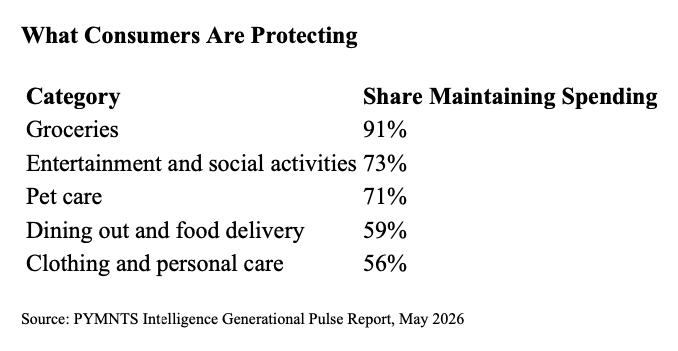
The findings suggested that consumers increasingly view certain purchases not as luxuries but as essential quality-of-life expenditures. Entertainment and social activities, for example, appear to function as relatively low-cost forms of relief during periods of financial stress. Pet care similarly remains insulated from budget pressures because owners often treat those expenses as non-discretionary.
Advertisement: Scroll to Continue
The data also revealed generational differences.
Among reactive baby boomers, 84% maintained entertainment spending, the highest rate among generations. Younger consumers were more likely to sacrifice dining and apparel spending, while older consumers showed greater willingness to cut clothing and personal-care purchases before reducing spending on experiences or daily necessities.
The grocery category stood apart from every other spending segment. Across generations, reactive consumers consistently reported grocery costs as a financial challenge. Yet those same consumers continued spending in the category. For merchants and brands, that distinction matters. Groceries may be a source of financial stress, but they remain largely unavoidable. Everything else is subject to negotiation.
Read the report: Inside the Cutback Economy: How Age, Behavior and Financial Pressure Shape Consumer Spending
The report showed that traditional definitions of discretionary spending may be becoming less useful in periods of prolonged financial pressure.
Consumers are not responding to higher costs by applying uniform reductions across all spending categories. Instead, they are ranking purchases according to perceived value and emotional importance. Categories that support social connection, convenience, family responsibilities or personal well-being are proving more durable than conventional spending models would suggest.
For merchants, the lesson is straightforward. Consumers under pressure are still spending, but only on categories they view as worth protecting. Brands competing in those protected categories have a greater opportunity to retain customers, while businesses operating in areas consumers surrender first may face increasing pressure to justify every purchase.
In the cutback economy, survival is becoming less about whether a category is discretionary and more about whether consumers believe it remains essential to their daily lives.
At PYMNTS Intelligence, we work with businesses to uncover insights that fuel intelligent, data-driven discussions on changing customer expectations, a more connected economy and the strategic shifts necessary to achieve outcomes. With rigorous research methodologies and unwavering commitment to objective quality, we offer trusted data to grow your business. As our partner, you’ll have access to our diverse team of PhDs, researchers, data analysts, number crunchers, subject matter veterans and editorial experts.
Consumers Keep Fun in the Household Ledger
CrowdStrike Launches Continuous Identity Solution to Police AI Agents
Cybersecurity Experts Ask Feds to Lift Restrictions on Mythos
Microsoft Faces Shareholder Lawsuit Over Alleged AI Spending Cover-Up
Get PYMNTS Today, AI, B2B and more.
We’re always on the lookout for opportunities to partner with innovators and disruptors.