


Ron Mackovich-Rodriguez
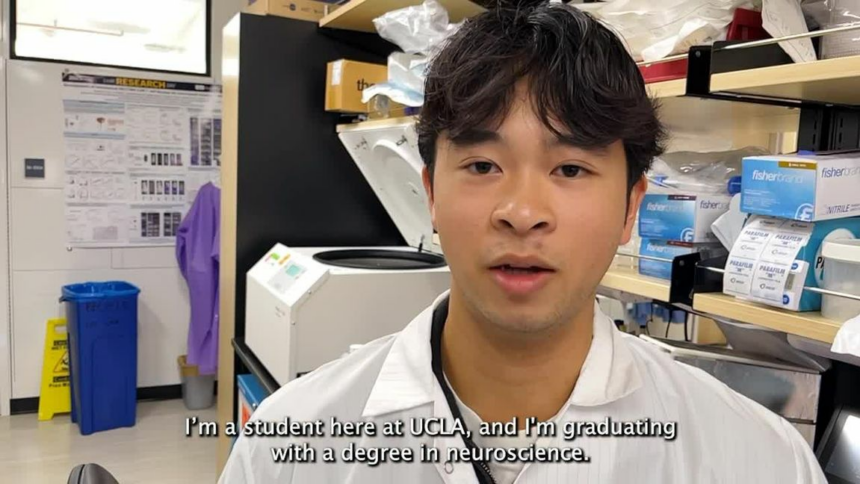
[Click the play button above to watch the video.]
Despite being one of the most lethal cancers affecting women, ovarian cancer receives just about 2% of total cancer research funding, according to U.S. National Cancer Institute estimates — far less than many cancers with significantly lower mortality rates.
This sobering reality is deeply personal for Aidan Le, who will graduate in June with a degree in neuroscience and intends to advance ovarian cancer research and treatment. Le’s father, Phong Hồng Lê, is a Vietnamese refugee who fled to the Philippines before settling in Australia and later the Boston area, where his parents met and where Aidan grew up. He was 8 years old when he lost his mother, Yến Thu Phạm, to ovarian cancer.
“Even when she was extremely sick and bedridden, she would encourage me and my sister to study,” Le said. “Education was always at the forefront of her mind as a way for immigrants and refugees to elevate ourselves.”
At UCLA, Le found mentors who helped him conduct research as an undergraduate – and gave him the opportunity to face his bête noire directly, including Dr. Liying Zhang, a professor of pathology and laboratory medicine and director of cancer molecular diagnostics at the UCLA Health Jonsson Comprehensive Cancer Center.
“That was my first time working with ovarian cancer,” Le said. “All my life I've strayed away from the pain of her loss, but being able to directly confront the disease itself was empowering.”
Energized by this experience, Le went on to immerse himself in both industry and academic research. During a Seattle-based internship with the biopharmaceutical company Bristol Myers Squibb, he specialized in flow cytometry, a technique for analyzing protein expressions on cells, to support a clinical trial for a new blood cancer therapy. The experience gave him a window into the fast-paced, highly specialized world of biopharma, where the focus is on translating discoveries into treatments that reach patients. It also gave him the opportunity to be mentored by his internship manager, Tony Lee, a UCLA alumnus with a Ph.D. in biomedical engineering.
Back at the UCLA Health Jonsson Comprehensive Cancer Center, Le now works in the lab of Dr. John K. Lee, a physician scientist whose lab primarily develops CAR-T cell therapies for prostate cancer. There, Le leads a project that branches from that work, focusing on developing antibody–drug conjugates, targeted therapies that deliver cancer-killing payloads directly to ovarian tumor cells. He hopes this line of inquiry will lead to discoveries and improvements upon existing medicines like Elahere, the first FDA-approved targeted therapy for platinum-resistant ovarian cancer, which still has low response rates for many patients.
When he arrived at UCLA, Le originally declared a major in international development studies, drawn to global systems and diasporic histories like those that shaped his own family story. Although he later changed majors, Le continued exploring identity and belonging through the Higher Opportunity Program for Education, a student-initiated project founded by UCLA’s Vietnamese Student Union. Through HOPE, he took on leadership roles, made lifelong friends and began to critically examine the need for more Vietnamese diasporic narratives — like those that shaped his own family story — in American higher education.
Vietnamese was Le’s first language. He was raised largely by his grandparents, who did not speak English, and his experience as well as his father’s refugee history led Le to apply to teach a seminar through UCLA’s Undergraduate Student Initiated Education program.
Under the mentorship of Professor Thu-Huong Nguyen-Vo, who holds dual appointments in the departments of Asian languages and cultures and Asian American studies, Le facilitated a seminar titled “Memory, Migration and the Vietnamese Diaspora.”
“I feel overwhelmingly proud to be able to represent not only my family but also the Vietnamese American and Vietnamese diasporic communities overall,” he said. “A lot of people have not had the opportunity to engage with their own families to connect, know and understand where they come from. I hope the seminar gives students a blueprint to learn more about their own family histories.”
Stepping back from the bench, Le has also begun thinking about ovarian cancer at a broader, global scale. He has been accepted into the Cancer Research UK Cambridge Institute for a Ph.D. program in medical science and has been offered prestigious research opportunities at MIT and Boston's Dana-Farber Cancer Institute, a full-circle opportunity as the latter is one of the institutions where his mother received care.
His long-term goal? To become a physician scientist, like Drs. Lee and Zhang, someone who leads discoveries in the lab and brings them directly to patients.
He hopes to one day work between the U.S. and U.K., bridging two global research ecosystems and serving patients with the expertise he’s building now, especially those in marginalized communities who often face the steepest barriers to care.
“That’s my hope,” Le said. “I don’t know that the future holds for sure, but I know my mom is looking over me. It will be extremely rewarding to achieve this knowing that I did it all for her.”
To watch an audio descriptive version of the video, click here.
Get top research & news headlines four days a week.
(Check your inbox or spam filter for confirmation.)
Subscribe to a UCLA Newsroom RSS feed and our story headlines will be automatically delivered to your news reader.
From memory to medicine: A son’s journey toward a cure – Newsroom | UCLA



Leave a Comment