




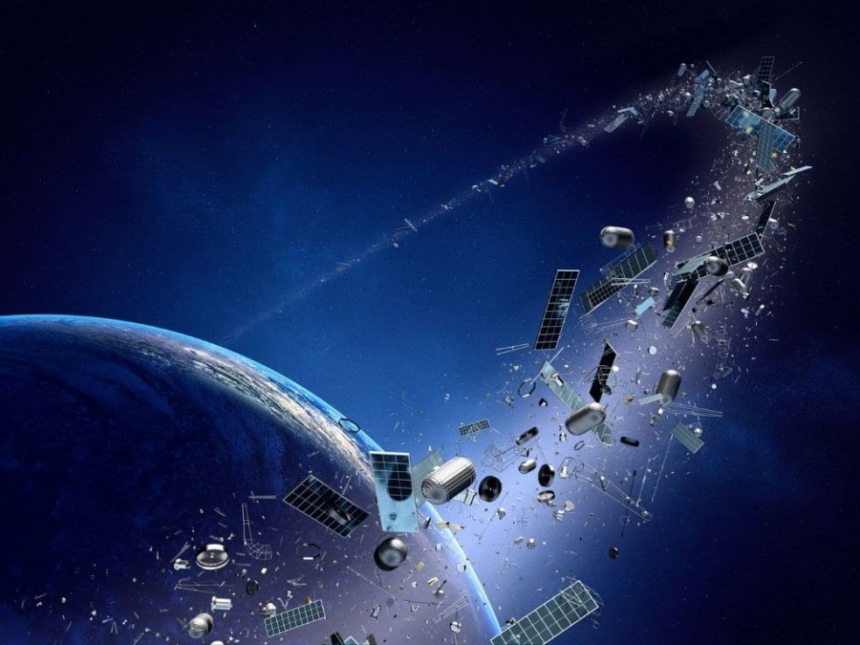
Russian scientists have discovered that tiny fragments of space debris could affect Earth’s climate. For the first time worldwide, researchers have conducted a quantitative assessment of how small artificial particles in orbit weaken the solar radiation that reaches the planet. According to their calculations, this factor currently has no substantial effect. However, if the current rate of accumulation of space junk continues, the scale of solar radiation reduction could increase thousands of times within the next 80–100 years. The researchers warn that in the future, this may affect Earth’s climate systems and ecosystems, which means that the operating rules of satellite “constellations” must be immediately re-examined, as reported by Izvestia.
“Today, space debris creates problems for space stations and ground-based telescopes. However, in the future, this factor could lead to negative environmental consequences. For now, satellite fragments block one-millionth of the solar radiation directed toward Earth, which is negligible. But if the growth rate of satellite systems continues, within 50 years the percentage of light that does not reach us could reach about one-millionth,” Stanislav Kozlov, Doctor of Physical and Mathematical Sciences and lead researcher at the Laboratory of Electrodynamic Processes in Geophysics of the Russian Academy of Sciences, told Izvestia.
According to him, this could trigger a chain of climate impacts. For example, the reduction of incoming solar energy would alter the circulation patterns of atmospheric masses and reduce the intensity of water evaporation. This, in turn, could affect precipitation patterns and make the climate more extreme, increasing droughts and hurricanes.
“If the attenuation of light reaches 0.1% or more, it could theoretically affect Earth’s energy balance due to a reduction in infrared radiation, as well as the ionosphere and the propagation of radio waves due to ultraviolet radiation. It could also affect the efficiency of solar energy and photosynthesis,” said Tatyana Ledashcheva, associate professor at the Department of Environmental Safety and Product Quality Management at the Institute of Ecology of the Patrice Lumumba Peoples’ Friendship University of Russia, to Izvestia.
According to Sergey Yazev, a senior researcher at the Institute of Solar-Terrestrial Physics of the Siberian Branch of the Russian Academy of Sciences and director of the Astronomical Observatory of Irkutsk State University, there are currently no effective technologies for cleaning near-Earth space of artificial pollution.
www.bankingnews.gr
Russian scientists: Space debris may cause extreme climate change – Bankingnews



Leave a Comment

