


There’s a number in the latest PYMNTS Intelligence consumer survey that ought to get the attention of everyone who’s still debating the impact of AI in the workforce. Eighty-six million Americans, 53% of everyone with a job, say they now use AI to do that job. The combined wages of those workers run to roughly $7 trillion a year. That’s more than the entire economic output of Germany. It puts the AI-powered American workforce, on a wage basis, behind only the United States and China among the economies of the world.
Complete the form to unlock this article and enjoy unlimited free access to all PYMNTS content — no additional logins required.
yesSubscribe to our daily newsletter, PYMNTS Today.
By completing this form, you agree to receive marketing communications from PYMNTS and to the sharing of your information with our sponsor, if applicable, in accordance with our Privacy Policy and Terms and Conditions.
It’s a staggering figure, and it deserves an immediate asterisk, because the survey is careful where the cable-news version of this story may not be. That $7 trillion is the weight of the workers who have adopted AI, not a measure of what AI added. The paychecks were being earned before the models arrived.
Read More: AI Doers Drown Out AI Naysayers
What the number actually tells us is the size of the AI on-ramp. The share of the working economy that now has AI somewhere in the workflow. And once a tool is in the workflow, as it turns out, it rarely stays at the office.
Among consumers whose employer hands them an AI platform, 78% use that work tool for personal tasks: 62% during work hours, 44% after hours, many of them both. The model is used to summarize a quarterly report, then plans a vacation, drafts a complaint letter, settles a dinner argument.
It’s tempting to read that as proof that work is where the AI habit gets made. It isn’t, and history matters here. ChatGPT didn’t arrive through the office. It launched as a consumer chatbot in November 2022, reached a million users in five days and a hundred million in two months. Only later did it start to seep into work for the low-stakes chores. The email someone didn’t want to write, the paragraph that needed smoothing. The habit was personal first. Work followed along for the ride.
Read More: The Battle for AI Isn’t About Models. It’s About Habits
Copilot and Claude ran the opposite route. Both entered through the enterprise, Copilot bundled into the Microsoft 365 suite and the Windows desktop, Claude through research, coding and the kind of document-heavy work that became its calling card. Their consumer footprints came later, and in Claude’s case are still being built.
No single arrow points from work to home for all of them. The origin stories run in different directions.
The survey can’t tell us where a habit was born. What it can tell us is directional influence. For a given platform, does using it more at work raise the odds that the same person keeps reaching for that same tool once they’re off the clock?
PYMNTS Intelligence calls this “Always-On” user. The person who uses AI for both work and personal life. There are about 70 million of them, 27% of all U.S. adults, up from 22% in August. They skew young, affluent and heavily engaged, over-indexing on Gen Z and millennials, on households earning more than $150,000 and on the Power AI User tier. This is precisely the cohort a brand wants forming a daily habit, because it is the cohort with the disposable income and the willingness to pay. And to keep doing so for a long, long time.
Read More: How Time Became the Next Great Asset Class
So far this sounds like a rising-tide story, and every platform is floating on it. The interesting part, the part the PYMNTS Intelligence lifts the veil to expose, is what happens when you stop asking how many people cross over from work to personal and start asking why.
The easy way to measure this is to look at the percentage of any LLM platform’s work users, and how many also use it personally. By that measure, ChatGPT runs away with it at 91%, with Gemini at 77% and the rest trailing. Case closed, you might be tempted to say.
Except it isn’t, and the PYMNTS Intelligence data helps to understand why there’s a different ending.
A 91% work/home rate doesn’t prove that work hooked anyone. ChatGPT users were going to use ChatGPT personally anyway. The brand is a household verb. To know whether the workplace is actually doing the converting, you have to compare the people exposed to a platform at work against the people who only ever use it personally. The gap between those two groups, the crossover lift, is the share of personal use you can fairly attribute to the work funnel.
Measured that way, the leaderboard rearranges.
The platforms getting a real lift from workplace exposure are Microsoft Copilot at +10 points, then Gemini, Claude and Perplexity bunched together at +9. ChatGPT’s lift is +4, and Meta AI’s is +1, not because they’re failing, but because their personal use was already strong. They don’t need the work hook to pull in the user.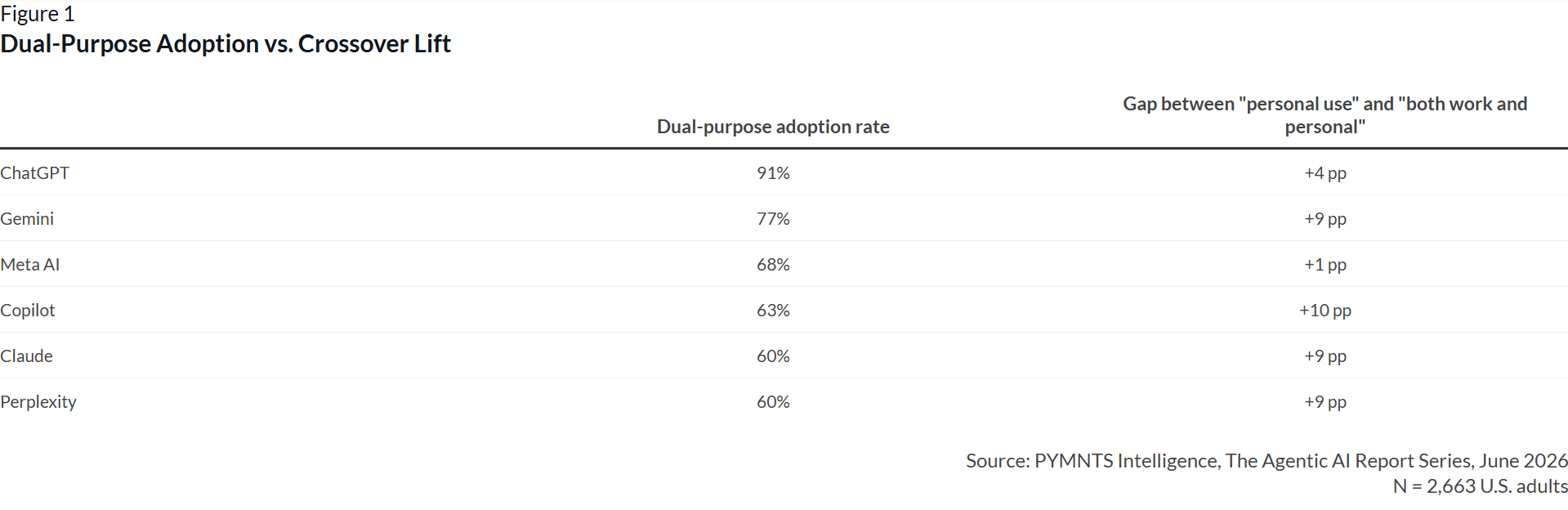
When applied to that 70-million Always-On base, Copilot’s lift translates to the largest absolute pipeline, roughly 7 million people carried from desktop (literally) to home, with Gemini, Claude and Perplexity each adding six to seven million more.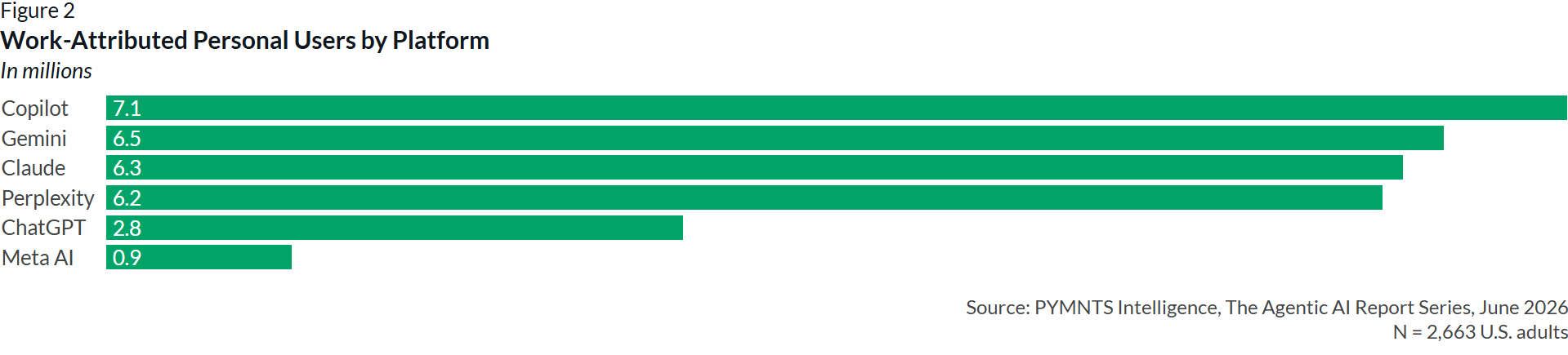
Case closed again, you might be templated to say. Copilot, hands down, wins the work/home crossover race.
Not exactly.
Read More: How Leading Enterprises Really Measure Gen AI ROI
It helps to remember where Copilot came from. Microsoft introduced it in March 2023 as a copilot “for work,” bolted onto the Microsoft 365 suite, and made it generally available first to enterprise customers buying 300 or more licenses.
From there it spread the way Microsoft software has always spread. Onto the Windows 11 taskbar, then into a dedicated Copilot key on new keyboards, then across the install base of Office and Edge. That heritage grants Copilot one genuine advantage at work, and it’s not a product advantage. It is the sanctioned default, the AI already inside the license a company has bought, the one that clears procurement and security review by virtue of being Microsoft. It’s often the AI a worker meets first because the others are gated on a corporate device.
So none of that footprint was won the way a consumer brand wins one, by a person deciding they wanted a product on its merits. It was distributed, the same way its predecessor Cortana once was. So, the question the crossover numbers leave open is whether any of that distribution has hardened into preference.
It helps to take a look at where Copilot’s crossover is strongest, and the answer seems clear. Its highest crossover rate, 79%, belongs to baby boomers and seniors, the cohort that started with Office and never left it.
Its lowest, in the high 40%, belongs to two categories. The workers who say AI isn’t really necessary to their jobs, and Mac users. In other words, Copilot crosses over best exactly where the Microsoft install base is deepest, and fades fastest where engagement is shallow or the device isn’t already Microsoft’s. That’s the signature of distribution, not preference. The tool comes home because it came bundled.
But the cleanest way to see distribution unmasked is to take the workplace out of the equation entirely and ask consumers what they actually reach for when given the choice.
Read More: Why OpenAI, Amazon and Apple Want to Be the Smartphone in Your Pocket
When people choose their own AI, rather than inherit it from an IT department, the order of finish looks nothing like the crossover-volume chart.
In the April data, among consumers naming the platforms they have used over the past year, ChatGPT is the runaway go-to for roughly 83% of iPhone users and 65% of Android users. Gemini comes second, lifted on Android by being the embedded default. Copilot trails badly, at about 33% on iOS and 40% on Android. Given the choice, in other words, only one in three consumers reach for the tool that the crossover math just crowned the “winner.”
And it isn’t just the personal side where ChatGPT runs away with it.
It also wins inside the office, the very ground Copilot was built to own. Among workers who use AI on the job, 73% reach for ChatGPT and 55% for Gemini; Copilot sits third at 47%. That last number is the not-much-talked-about rebuttal of the idea that Copilot dominates the workplace because it is the only thing IT permits. If that were true, ChatGPT couldn’t be outdrawing at work by twenty-six points.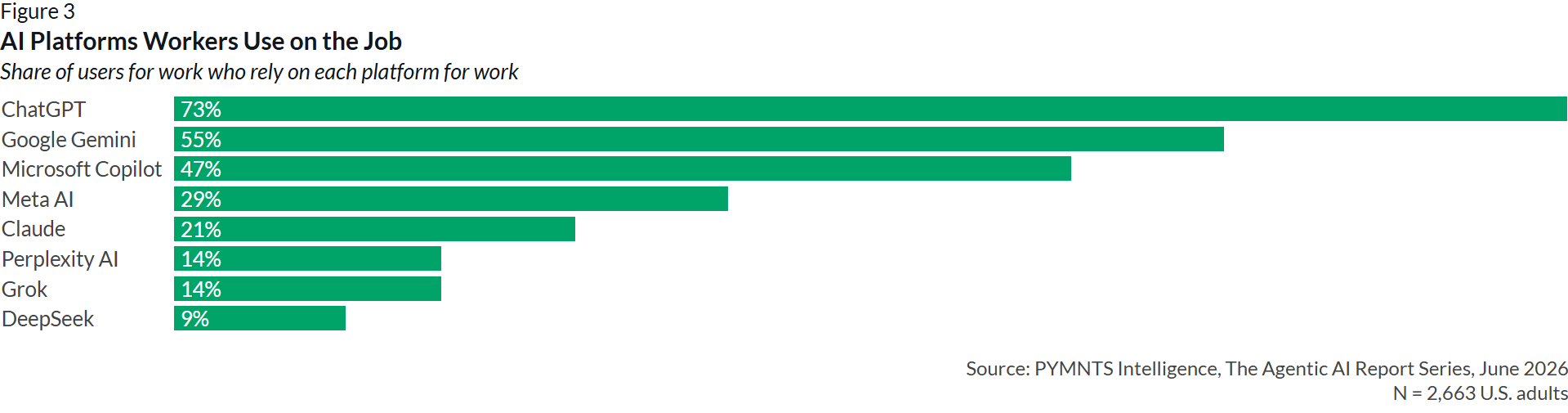
What Copilot has is the inside track, the default that arrives already approved while the alternatives wait on a security review or a personal login. More striking still, 66% of all work-AI users use ChatGPT for both work and home, the highest joint reach as measured across the national survey of 2,663 consumers in April of 2026 and more than double Copilot’s 30%.
Read More: Big Tech Faces the AI Innovator’s Dilemma
PYMNTS Intelligence also asked this group of consumers which AI tool was “most helpful” for a given personal task; ChatGPT is named first on all nine personal task groups measured. Copilot clocked in at one, finances.
Asked whether AI is “essential” or “productivity-enhancing” at work, Claude’s users say “yes” more than any other platform: 81%, against 66% for every other model, , a 15-point gap, the widest of any tool measured. Perplexity is next at +11. Copilot, the crossover-volume leader, sits at +8. It’s perceived-productivity edge is less than half the size of its distribution edge.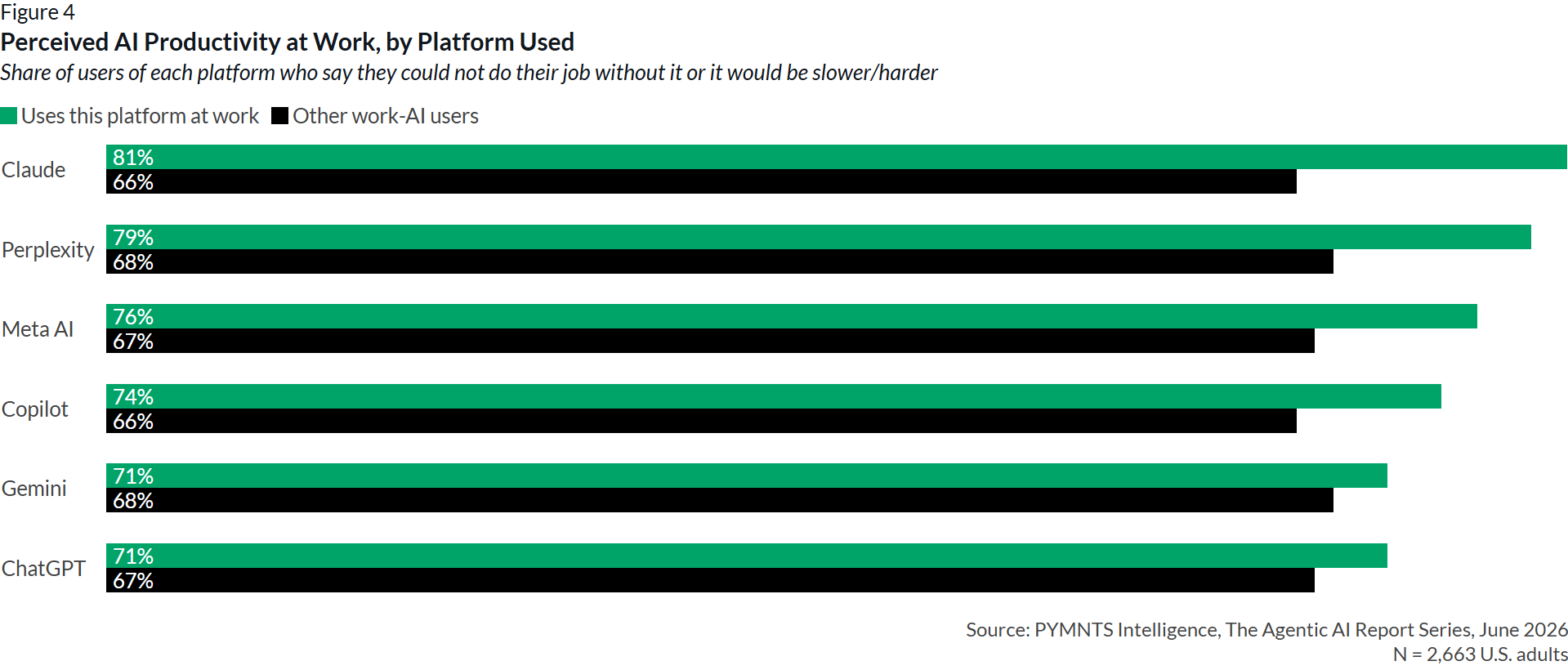
Among Claude’s work users, 81% say they couldn’t do their job, or would be meaningfully slower, without it. That’s not the description of a tool someone tolerates because IT installed it. That’s the description of a tool someone would go out and re-acquire if it vanishes tomorrow.
Or download the app and use it on their personal device.
The PYMNTS Intelligence study is explicit that these productivity readings are correlational, not causal. The workers who seek out a Claude or a Perplexity may simply be more productivity-minded to begin with.
But a platform whose crossover rides on the deepest install base and the oldest habits is touting a moat someone else dug for them. The bundle, the default, the decades of Office muscle memory.
A platform whose users cross over while also reporting the highest perceived productivity and the highest “couldn’t-work-without-it” dependence is leaning on a moat strengthened by its own performance. One kind of stickiness survives a renegotiated enterprise contract or a switch to a Mac.
Volume may tell you who’s winning on one metric, but the reason behind the volume tells you who keeps winning. The crossover that comes from a worker choosing the tool again on their own time, for their own tasks, because it demonstrably makes them better at the work is the crossover that doesn’t depend on anyone’s licensing terms staying put.
It is the same lesson the early years of eCommerce taught. Amazon didn’t win retail because it had the best warehouse software. It won by becoming the most reliable first stop for the broadest range of everyday needs, and by making the act of starting anywhere else feel like a choice that needed a really good reason to make the switch.
AI platforms are running the same race, and the workplace is simply the cheapest shelf space any of them will ever get. The open question is which ones convert that shelf space into the kind of preference that survives after the shelf is taken away.
Read More: The Protocol Power Struggle Reshaping AI-Driven Commerce
The moment a consumer can reach for anything with equal ease, the data says they overwhelmingly reach for the tool they chose, not the one their employer assigned. On that test, Copilot finishes a distant third to a tool that’s already a household verb.
Join the 21,000 subscribers who’ve already said yes to what’s NEXT.
PYMNTS CEO Karen Webster is one of the world’s leading experts in payments innovation and the digital economy, advising multinational companies and sitting on boards of emerging AI, HealthTech and real-time payments firms, including as a non-executive director on the board of Sezzle, a publicly traded BNPL provider. In 2009, she founded PYMNTS.com, a top media platform covering innovation in payments, commerce and the digital economy. Webster is also the author of the NEXT newsletter and a co-founder of Market Platform Dynamics, specializing in driving and monetizing innovation across industries.
Anthropic Calls for Frontier AI Freeze to Prevent Self-Building Tech
House Members Propose Replacing State AI Laws With National Standard
Big Banks Launch Tokenized Deposit Network to Fight Off Stablecoin Threat
Cash App Turns Everyday Accessories Into Payment Tools
Get PYMNTS Today, AI, B2B and more.
We’re always on the lookout for opportunities to partner with innovators and disruptors.