


Saving a coastline has always meant holding the line. If the mangroves survive and the seagrass stays put, the carbon stays locked in the sediment where it belongs. That logic has driven billions in coastal conservation investment over the past decade.
A new global synthesis suggests the logic is incomplete. Whether these carbon stocks survive depends not only on whether the ecosystems persist, but on where they end up – and whether the land behind them is open.
Blue carbon describes the organic carbon held by coastal vegetated ecosystems, built up over thousands of years.
Global reserves across mangroves, salt marshes, and seagrass meadows sit between 10 and 24 billion metric tons, stored mostly in sediments rather than in the plants above them.
Waterlogged soils make these habitats exceptional carbon vaults. Dead material decomposes far more slowly here than in land-based forests. Carbon from centuries ago can still be sitting in coastal sediment today.
Per acre, these ecosystems capture carbon faster than most terrestrial forests, as a recent study documented.
Despite covering under 2% of the ocean surface, they rival total forest carbon storage. That makes their vulnerability consequential at scale.
Agradeep Mohanta, a botany researcher at the Maharaja Sayajirao University of Baroda (MSU Baroda), India, led a synthesis of global datasets, spatial wetland models, and sediment carbon databases to project what climate change means for these ecosystems through 2100.
The central threat isn’t sea level rise in isolation. It’s what happens when wetlands can’t escape it. Rising seas demand landward migration. Where roads, seawalls, and development block that path, there’s nowhere to go.
This is coastal squeeze – the compression of coastal ecosystems against a barrier of human infrastructure.
Trapped between rising water and fixed development, habitats contract and eventually disappear. The sediment carbon they held oxidizes and enters the atmosphere.
Under high coastal pressure, Mohanta’s synthesis estimates that global mangrove sediment carbon stocks could fall between 15 and 30% by 2100. That is a large loss for ecosystems ranked among the most carbon-dense on Earth.
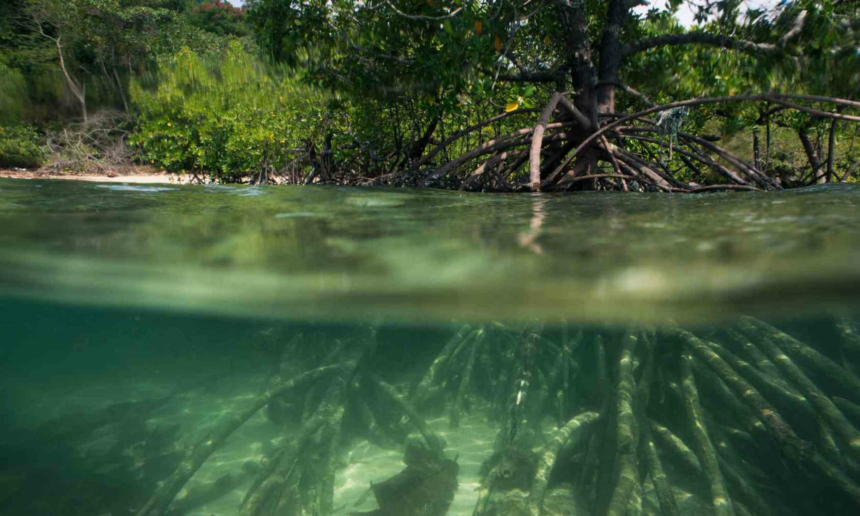
When mangrove forests shrink because they have no room to migrate, the sediment carbon they were sustaining gets exposed to oxygen.
Organic matter locked in oxygen-deprived soil for potentially centuries begins to break down and release. Not gradually. Fast.
This is already happening where seaward mangrove loss isn’t offset by landward gain. The infrastructure lining so many coastlines doesn’t just displace habitat. It freezes carbon that would otherwise stay buried.
The calculation changes when managed retreat enters the picture. Mohanta’s synthesis found that adaptive management – specifically allowing wetlands to migrate inland – could produce net carbon gains globally, even under significant sea level rise.
Prior research on coastal wetland responses to rising seas showed that where inland space exists and development is pulled back, wetland areas can actually grow. Mohanta’s work extends that to carbon stock implications.
Restricting inland migration locks in losses. Allowing it opens the possibility of gains. That variable is something governments and coastal planners directly control.
The synthesis also ran country-level projections for mangroves, where data were strong enough.
Indonesia emerged with the greatest emissions risk – home to vast mangrove forests but facing intense coastal development that limits the inland migration those forests need.
Mexico and Australia showed the opposite trajectory. Geographic conditions and lower coastal squeeze give both countries realistic pathways for carbon accumulation. Their mangrove stocks could grow rather than shrink under appropriate management.
These aren’t countries facing the same challenge at different scales. Their carbon futures diverge because their starting conditions do. Indonesia’s window is narrower, and the synthesis makes that point quantitatively.
Temperature change is also altering blue carbon geography beyond sea level alone. Mangroves are historically limited by how cold winters get – freeze events kill them.
As those events become rarer, mangroves push into higher latitudes, taking over zones once dominated by salt marshes.
Satellite data has tracked this northward expansion directly along North American coastlines. Salt marsh territory can become mangrove forest within decades.
That transition changes the carbon storage profile of the area, along with the broader ecology around it.
Wind and wave patterns are changing too. These forces regulate how much carbon stays buried in coastal sediments versus getting churned up and released.
Climate change is altering both, with effects on seagrass meadows that remain poorly understood.
Until this study, assessments linking projected habitat change under contrasting migration scenarios to carbon stock outcomes at global and national scales were largely absent.
The 15–30% decline under high coastal squeeze, and the net-gain possibility under managed migration, are new benchmarks.
The study also exposed a gap worth closing. Salt marsh and seagrass datasets aren’t yet developed enough for the same national-scale projections mangroves now support.
Both are significant carbon reservoirs. Planning decisions about both are being made without equivalent modeling tools.
What the synthesis makes plain is that ecosystem survival is only part of the equation. Space is the variable – the space these ecosystems need to use as coastlines change.
That space is a policy decision. Nowhere more consequential right now than Indonesia.
The study is published in Regional Studies in Marine Science.
—–
Like what you read? Subscribe to our newsletter for engaging articles, exclusive content, and the latest updates.
Check us out on EarthSnap, a free app brought to you by Eric Ralls and Earth.com.
—–
Mangroves, seagrass, and salt marshes: The blue carbon shield is shifting under climate change, and the risk zones are growing – Earth.com



Leave a Comment