




Home –
Researchers at Harvard’s John A. Paulson School of Engineering and Applied Sciences have developed a 3D printing method capable of producing hair-thin filaments that bend, twist, expand, or contract in response to temperature, behaving, in essence, like programmable artificial muscles. The work, published in Proceedings of the National Academy of Sciences, comes from the lab of Jennifer Lewis, the Hansjörg Wyss Professor of Biologically Inspired Engineering, with postdoctoral researcher Mustafa Abdelrahman as first author.
The technique builds on a platform developed in the Lewis lab called rotational multimaterial 3D printing, which extrudes two materials simultaneously through a rotating nozzle. One is a liquid crystal elastomer, an active material that contracts along a preferred molecular direction when heated, and the other is a passive soft elastomer that holds its shape regardless of temperature. By controlling exactly where each material sits around the filament’s cross-section, and by rotating the nozzle during printing, researchers can write a helical molecular alignment directly into the filament as it forms. The result: shape-change behavior that is fully pre-programmed during fabrication, with no post-processing or manual assembly required.
“I saw this really beautiful [rotational 3D printing platform] and thought, ‘What if we plug in active materials and pattern them within the filament, can we drive shape change that way?’” said Abdelrahman.
From Single Filaments to Functional Structures
The real demonstration of the technology’s potential came when the team used individual programmed filaments as building blocks for more complex architectures. Sinusoidal, or wavy, filaments that appear visually identical behave in opposite ways depending on where the active material sits, straightening and expanding when the elastomer is on the outside of the wave, or tightening and contracting when it is on the inside.
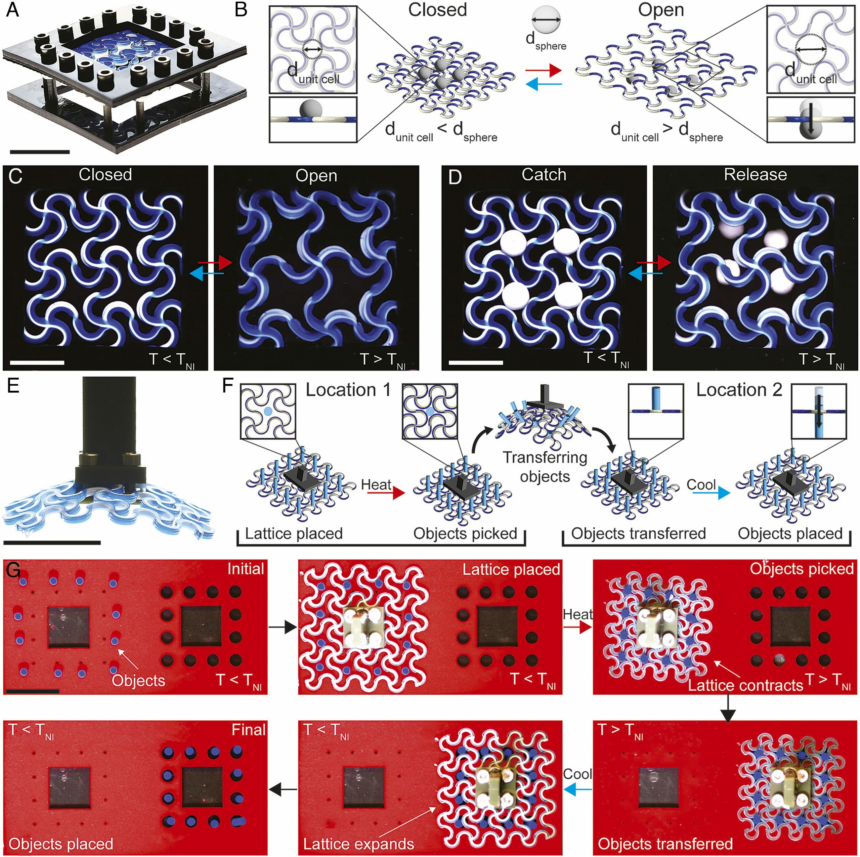
From these units, the researchers assembled flat lattices capable of opening and closing in response to heat, functioning as active filters that allow particles through when warm and trap them when cooled, and as pick-and-place grippers that can lift multiple rods simultaneously and release them on demand. A lattice with alternating expanding and contracting regions morphed into a dome-shaped structure when heated, closely matching computer-predicted simulations. Validation and modeling were carried out in collaboration with Professor L. Mahadevan, a specialist in the mechanics of natural structures, while molecular alignment was characterized with Professor Joanna Aizenberg’s lab using X-ray scattering at Brookhaven National Laboratory.
The team has already printed filaments as narrow as 100 microns in diameter and sees room to go smaller. “In terms of scalability, you could create more complex nozzles that integrate with other materials in the future – like, having a liquid metal channel to enable actuation, or integrating other functionality,” said graduate student and co-author Jackson Wilt.
Among the applications the team envisions are reconfigurable soft grippers, tunable filters and valves, and injectable filaments that lock together in vivo to form porous, clot-promoting structures for biomedical use. As Lewis put it: “This filament design and printing framework could accelerate the transition of artificial muscle-like materials from the lab to real-world technologies.”
Challenges and Limitations: What Still Stands Between Lab and Scale
The Harvard team is candid about the boundaries of the current system. Miniaturization remains one of the most immediate constraints: nozzle resolution is tied to the DLP resin printer used to fabricate the custom coextrusion heads, which limits feature sizes to roughly 50 microns. While reducing nozzle diameter from 1 mm to 0.5 mm successfully brought filament diameter down from 600 to 300 microns, it came at a cost, lower print speeds are required at smaller scales, which in turn reduces the shear-induced molecular alignment of the liquid crystal elastomer. Since alignment is what drives actuation, this creates a direct trade-off between miniaturization and performance.
Temperature dependence is another practical constraint. All actuation demonstrated in this study relies on heating samples above the nematic-to-isotropic transition temperature of the liquid crystal elastomer, a threshold that, in the current ink formulation, sits well above ambient conditions. The demonstrations were conducted by submerging lattices in heated silicone oil baths, a setup far removed from the untethered, body-integrated, or ambient-condition environments where soft robotic and biomedical applications would ultimately need to operate.
The study lists Yeonsu Jung, Rodrigo Telles, Gurminder K. Paink, and Natalie M. Larson among its contributing authors. Funding was provided by the National Science Foundation (NSF) via the Harvard Materials Research Science and Engineering Center and the Army Research Office’s Multidisciplinary University Research Initiative. Experimental work was carried out across two federal facilities: the nanoscale research center at Harvard and the synchrotron light source at Brookhaven National Laboratory, both operating under NSF and DOE support respectively. Harvard’s technology transfer office has since moved to secure intellectual property protections on the underlying innovations and is exploring pathways to bring them to market.
A Maturing Field Reaches for the Body
This latest result from the Lewis lab is part of a sustained research trajectory in programmable soft materials at Harvard. An earlier study from the group, led by Jackson Wilt and former postdoctoral researcher Natalie Larson, used the same rotational multimaterial 3D printing platform to produce soft robotic structures with embedded actuation pathways, pointing toward applications in surgical robotics and human assistive technologies.
Separately, Lewis and Princeton University’s faculty member Emily Davidson refined the science of liquid crystal alignment during extrusion-based 3D printing, shifting the process from an experimental art to a more exact, measurable discipline, a foundational step for reliable manufacturing of LCE-based materials at scale.
Liquid crystal elastomers are now attracting serious attention across soft robotics, energy damping, and biomedical engineering. The ability to pre-program shape change into a filament at the moment of printing, rather than engineering it afterward, removes a key barrier to translating lab results into usable devices.
3D Printing Industry is inviting speakers for its 2026 Additive Manufacturing Applications (AMA) series, covering Energy, Healthcare, Automotive and Mobility, Aerospace, Space and Defense, and Software. Each online event focuses on real production deployments, qualification, and supply chain integration. Practitioners interested in contributing can complete the call for speakers form here.
To stay up to date with the latest 3D printing news, don’t forget to subscribe to the 3D Printing Industry newsletter or follow us on LinkedIn.
Explore the full Future of 3D Printing and Executive Survey series from 3D Printing Industry, featuring perspectives from CEOs, engineers, and industry leaders on the industrialization of additive manufacturing, 3D printing industry trends 2026, qualification, supply chains, and additive manufacturing industry analysis.
Featured image shows active–passive lattices for filtering and gripping objects. Image via Mustafa K. Abdelrahman et al., Proceedings of the National Academy of Sciences.
Paloma Duran holds a BA in International Relations and an MA in Journalism. Specializing in writing, podcasting, and content and event creation, she works across politics, energy, mining, and technology. With a passion for global trends, Paloma is particularly interested in the impact of technology like 3D printing on shaping our future.
Our site uses cookies. Learn more about our use of cookies: cookie policy
Harvard 3D Prints Filaments That Bend and Contract Like Biological Muscle – 3D Printing Industry



Leave a Comment

