




Throughout the course of human spaceflight, astronauts have conducted research on anything from muscle atrophy in microgravity to the psychological effects of long-duration missions.
But even though more than 100 women have traveled beyond Earth’s gravity by now, no one has ever attempted to study a physiological process that half the population experiences: menstruation.
At least, that’s according to Virgin Galactic, a commercial aerospace company specializing in suborbital flights to space. Now, as Virgin Galactic prepares to resume commercial operations in 2026, the company looks to change that.
Founded by billionaire Richard Branson, Virgin Galactic has revealed plans to conduct a research spaceflight in 2027 focused on better understanding whether and how microgravity and space travel can influence menstrual cycles and women’s hormonal health. Led by two women behind a nonprofit focused on women’s reproductive health, the mission “represents a landmark moment at the intersection of commercial spaceflight, women’s health and scientific innovation,” Virgin Galactic said in a statement.
Here’s everything to know about the upcoming mission, including the implications it could have for not only future astronauts, but also for healthcare innovation on Earth.
Virgin Galactic is an aerospace and space travel company that is part of British billionaire Richard Branson’s Virgin Group conglomerate.
Like its competitor Blue Origin, founded by billionaire Jeff Bezos, Virgin Galactic specializes in transporting paying customers on brief flights to the edge of space. The market is one Blue Origin recently took a hiatus from as it turns its focus instead to developing a lunar lander for NASA’s Artemis moon missions.
A tenant of Spaceport America in New Mexico, Virgin Galactic has flown 32 people to space across 12 missions.
Virgin Galactic has announced a spaceflight planned for 2027 that the company claims will be the first research mission to study menstruation in microgravity.
An exact target date for the flight, known as “Operation Period,” has not been announced. Virgin Galactic said in a May 28 press release the flight will be used to study the menstrual cycle beyond Earth in suborbital space.
Previous Virgin Galactic missions have lasted more than an hour from takeoff to touchdown, but passengers typically only have a few minutes to see Earth from space while experiencing a few minutes of weightlessness. That suggests the crew of the mission won’t have long to perform research, which Virgin Galactic said will focus on “menstrual fluid dynamics and menstrual product performance.”
Results from the mission could have implications for long-duration spaceflight, as well as the broader medical community, according to Virgin Galactic. “Operation Period” is more officially dubbed OP-01, suggesting future missions under the banner are in the works.
“At Virgin Galactic, we are committed to enabling human-tended research that expands the scope of what can be studied in space,” Amber Favaregh, Virgin Galactic director of system analysis and research, said in a statment.
Manju Bangalore, the founder of Operation Period, a nonprofit organization focused on reproductive health research and advocacy, will fly on the mission with aerospace engineer and pilot Priya Abiram – the director of research at the nonprofit.
The pair are expected to become the youngest South Asian women who have traveled to space, according to Virgin Galactic.
“I have dreamed about this since I was four years old and I made a promise to myself I’d make it happen before I turned 30,” Bangalore, a 28-year-old reproductive health scientist, said in a video on Instagram. “This dream has been in motion for so long.”
Abiram, 22, added in her own post on Instagram that in her professional life, she’s “spent every single hour working toward becoming an astronaut.”
The mission would come on the heels of Virgin Galactic returning to flight for the first time in more than two years.
Virgin Galactic recently shared a first look at its new spaceplane that later in 2026 is due to begin taking paying customers to the edge of space.
Developed to be reused for faster turnaround time between missions, the vehicle is an upgraded design from Virgin Galactic’s previous spaceplane, according to the company’s most recent financial report. Officially dubbed “SpaceShip,” the spaceplane has undergone assembly and ground tests at the company’s factory in Arizona as Virgin Galactic prepares to transport it later this summer to Spaceport America so that flight tests can begin.
Capable of flying up to eight missions per month, the SpaceShip can seat six passengers and would replace the VSS Unity spaceplane, according to Virgin Galactic.
But Virgin Galactic recently brought Unity out of retirement.
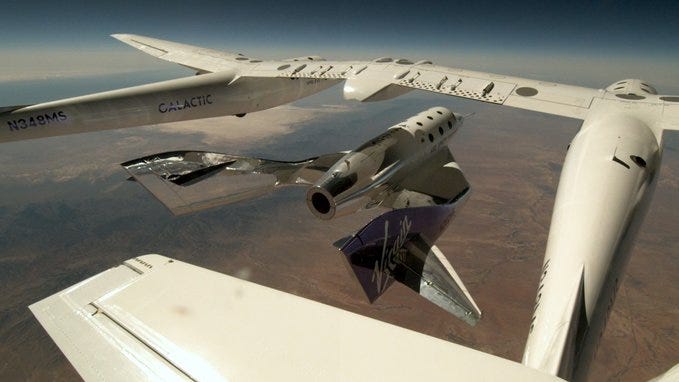
The spaceplane flew May 27 over New Mexico on what Virgin Galactic referred to as a “glide flight.” The flight allowed for Virgin Galactic pilots to train and for ground teams to “build operational readiness” ahead of tests with the new SpaceShip prototype, the company said in a press release.
Spaceflights led by Virgin Galactic resemble a traditional commercial aircraft takeoff on a runway as the company deploys an air-launch strategy to get its vehicles to the edge of space.
The VMS Eve, what’s known as the mothership, is a four-engine, duel fuselage jet carrier aircraft that transports the spaceplane to what Virgin Galactic refers to as “release altitude.” There, the VSS Unity separates from the aircraft to travel about 54 miles high – within range of what the U.S. military and NASA define as the beginning of space – before landing on a runway.
Eric Lagatta is the Space Connect reporter for the USA TODAY Network. Reach him at elagatta@usatodayco.com
Virgin Galactic to study menstruation in space. What is 'Operation Period?' – USA Today



Leave a Comment

