


In my November 16, 2025 Substack article, “Arm at the Edge – Apple’s AI Paradox,” I argued that Arm (ARM) occupied a unique position in artificial intelligence because its architecture sat beneath every major AI strategy, whether pursued by Apple (AAPL), Samsung (SSNLF), Google (GOOGL), or Qualcomm (QCOM). At the time, the discussion centered primarily on edge AI and smartphones. Eight months later, Nvidia’s (NVDA) expanding commitment to Arm-based CPUs and growing investor concerns surrounding Apple’s AI execution suggest that the thesis has expanded well beyond mobile devices.
The irony is difficult to ignore. Apple helped create Arm in 1990 and today ships hundreds of millions of Arm-based devices every year. Yet investors increasingly question whether Apple has fallen behind in artificial intelligence. Nvidia, by contrast, entered the Arm ecosystem decades later but is now using Arm CPUs as a cornerstone of the infrastructure powering the global AI boom.
The same architecture that helped build the smartphone era is increasingly becoming part of the foundation of the AI era.
Today’s news surrounding Nvidia and Arm is therefore about far more than another CPU announcement. It represents further evidence that Arm’s future growth may be driven as much by AI infrastructure as by smartphones. What began as an edge-AI story is rapidly becoming a datacenter story.
When I originally wrote about Apple’s AI paradox, the discussion centered on why Apple appeared to be lagging Samsung and Google in on-device artificial intelligence despite using the same Arm architecture. The conclusion was that Arm provides the language of computation, but individual companies determine how aggressively they implement it. Apple emphasized battery life, thermal management, privacy, and efficiency. Competitors increasingly optimized for neural throughput and generative AI workloads.
That conclusion remains valid today, but the market’s attention has shifted. Investors are no longer focused solely on smartphones. They are focused on AI factories, hyperscale datacenters, and the infrastructure required to train and deploy large language models. This is where Nvidia enters the story.
Nvidia’s Grace and Vera CPU roadmaps demonstrate that Arm architecture is no longer confined to smartphones, tablets, and PCs. It is becoming an increasingly important component of AI infrastructure itself.
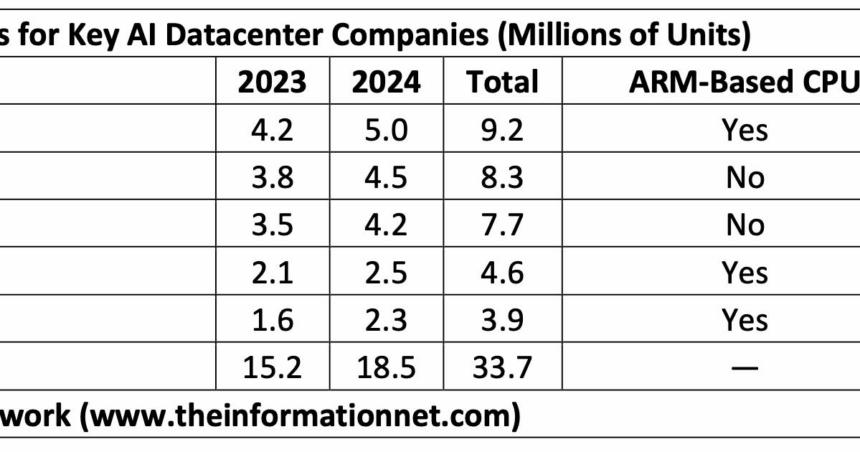
I show in Table 1 that Arm’s datacenter opportunity was already emerging by 2024, well before Nvidia’s current CPU initiatives became a major topic for investors. Amazon’s Graviton deployments accounted for 9.2 million cumulative processor shipments in 2023 and 2024, while Alibaba added another 4.6 million Yitian processors. Combined shipments among the major cloud providers reached 33.7 million processors. Nvidia’s Grace and Vera programs are not creating a new trend. They are accelerating one that was already underway.
I originally presented this thesis at a BofA Merrill Lynch Investor Presentation to Asian Institutional Investors on November 12, 2024.
Several important conclusions emerge from Table 1. First, hyperscalers have been steadily adopting alternative processor architectures for years. Second, Arm has already demonstrated that it can compete successfully in cloud environments where performance, power consumption, and scalability matter. Third, Nvidia’s decision to build future AI systems around Arm CPUs represents a validation of technology that many cloud providers have already embraced.
For Arm investors, this matters because datacenter processors carry significantly higher strategic value than smartphone processors. A smartphone upgrade cycle may occur every few years. AI infrastructure spending is measured in hundreds of billions of dollars and is being driven simultaneously by Amazon (AMZN), Microsoft (MSFT), Alphabet (GOOGL), Meta Platforms (META), Oracle (ORCL), and increasingly sovereign AI initiatives worldwide. Every additional Arm CPU deployed into those environments expands the company’s royalty opportunity.
The AI Paradox Revisited: Nvidia Validates Arm While Apple Falls Behind – Dr. Robert Castellano's Semiconductor Deep Dive Newsletter



Leave a Comment