


ASU professor’s book examines historical relationship between American football and fútbol
iStock illustration
When Andrés Martinez moved from Mexico to the United States as a 15-year-old, he quickly discovered that when he tried to talk about one of his favorite subjects, people looked at him as if he was speaking a second language.
“I couldn’t find anybody to talk about the next World Cup, leagues in Europe or leagues anywhere,” said Martinez, a special advisor to Arizona State University President Michael Crow, a professor of practice in the Walter Cronkite School of Journalism and Mass Communication and co-director of ASU’s Great Game Lab. “I felt like I had been dropped behind some iron curtain.”
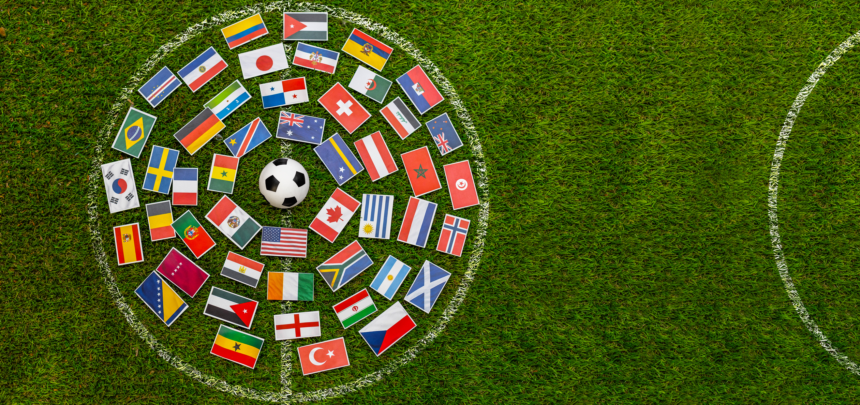
Thankfully, Martinez said, the popularity of soccer in the United States has changed to a degree he never would have imagined. And the sport’s gravitational pull will become even stronger when the 2026 FIFA men’s World Cup begins June 11, hosted by 11 cities in the U.S., three in Mexico and two in Canada.
It’s a timely nod to Martinez’s recently published book, “The Great Game,” which examines the relationship between American football and fútbol, the Spanish word for soccer, and how those worlds are converging with the World Cup.
ASU News talked to Martinez about his book.
Note: Answers have been edited for length and clarity.
Question: Let’s start here: Describe what your book is about.
Answer: It’s about how the U.S. engages globally through sport. The argument is that sport was a way, historically, in which we manifested our separateness from the rest of the world by rejecting the global nature of fútbol for our own football. We developed homegrown games that other people didn’t play. Going back to the 19th century, this was a very conscious effort to decouple ourselves.
But this has changed. We’ve had success in recent decades in getting people interested in our sports. You have a World Baseball Classic. You have the NFL playing (international games) in places you never would have imagined. And on the other side of the street, the more significant change has been the rise of soccer within the United States. So, I was really interested to sort of tell stories and sort of examine both sides of this equation.
Q: Why do you think the U.S. was interested in decoupling itself from sports played around the world?
A: In the late 19th century, … there is a desire to not remain in the shadow of the British empire. British culture was dominant when it came to all sporting activities. And we kind of rebelled against that. We did not want to follow their lead and just continue playing cricket. It was also a time where there was a lot of anxiety about how people can embrace having an American identity. That gets poured into sports. The easiest way to signal that you have embraced your new country is by picking up a baseball bat or an oval shaped football instead of a round one.
Q: That changed with the world’s merging economy, right? In your book you talk about how multinational companies have played a role in soccer’s growing popularity throughout the world.
A: It’s the corporate imperative of globalization. There’s a sort of top-down imperative where American multinational companies wanting to be present everywhere in the world cannot simply market themselves through games that only reach 25% or 30% of the global GDP (gross domestic product). I open my first chapter with the “Mean” Joe Greene Coke commercial (from 1979). Everyone thought this was the greatest commercial ever, but internationally they had no idea who this person was. So they had to shoot the exact same ad with (Argentinian soccer star) Diego Maradona.
Q: Would you agree that the 1999 U.S. women’s team that won the World Cup and featured stars such as Mia Hamm, Brandi Chastain and Julie Foudy deserves credit for the soccer boom in this country?
A: There was a lot of discussion about how that was huge for women’s sports and huge for women’s soccer, but more than that, I think it transformed where soccer sits within American culture, for men and women. It’s a wonderful story of unintended consequences.
Congress did not pass Title IX to bring the U.S. closer to this sporting global culture. And FIFA, which very much wanted the U.S. to start caring more about the game, never would have thought that the way to do it was through the women’s game. But that’s what happened.
Q: Do you think soccer’s popularity in the U.S. will grow with the World Cup being played here, or has the sport already established its roots and spread?
A: When you look at what’s happened in media and some of the things driving the sort of transatlantic investment and the importance of the women’s game, I don’t think it’s make or break. I think it’s a very interesting opportunity to take stock of how far we’ve come in terms of soccer becoming part of our shared culture in the way that our big three homegrown sports (football, basketball and baseball) are.
We haven’t really had many opportunities in this country in the past of combining our sports passion with our kind of patriotism and nationalism. Now we have a chance to.
The problems were not hypothetical. Neither was the audience.In early May, eight groups of students from Arizona State University’s Institutional Corrections class presented research-backed ideas to…
In a quiet field in Poland, surrounded by fragments of a World War II bomber, retired Lt. Col. Rich Ingleby had a realization he could not shake. The work of bringing fallen service members home was…
By Georgann YaraResearchers and experts from Arizona State University and two other leading research universities explored the importance of maintaining global security and defense amid rapidly…
Contact ASU News
Manage subscriptions
Football worlds collide with World Cup – ASU News



Leave a Comment