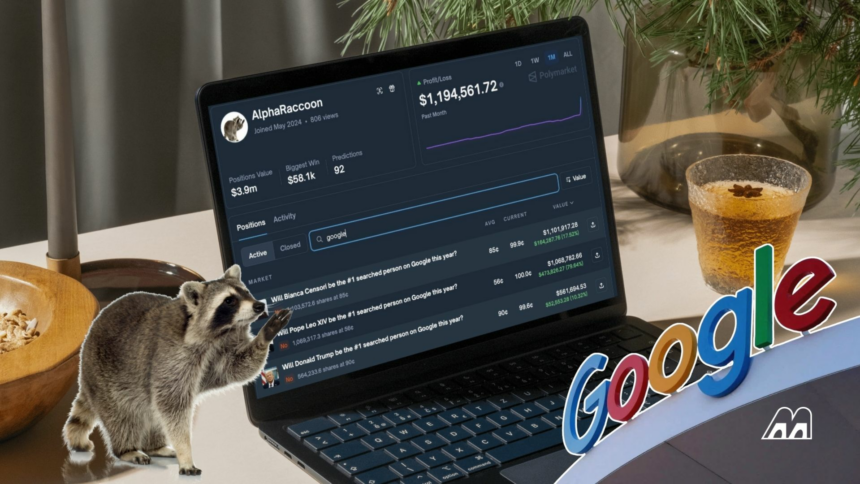
A Google engineer’s Polymarket insider trading case shows how crypto’s transparency turned a $1.2M win into a federal indictment. Michele Spagnuolo allegedly used confidential “Year in Search” data to place bets he knew would pay off — before anyone else could see the results.
Table of Content
Most Read
Sponsored
TL;DR
A Google engineer just caught federal charges for a $1.2 million Polymarket insider trading scheme — and the way it unravelled says as much about crypto’s transparency as about one person’s bad judgment. Federal prosecutors charged Michele Spagnuolo, 36, on May 27, 2026, with turning confidential Google search data into $1.2 million in Polymarket winnings. It’s the second federal insider trading case tied to Polymarket this year. Here’s exactly what happened, how he got caught, and what it means for the future of prediction markets.
Spagnuolo operated under the alias “AlphaRaccoon.” Specifically, he allegedly traded on Polymarket using confidential Google business information. The SDNY complaint lays it all out.
In fact, he’s an Italian citizen living in Switzerland. Authorities arrested him on Wednesday and charged him with commodities fraud, wire fraud, money laundering, and other counts. According to the complaint, he placed bets on Google search trends using internal company data.
Spagnuolo appeared before a federal magistrate, who released him on a $2.25 million bond. Meanwhile, Google confirmed it cooperated with the investigation. A spokesperson said: “The employee accessed our marketing material using a tool available to all employees, but using such confidential information to place bets is a serious breach of our policies. We’ve placed the employee on leave and will take appropriate action.”
This wasn’t a complicated hack. In fact, Spagnuolo didn’t need to break into any system. Rather, he already had legitimate access.
Every year, Google publishes its Year in Search report. It reveals the most-searched people, topics, and trends of the year. Crucially, employees can view this data before any public release. So Spagnuolo allegedly used that access window on Polymarket — a platform where users place real-money bets on real-world events using cryptocurrency.
He bet through the AlphaRaccoon account. Specifically, his trades were YES and NO bets on who would top Google’s most-searched list. In one example, he placed $381.12 on the singer D4vd, ranking among the year’s most-searched people. He also put just $5 on D4VD to be number one — at an implied probability slightly above 0%.
The edge was devastating. As the indictment puts it: Spagnuolo “knew the outcome of these wagers before the trading public did because he had accessed Google’s confidential, commercially valuable internal data.”
He wasn’t guessing. Instead, he was collecting.
Here’s the twist many crypto newcomers don’t expect: trading on a blockchain doesn’t make you invisible. In fact, it can make you more visible.
Polymarket’s chief legal officer, Olivia Chalos, said in a statement that the platform is “the only prediction platform to date whose cooperation has led to insider trading charges in the United States.” She added that, since users trade with crypto, activity is “transparent, traceable, and bad actors leave footprints.”
Meanwhile, someone moved part of the funds to a payment processor account in Italy. Investigators then traced that account back to an ID card belonging to Spagnuolo. Together, that trail — part on-chain, part paper — sealed the case.
Polymarket, which recently partnered with Nasdaq to bring more institutional legitimacy to prediction markets, flagged the suspicious trading and worked directly with the DOJ. That cooperation now anchors its public case for self-regulation.
Last month, SDNY charged a US special forces soldier. According to prosecutors, he used classified knowledge of a planned military operation to capture Venezuelan President Nicolás Maduro. The soldier bet on Polymarket ahead of the raid and pocketed over $400,000. Still, he has pleaded not guilty.
Two federal cases in under six weeks got Congress’s attention fast. As a result, the House Oversight Committee opened an investigation into Polymarket and Kalshi. Specifically, lawmakers want to know how both platforms handle identity checks, geographic restrictions, and unusual trades.
The stakes are real. After all, prediction market volumes hit $51 billion last year and could reach $240 billion in 2026. That kind of growth attracts serious capital — and bad actors. Consequently, enforcement is accelerating.
In March 2026, both platforms announced new anti-insider rules aligned with recent CFTC guidance on prediction market manipulation. For example, new restrictions now bar politicians from trading on their own campaigns, athletes from betting on their own sports, and employees from trading on contracts tied to their employers.
The Spagnuolo case isn’t about one rogue engineer. Rather, it tests a bigger question: does insider trading law — built for stock markets — cover prediction markets too?
Traditionally, insider trading rules grew up around securities. However, the CFTC issued a February 2026 advisory on how these rules apply to prediction platforms. The Spagnuolo charges use commodities fraud and wire fraud — not traditional securities law — and that shows prosecutors have found a path that works.
For Google, moreover, this exposes a real data governance gap. After all, every employee reportedly had access to the same internal tool Spagnuolo used. That’s a systemic policy failure, not a one-off incident.
For crypto broadly, the case makes one thing clear: the blockchain cuts both ways. Specifically, every bet is public and permanent — and federal investigators can read it too. In fact, data transparency was a theme Google itself put front and centre at Google I/O 2026, and the parallels to this case are hard to ignore.
Meanwhile, the CFTC separately filed a civil case against Spagnuolo. As a result, he now faces criminal and regulatory pressure at the same time. Altogether, the prediction market industry is officially on notice.
Polymarket is a prediction market platform where users bet real money — via cryptocurrency — on real-world events. For example, that includes election results, search trend rankings, and geopolitical outcomes. The CFTC regulates it in the US.
Prosecutors allege he accessed confidential Google search data and used it to place profitable bets on Polymarket. As a result, he faces charges of commodities fraud, wire fraud, and money laundering. The DOJ filed a criminal case; the CFTC filed a separate civil one.
Yes. Even though prediction markets don’t follow the same rules as stock exchanges, misusing confidential information to profit from trades still breaks federal anti-fraud and commodities law. Furthermore, the CFTC reinforced this with formal guidance in February 2026.
Polymarket cooperated with the DOJ and flagged the unusual trades. Additionally, blockchain transparency played a key role — crypto transactions are traceable. Investigators then linked the funds to a payment account in Italy opened using Spagnuolo’s own government ID.
Polymarket faces a congressional probe alongside rival platform Kalshi. Both have already introduced new rules against insider trading. Nevertheless, the platform’s best defence is cooperation — it’s trying to prove it can police itself before regulators step in.
Vincee Cole
Vincee Cole is a technology journalist with four years of experience covering the full spectrum of modern tech — from consumer devices, artificial intelligence, to quantum computing, blockchain, and digital assets. His reporting cuts through complexity to deliver stories that are sharp, grounded, and relevant to both general readers and industry insiders. Previously, he worked with fintech research teams across Southeast Asia, analysing how emerging technologies are reshaping financial systems at scale.
Read more
© 2026 MemeBurn. All rights reserved.